


Trachoma, caused by the bacterium Chlamydia trachomatis, remains the leading infectious cause of blindness worldwide, and an estimated 97 million people still live in trachoma-endemic areas as of 2025. Repeated infections trigger conjunctival inflammation, eyelid scarring, trichiasis, and eventual vision loss if untreated. Transmission is closely tied to poor facial hygiene, overcrowding, and environmental conditions that facilitate fly-eye contact, which is why the World Health Organization’s SAFE strategy combines surgery, antibiotics, facial cleanliness, and environmental improvement. In Yemen, roughly 1.25 million people live in areas requiring interventions for trachoma elimination, and multiple evaluation units exceed the trachomatous inflammation-follicular threshold of 5 percent in children aged 1 to 9 years. Yet in fragile and conflict-affected settings like Yemen, community-level prevention is often weak, and programmatic focus has historically leaned toward the biomedical surgery and antibiotic components while the facial cleanliness and environmental components remain disproportionately scarce.
A new mixed-methods pre-post implementation study published in Frontiers in Tropical Diseases examined whether targeted capacity strengthening for community health workers could shift trachoma prevention and referral practices in Al Sabra district, Ibb governorate. The intervention ran from 7 May to 9 July 2025 and involved fifteen community health workers, two district supervisors, and one governorate supervisor across three primary health care facilities: Ainan, Bilad Al Shoaibi, and Najd Al-Jamai. The research team, led by Leen Daoud of the Eastern Mediterranean Public Health Network in Amman, Jordan, and including colleagues from the Global Institute for Disease Elimination in Abu Dhabi, the University of Ottawa, and Sana’a University, designed the study to test feasibility, acceptability, and short-term changes in knowledge, confidence, and reported practices rather than to produce statistically powered estimates.
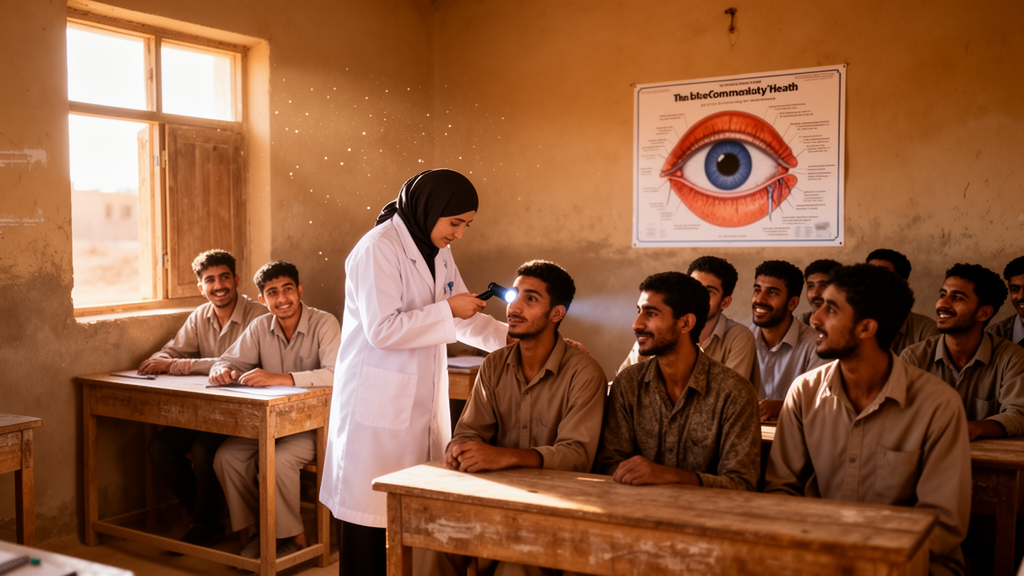
The intervention consisted of a one-day training workshop covering trachoma epidemiology, the WHO SAFE strategy, hygiene promotion, case identification, referral protocols, and communication techniques. Participatory methods including role-plays and case scenarios reinforced practical application. Community health workers received fact sheets and checklists to support case identification, referral, and hygiene promotion during community engagement. They were instructed to report and refer suspected trachoma cases using a standardized referral form developed collaboratively with Yemen’s Ministry of Public Health and Population and the District Health Office. Supervisors conducted routine follow-up, and a WhatsApp group was established to facilitate real-time communication, problem-solving, and peer support throughout the two-month intervention, providing a low-cost supervision option because available funds for frequent in-person field supervision were insufficient.
Quantitative data included structured knowledge surveys administered at baseline and endline, alongside a retrospective desk review of routine clinical records from 1 January through 30 September 2025. Because trachoma is not routinely differentiated in primary care due to the absence of specialized ophthalmic services and limited diagnostic capacity, all reported cases of eye infections were reviewed as a proxy indicator. The survey comprised 18 items, with questions 1 through 11 assessing factual knowledge of trachoma including transmission, symptoms, prevention, treatment, risk factors, the SAFE strategy, and environmental improvement, and questions 12 through 18 assessing prior training, risk perceptions, and self-reported confidence in case identification, referral, and community education. Qualitative data were collected through in-depth interviews with healthcare facility personnel, community dialogues at baseline, and focus group discussions at endline, with detailed Arabic notes translated into English and analyzed using NVivo 15 following Braun and Clarke’s six-step thematic analysis framework.
At baseline, knowledge was uneven. Only 50 percent of participants correctly identified what trachoma is, 72.2 percent selected at least one correct transmission mode, and while 100 percent correctly identified preventive measures, risk factors, and recommended treatment, only 27.8 percent identified effective prevention components and just 22.2 percent identified the key prevention message in education. Notably, zero percent correctly identified the least effective community intervention. Participants perceived trachoma as a significant community concern, with none rating it as low, and confidence in identification, referral, and community education was generally high. Training exposure varied, with 50 percent reporting training within the past 6 to 12 months, 39 percent more than one year ago, and 11 percent never trained.
At endline, the fifteen community health workers demonstrated high item-level knowledge, answering all items correctly except the question on the least effective community intervention. All participants had received training within the previous three months and reported prior exposure to trachoma-related content. Confidence in case identification, referral, and community education was uniformly high, with 100 percent reporting they were very confident in each domain. However, because the baseline survey included community health workers and supervisors anonymously without personal or role identifiers, whereas the endline survey included community health workers only, these findings were interpreted descriptively rather than as a direct paired comparison. Open-ended responses consistently described the training as useful, practical, and easy to apply, with community health workers reporting improved ability to distinguish trachoma from other eye conditions and greater clarity regarding prevention messages.
Qualitative findings suggested greater community awareness, less reported reliance on traditional remedies, and wider use of facial cleanliness and hygiene practices, particularly among mothers and children. At baseline, participants described a mix of biomedical knowledge and cultural explanations, including beliefs in the evil eye or magic, and confusion between trachoma and other eye conditions under the local term Nafadhi. One healthcare facility personnel noted that people rubbed their eyes with basil leaves not realizing the condition was contagious. At endline, participants perceived better symptom recognition and a more biomedical understanding, with one interviewee observing that redness and swelling previously seen as normal eye problems were now recognized as indicators of trachoma. Mothers were consistently identified as key drivers of change in household hygiene practices, and community health workers were described as trusted agents of change whose visibility and trust within communities were widely acknowledged.
Routine facility data did not show a clear or sustained change in reported eye infection cases during the short follow-up period. Across baseline months, 53 cases were reported with the highest number in March at 17 cases, while across May to September, 48 cases were recorded, declining from 18 in May to three each in August and September. Although the decline after May occurred during and following the intervention, it may reflect seasonal influences rather than an intervention effect. Ibb has two typical rainy seasons, March through May and July through September, and changes in rainfall could affect household water availability, hygiene opportunities, fly density, non-trachomatous conjunctivitis, road access, and facility attendance. Evidence from other endemic settings, including studies in Pakistan and Ethiopia documenting significant seasonal variation in active trachoma prevalence and hygiene practices, makes such an explanation plausible, though not conclusive. The non-specific nature of the facility records prevents direct attribution.
The study highlights critical structural constraints that persist despite high levels of awareness and motivation. Water scarcity remains the dominant barrier to sustaining the facial cleanliness and environmental components of elimination, with households in Al Sabra relying on inconsistent water sources that may restrict the frequency of hygiene practices regardless of knowledge levels. Similar findings have been reported elsewhere in Yemen, where active trachoma was more common among households using unimproved or surface water for washing. However, the WASH upgrades for health in Amhara cluster-randomized trial found that an intervention combining water points, wash stations, soap provision, and hygiene promotion did not reduce ocular Chlamydia trachomatis transmission over three years, suggesting that behavioral interventions may need to be coupled with tangible environmental improvements while recognizing that improved infrastructure alone may not be sufficient.
These exploratory findings suggest that targeted community health worker capacity strengthening may support prevention behaviors and community engagement relevant to the facial cleanliness and environmental components of the SAFE strategy. Programmatically, three strategic priorities emerge: community health worker-led behavior change must be linked to tangible water and sanitation improvements including reliable household water access and latrines in homes and schools; support systems should be institutionalized through structured supervision, transport mechanisms, updated information and education tools, and focused training to strengthen referral quality; and monitoring systems should move beyond proxy indicators toward measures that better reflect impact, including tracking referral completion, timeliness of care, and household hygiene assessments. The variation in prior training identified at baseline and community health workers’ requests for continued support suggest that one workshop is insufficient, and a standardized capacity-strengthening approach should combine initial training with refresher sessions, regular supervision, appropriate training materials, and referral support. The results highlight the importance of investing in community-based systems alongside biomedical interventions in fragile settings.
Subject of Research: Epidemiology
Article Title: Capacity strengthening for community health workers in trachoma prevention and referrals: a mixed-methods study in Al Sabra district, Ibb governorate, Yemen
Article References: Daoud, L., Al Gunaid, M., Diawara, A., Elsheik, M., Krentel, A., & Al-Haidari, S. A. (2026). Capacity strengthening for community health workers in trachoma prevention and referrals: a mixed-methods study in Al Sabra district, Ibb governorate, Yemen. Frontiers in Tropical Diseases, 7, Article 1854052. https://doi.org/10.3389/fitd.2026.1854052
Image Credits: AI Generated
DOI: 10.3389/fitd.2026.1854052
Keywords: trachoma, community health workers, Yemen, SAFE strategy, neglected tropical diseases, facial cleanliness, hygiene, referral systems, conflict-affected settings, behavior change, public health, blindness prevention
Cite Scienmag News
Phoebe Ingram. (October 15, 2026). Training Community Health Workers in Yemen Offers Hope Against Trachoma. Scienmag. https://scienmag.com/training-community-health-workers-in-yemen-offers-hope-against-trachoma/
Phoebe Ingram. "Training Community Health Workers in Yemen Offers Hope Against Trachoma." Scienmag, 15 October 2026, https://scienmag.com/training-community-health-workers-in-yemen-offers-hope-against-trachoma/. Accessed 15 October 2026.
Phoebe Ingram. "Training Community Health Workers in Yemen Offers Hope Against Trachoma." Scienmag. October 15, 2026. https://scienmag.com/training-community-health-workers-in-yemen-offers-hope-against-trachoma/


