


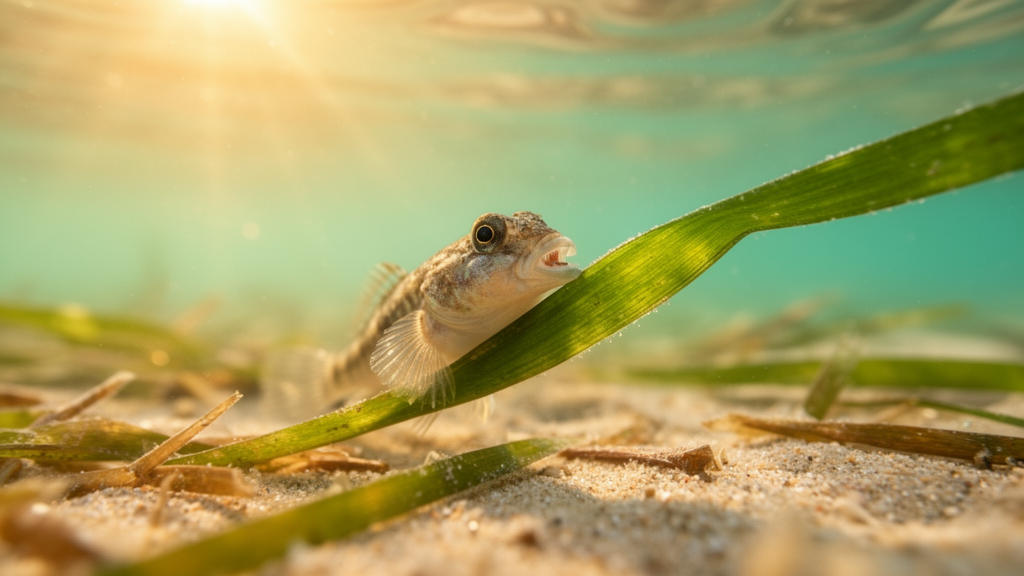
Deep in the burrows of a thalassinidean shrimp on tropical seagrass flats lives one of the strangest gobies ever described. The small-eyed goby Austrolethops wardi spends its entire life underground, in permanent darkness, alongside the shrimp Neaxius acanthus. It has lost its scales and pigmentation, its skin is pinkish and translucent, and its visual system is reduced — classic traits of troglomorphic fishes. But what has puzzled biologists most is its diet. Among the more than 2,450 known species of Gobioidei, A. wardi is the only one that feeds exclusively on seagrass, collected by its host shrimp and deposited inside the burrow. A new study, published in the Annals of the Natural History Museum Vienna, has now examined whether this radical dietary shift left any trace in the fish’s feeding apparatus — and the answer is a fascinating case of evolutionary inertia.
Most of the roughly 1,400 gobiid species are small carnivorous generalists, feeding on mobile zoobenthos. Around 120 species form obligate associations with burrow-dwelling alpheid shrimps, acting as sentries at the burrow entrance while the shrimp digs. But A. wardi is different. It belongs to an independently evolved association, inhabiting the burrows of a Strahlaxiidae shrimp rather than an alpheid, and it never leaves. The two lineages — alpheid-associated gobies and Austrolethops — apparently diverged about 30 million years ago in the Eocene. The burrows of Neaxius acanthus are stable structures ending in a voluminous chamber, forming a subsurface habitat for a variety of organisms including bivalves, gammarids, amphipods, polychaetes and, of course, the goby itself.
The research team, working with specimens collected from a multi-species seagrass bed off the island of Barrang Lompo in the Spermonde Archipelago, Indonesia, compared A. wardi with three sympatric gobiid species occupying different trophic guilds: the carnivorous Cryptocentrus cinctus, and the omnivorous sand-sifters Amblygobius phalaena and Valenciennea sexguttata. Using micro-computed tomography at the University of Vienna with a Bruker/SkyScan 1272 system — reconstructed voxel sizes between 3 and 6.5 micrometres — the researchers scanned the oral and pharyngeal jaws of all specimens and segmented each bone individually in 3D. Two additional specimens of A. wardi were cleared and double-stained for bone and cartilage, allowing detailed imaging of the trophic skeleton.
Fish have two sets of tooth-bearing jaws. The oral jaws — premaxilla, maxilla and dentary — grasp the food and prevent prey from escaping. The pharyngeal jaws at the end of the pharynx process it. In many fish species, mouth and tooth morphology are closely tied to diet, so the researchers expected a seagrass specialist to show clear adaptations. Herbivorous fishes typically have complex teeth — bicuspid, tricuspid, peg-shaped, flattened or chisel-like — and a long, often multiple-times-coiled gut. Yet the gut of A. wardi, described in an earlier study, is short and simple, closely resembling that of carnivorous gobies. The authors of that work concluded it could be a relic of a more carnivorous ancestry.
The new morphological analysis revealed a striking split. The premaxilla of A. wardi differs significantly in shape from the three compared species. It is elongated, about three times longer than high, with its posterior end bent ventrally below the tooth rows. Most notably, the ascending process is relatively short — 31.2 percent of premaxilla length versus 45.3 to 56.7 percent in the other species — and the articular process is distinctly reduced, at just 4.7 percent versus 22.5 to 33.8 percent, and fused with the ascending process to form a single combined ascending-articular branch. This fusion, the researchers argue, is a hallmark of a shift from suction feeding to biting. In acanthomorph fishes, the basal system for jaw protrusion relies on a long ascending process separated from the articular process, enabling lateral expansion of the oral cavity during suction. Shortening and fusion of these processes reduces that expansion and optimises the transmission of biting force — opening the door to feeding on immobile prey and plants.
Further evidence for a biting-dominated feeding mode comes from the lower jaw. The dentary of A. wardi is narrow anteriorly but rapidly widens into a massive, deep posterior portion, with a concave ventral margin — a geometry that increases force efficiency during biting. The anguloarticular is anteriorly bifurcated, with a massive and deep dorsal fork, and the retroarticular is the most robust of all four species. Biting species generally have stronger jaws than suction feeders, and the researchers suggest these massive bones help A. wardi cope with the compressive forces generated when grasping seagrass fragments, particularly those agglutinated into the burrow wall lining.
But here is where the story takes its most intriguing turn. Despite the specialised diet, the teeth themselves show hardly any adaptation to herbivory. The dentition of A. wardi is caniniform — elongated, pointed, with a narrow base and moderately curved tips — which is the ancestral tooth shape of teleost fishes and the typical form of most carnivorous gobies. The only differences from the carnivorous C. cinctus are quantitative: A. wardi carries more teeth, roughly 160 on the left premaxilla and 145 on the left dentary, arranged in up to six rows, and its dentition is the most uniform, with no abrupt change in tooth length or enlarged caniniform teeth. The pharyngeal jaws and their teeth, as well as the bony, blade-like gill rakers on the first branchial arch, look essentially like those of carnivorous gobies. The sand-sifting species, by contrast, show far more derived trophic morphology, with numerous thin, cushion-like pharyngeal teeth clearly adapted to their feeding mode.
The researchers propose that the organic-enriched lining of the shrimp burrow — shredded seagrass agglutinated by mucus secreted by the shrimp’s mucus glands and colonised by microbes, meiofauna and foraminifera — may be the primary food of A. wardi. This material has lower carbon-to-nitrogen ratios than plain seagrass detritus and would represent a superior food source, but it would be accessible only by biting. Stable isotope analyses have shown the goby is a primary consumer of detrital seagrass, with seagrass making up 94 percent of gut content, epiphytes 3 percent and small animals such as copepods and ostracodes just 1 percent. The slightly recurved front teeth and the large number of teeth may enable successful uptake of these fragments without requiring any fundamental redesign of the grasping system.
The broader lesson is one of phylogenetic conservatism. Comparative studies have shown that diet influences the shape of the premaxilla but not the shape of the teeth, which instead reflect phylogenetic relationships. Tooth shape in carnivorous and herbivorous fishes is related to phylogenetic history, and the caniniform dentition of A. wardi is a retained ancestral character. The morphological changes that did occur followed the shift from an ancestral carnivorous, suction-dominated feeding mode to a herbivorous, biting-dominated one — affecting the oral jaw skeleton but leaving the teeth, pharyngeal jaws and gill rakers essentially untouched. As Wainwright and Bellwood famously concluded, morphology is not a perfect predictor of prey-use patterns. Austrolethops wardi, with its carnivore’s teeth, carnivore’s gut and carnivore’s gill rakers packed into a pink, scaleless, seagrass-eating body, is a vivid example of exactly that.
Subject of Research: Trophic morphology and feeding apparatus of the seagrass-feeding burrow goby Austrolethops wardi
Article Title: Does phylogenetic conservatism obscure the trophic ecology of the Small-Eyed Goby Austrolethops wardi Whitley, 1935 ( Teleostei , Gobiidae ), an inhabitant of shrimp burrows?
Article References: Kast, S., Moritz, T., & Ahnelt, H. (2026). Does phylogenetic conservatism obscure the trophic ecology of the Small-Eyed Goby Austrolethops wardi Whitley, 1935 (Teleostei, Gobiidae), an inhabitant of shrimp burrows?. Annals of the Natural History Museum Vienna, 127, 137-154. https://doi.org/10.3897/anhmw.189442
Image Credits: AI Generated
DOI: 10.3897/anhmw.189442
Keywords: Austrolethops wardi, Gobiidae, seagrass, shrimp burrow, phylogenetic conservatism, trophic morphology, Does, phylogenetic, conservatism, obscure, trophic, ecology
Cite Scienmag News
Gavin Prescott. (October 15, 2026). Seagrass-Eating Goby Keeps Carnivore Jaws, Study Finds. Scienmag. https://scienmag.com/seagrass-eating-goby-keeps-carnivore-jaws-study-finds/
Gavin Prescott. "Seagrass-Eating Goby Keeps Carnivore Jaws, Study Finds." Scienmag, 15 October 2026, https://scienmag.com/seagrass-eating-goby-keeps-carnivore-jaws-study-finds/. Accessed 15 October 2026.
Gavin Prescott. "Seagrass-Eating Goby Keeps Carnivore Jaws, Study Finds." Scienmag. October 15, 2026. https://scienmag.com/seagrass-eating-goby-keeps-carnivore-jaws-study-finds/


