


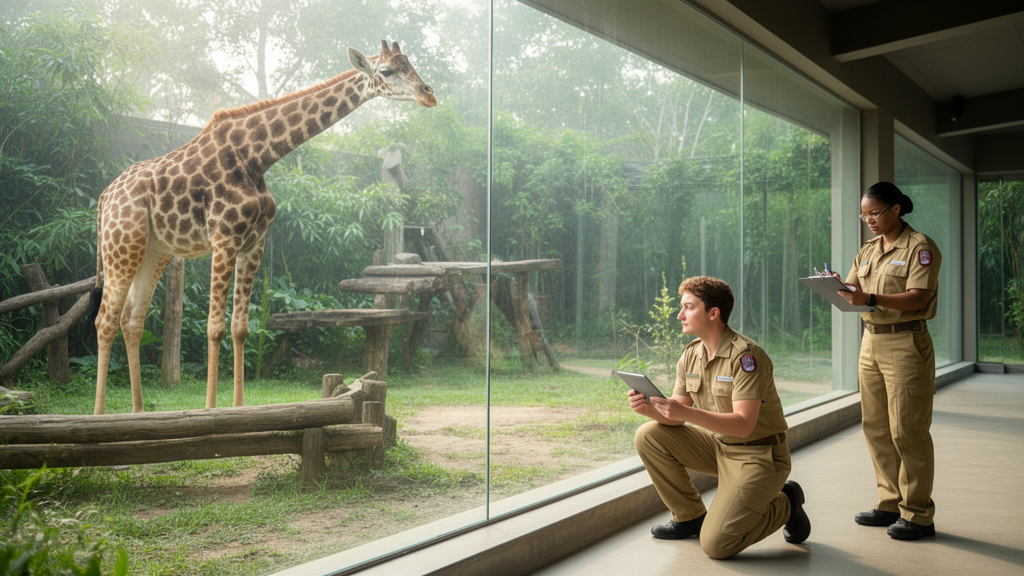
Zoo animal welfare is usually judged by combining two very different kinds of evidence: what the animal looks like and how it behaves, and the conditions in which it lives. A new study published in Frontiers in Ethology argues that merging those two streams too early can hide exactly where a welfare problem lies. Researchers led by Ji-yoon Kim of Animal Welfare Research under Human Care in the Republic of Korea tested a framework called the Animal State–Husbandry Context (ASHC) Grid across 20 mammalian species at a large public zoo, and found that identical overall welfare scores can conceal strikingly different underlying profiles.
The core idea is deceptively simple. Animal State (AS) covers what is directly expressed by the animal: body condition, visible clinical signs, feeding behaviour, behavioural diversity, abnormal repetitive behaviour, social interactions, responsiveness and reactions to humans. Husbandry Context (HC), by contrast, covers what is currently observable about the environment: enclosure space, thermal conditions, hygiene, lighting, shelter, substrate, retreat opportunities, nutrition, choice and control, group composition, structural complexity, enrichment, safety and visitor exposure. The two are related, the authors stress, but they are not equivalent, and the links between them are not established for every indicator.
Under limited-access conditions, the distinction matters even more. When assessors cannot enter off-exhibit areas, interview keepers or consult veterinary records, an observed problem cannot safely be attributed to current husbandry. A stereotypy seen today may reflect past housing, learning history or individual factors, and some behaviours persist after conditions improve. The reverse inference is equally risky: the absence of visible distress does not prove that the current environment is free of concern. Keeping the two domains separate at the observation stage, the researchers argue, prevents premature causal storytelling while still capturing where concern is located.
To test the framework, eleven assessors worked in three-person teams, each assigned to particular species, from African crested porcupines and Asian elephants to chimpanzees, fennec foxes, meerkats, siamangs and western lowland gorillas. All evidence came from public viewing areas during regular opening hours between April and June 2026. Assessors took behavioural videos of at least three minutes each, photographed appearance and enclosure features, and used laser distance meters, lux meters, sound level meters and thermo-hygrometers to record environmental conditions. Every scored item was rated on a six-level anchored scale from 1 to 10, with higher numbers indicating greater concern.
The scoring procedure was deliberately structured to avoid groupthink. Each assessor first scored independently, then the team held a structured evidence-review discussion lasting roughly 80 to 120 minutes, comparing photographs, videos, measurements and species-specific reference material. Crucially, no consensus score was produced: each assessor revised their own scores individually afterwards, and the three revised sets were retained separately. Agreement was then measured with Krippendorff’s alpha, and the results were impressive at the overall level: 0.961 for Animal State, 0.932 for Husbandry Context and 0.939 for the combined ASHC score.
Agreement was weaker for some specific items, however. Nutritional provision reached only 0.657, enrichment 0.721 and choice and control 0.766, all falling into the tentative range. The authors note that these indicators may be genuinely harder to judge from public viewing areas, because provision can change over time and animals’ functional use of resources is not always visible. They suggest that clearer scoring guidance and evidence requirements may be needed for such items. The team also cautions that the high overall agreement reflects scores revised after shared review, not fully independent reproducibility, and that consistency is not the same as validity.
The headline finding is about what summary scores conceal. Across the 20 species, mean Husbandry Context was 4.24 and mean Animal State was 2.78, with HC exceeding AS in 18 of 20 species. Yet the paired profiles told far richer stories. The siamang and the western lowland gorilla had almost identical overall ASHC values of 4.36 and 4.31, but their compositions were radically different. The siamang showed strong husbandry concern (HC 6.61) against a low animal-state score of 2.10, with animals observed brachiating, playing, grooming and vocalising. The gorilla, an older female, showed regurgitation and re-ingestion, self-clasping and low responsiveness, producing a higher AS of 4.08 and a nearly balanced profile.
Only two species, the jaguar and the sun bear, showed the opposite pattern, with animal-state concern exceeding husbandry concern. The jaguar displayed repetitive behaviour and repeated fur licking, while the sun bears showed repeated aggression, wounds and marked panting in warm conditions. The researchers are careful to stress that these negative gaps do not demonstrate that current husbandry caused the observed states; unobservable management or health history could be responsible, and follow-up information would be needed before any causal claim. Indicator-level contrasts reinforced the point: the fennec fox and South American coati shared an identical husbandry summary of 3.86, but the fox’s concerns centred on thermal environment, noise, enrichment and choice, while the coati’s centred on substrate, shelter, retreat and drainage.
Even behavioural summaries hid divergent realities. The African crested porcupine and the meerkat both scored 3.11 on behavioural AS, but for different reasons. The porcupines repeatedly huddled in one area with little postural variation, minimal enrichment use and repeated social avoidance across more than ten observation periods, while the meerkats’ vigilance, a normal part of their sentinel behaviour, was repeatedly tied to visitors approaching or tapping on glass. The Asian elephant, meanwhile, had a low overall score yet retained a focal concern for retreat and concealment. In each case, the detailed profile narrows the questions that follow-up assessment should ask, rather than delivering a diagnosis.
The authors position ASHC not as a replacement for comprehensive internal welfare assessment, nor as a validated composite welfare index, but as a complementary framework for organising observable evidence and directing further investigation. Species were purposively selected, individual numbers ranged from one to nine per species, and a sensitivity analysis confirmed the main pattern under an alternative weighting scheme. The practical message for zoos, welfare scientists and even concerned visitors is that a single number can flatten a complex story. Separating what the animal shows from what the environment offers preserves the location and composition of welfare concern, and points precisely to where keeper records, veterinary history and longitudinal data should be examined next.
Subject of Research: Zoo animal welfare assessment using the Animal State–Husbandry Context Grid across 20 mammalian species
Article Title: Animal state and husbandry context profiles in limited-access zoo welfare assessment: evidence from 20 mammalian species
Article References: Kim, J.-Y., Lee, W., Jeong, D.-W., & Kim, M.-G. (2026). Animal state and husbandry context profiles in limited-access zoo welfare assessment: evidence from 20 mammalian species. Frontiers in Ethology, 5, Article 1919787. https://doi.org/10.3389/fetho.2026.1919787
Image Credits: AI Generated
DOI: 10.3389/fetho.2026.1919787
Keywords: animal welfare, zoo animals, welfare assessment, animal behaviour, husbandry, mammals, Krippendorff's alpha, stereotypic behaviour, enclosure design, enrichment, limited-access observation, Frontiers in Ethology
Cite Scienmag News
William Thompson. (October 15, 2026). Seeing the Whole Picture: New Zoo Welfare Framework Keeps Animal State and Husbandry Apart. Scienmag. https://scienmag.com/seeing-the-whole-picture-new-zoo-welfare-framework-keeps-animal-state-and-husbandry-apart/
William Thompson. "Seeing the Whole Picture: New Zoo Welfare Framework Keeps Animal State and Husbandry Apart." Scienmag, 15 October 2026, https://scienmag.com/seeing-the-whole-picture-new-zoo-welfare-framework-keeps-animal-state-and-husbandry-apart/. Accessed 15 October 2026.
William Thompson. "Seeing the Whole Picture: New Zoo Welfare Framework Keeps Animal State and Husbandry Apart." Scienmag. October 15, 2026. https://scienmag.com/seeing-the-whole-picture-new-zoo-welfare-framework-keeps-animal-state-and-husbandry-apart/


