


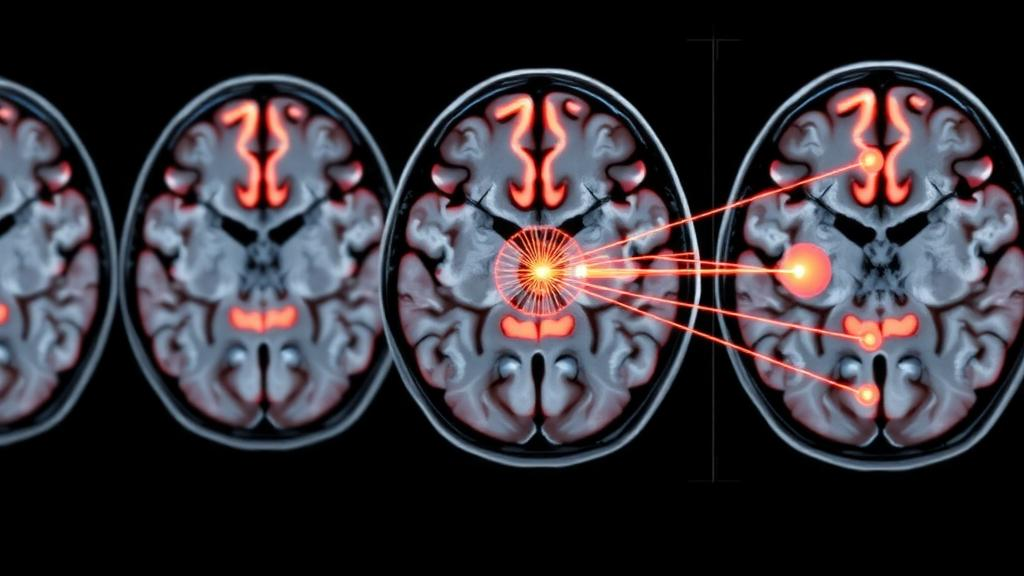
Every MRI scan of a brain tumor hides a puzzle: which bright or dark patches belong to the tumor, which belong to swelling, and which are simply healthy tissue caught in the picture. Radiologists solve this puzzle by hand, and computer scientists have long tried to automate it with clustering algorithms that sort image pixels into groups. The trouble is that the workhorse of the field, the k-means algorithm, demands that the operator already know how many groups exist before the analysis begins. A new study published in Frontiers in Imaging argues that a technique borrowed from quantum mechanics can sidestep that requirement entirely, letting the data itself reveal how many tissue classes an image contains.
The method, called Dynamic Quantum Clustering, or DQC, was developed by Jacksson Sánchez of Universidad Nacional Pedro Henríquez Ureña in the Dominican Republic and Miguel Martín-Landrove of the Universidad Central de Venezuela. Their idea is to treat every distinct intensity value in an MRI scan as a particle moving through an abstract landscape shaped by the data itself. The landscape is built from a Parzen estimator, a smooth probability density constructed by summing Gaussian kernels centered on every data point. In the quantum picture, this density is interpreted as the ground-state wavefunction of a physical system, and the Schrödinger equation then yields a quantum potential derived directly from how the data are distributed.
Once the potential is in place, the dynamics begin. Using the Ehrenfest theorem, the researchers derive an equation of motion for each intensity vector, which evolves as if it were a real particle rolling through the quantum potential. To make the particles settle rather than oscillate forever, the team adds a damping term, turning the motion into a second-order Langevin equation. Over time, the system loses kinetic energy and each point slides into a local minimum of the potential landscape. Points that fall into the same minimum form a cluster, so the final grouping emerges from the physics of the landscape rather than from a guess about how many clusters should exist.
Applying this machinery to medical images required a two-phase pipeline. In the first phase, a coarse segmentation isolates a three-dimensional region of interest around the suspected tumor, suppressing irrelevant anatomy and artifacts. The algorithm computes the image histogram, builds the Parzen estimator, evaluates the Schrödinger potential, and lets the data evolve dynamically. A second pass through the dynamics produces what the authors call a trap potential, whose local minima reveal both the number and approximate locations of the dominant clusters. Those minima then serve as data-driven initial centroids for a conventional k-means classification, and a second, refined phase of DQC segmentation operates inside the confined region to sharpen the final delineation.
The tuning of a single parameter proved decisive. The Gaussian kernel width, which plays the role of a mass in the dynamical system, controls how smooth the potential landscape becomes. Set it too small and the landscape bristles with local minima, fragmenting the image into far too many classes. Set it too large and the estimator becomes so smooth that distinct anatomical regions merge into one. The researchers found that the number of detected classes follows a power-law decline as the kernel parameter increases, a scale-invariant behavior that makes tuning predictable across datasets. They standardized the parameter by tying it to the histogram bin width, ensuring consistent smoothing behavior regardless of each image’s intensity range.
To test the approach, the team drew on publicly available collections from The Cancer Imaging Archive, including the TCGA-LGG and REMBRANDT repositories for lower-grade gliomas, the TCGA-GBM and UPENN-GBM datasets for glioblastoma, and the BraTS 2023 meningioma collection for benign tumors. The single-modality analysis focused on contrast-enhanced T1-weighted MRI, a sequence in which actively growing tumor tissue lights up after contrast injection. When the minima of the DQC trap potential were compared with the centroids that k-means computes on its own, the correspondence was strikingly close, suggesting the quantum dynamics naturally guide data points toward the same stable positions that classical optimization must hunt for.
Head-to-head comparisons against ground-truth segmentations from the BraTS challenge told a nuanced story. For segmentations using up to four classes, k-means significantly outperformed DQC on the Dice similarity index, a standard overlap metric. But by five classes the difference vanished statistically, and the best Dice values achieved by both methods, around 0.86 to 0.87, were comparable to the best results reported in the BraTS 2023 challenge for contrast-enhancing tumor regions. The authors note that k-means typically requires external optimization tricks, such as particle swarm methods, to avoid poor convergence, whereas DQC arrives at its centroids through the dynamics themselves.
The real ambition, however, lies in multimodal imaging. Modern neuro-oncology relies on several MRI sequences at once, such as T1-weighted, contrast-enhanced T1-weighted, and T2 FLAIR images, each highlighting different tissue properties. The researchers extended DQC to these datasets in two ways. The direct approach builds an n-dimensional joint histogram from all co-registered modalities and lets the quantum dynamics unfold in that higher-dimensional space, fully exploiting the complementary information but at a steep computational cost, since the number of potential minima remains unknown until many iterations have elapsed. The alternative approach runs DQC independently on each single-modality image and then integrates the results, trading some theoretical elegance for dramatically faster convergence.
The authors are candid about the method’s limits. DQC operates purely on the mathematical representation of the data and knows nothing about the biological or clinical meaning of what it separates, so its output reflects similarities in feature space rather than true tissue classes. Removing artifacts and irrelevant anatomy still demands a qualified human eye, making the pipeline semi-supervised rather than fully automatic. Clinical interpretation, they stress, must always involve medical professionals.
Even so, the study marks a notable crossing point between fundamental physics and clinical imaging. The same framework can, in principle, ingest richer features beyond raw intensity, such as apparent diffusion coefficient maps from diffusion MRI or pharmacokinetic parameters from dynamic contrast-enhanced studies, raising the dimensionality of the feature space without changing the underlying algorithm. As machine learning pipelines for medical imaging grow hungrier for robust, assumption-free initialization methods, the idea that a Schrödinger equation written over a histogram can tell radiologists how many tissue classes they are looking at may prove one of the more elegant tricks to migrate from theoretical physics into the hospital reading room.
Subject of Research: Application of dynamic quantum clustering, a quantum mechanics-based unsupervised algorithm, to brain tumor segmentation in single- and multi-modality MRI
Article Title: A dynamic quantum clustering approach to brain tumor segmentation
Article References: Sánchez, J., & Martín-Landrove, M. (2026). A dynamic quantum clustering approach to brain tumor segmentation. Frontiers in Imaging, 5, Article 1882713. https://doi.org/10.3389/fimag.2026.1882713
Image Credits: AI Generated
DOI: 10.3389/fimag.2026.1882713
Keywords: dynamic quantum clustering, brain tumor segmentation, MRI, glioblastoma, k-means clustering, quantum potential, medical image analysis, multimodal imaging, Dice similarity index, The Cancer Imaging Archive, Schrödinger equation, unsupervised machine learning
Cite Scienmag News
Katie Riggs. (October 15, 2026). Physicists Borrow Quantum Mechanics to Map Brain Tumors on MRI Scans. Scienmag. https://scienmag.com/physicists-borrow-quantum-mechanics-to-map-brain-tumors-on-mri-scans/
Katie Riggs. "Physicists Borrow Quantum Mechanics to Map Brain Tumors on MRI Scans." Scienmag, 15 October 2026, https://scienmag.com/physicists-borrow-quantum-mechanics-to-map-brain-tumors-on-mri-scans/. Accessed 15 October 2026.
Katie Riggs. "Physicists Borrow Quantum Mechanics to Map Brain Tumors on MRI Scans." Scienmag. October 15, 2026. https://scienmag.com/physicists-borrow-quantum-mechanics-to-map-brain-tumors-on-mri-scans/


