


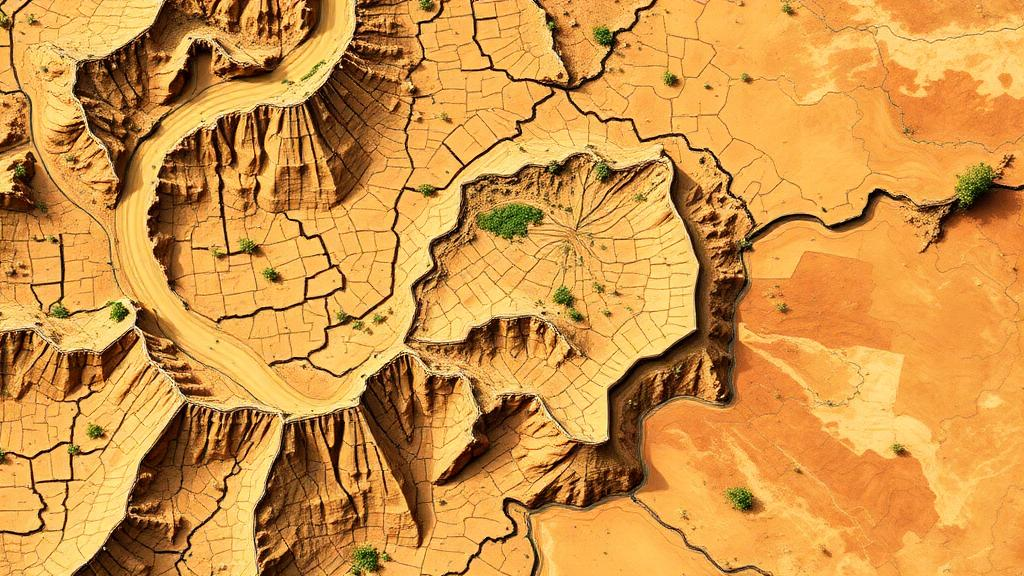
On China’s Loess Plateau, where centuries of erosion have carved a landscape of deep gullies and fragile soils, the fate of vegetation under climate change hinges on a deceptively simple question: when does water scarcity actually bite? A new 24-year analysis published in Theoretical and Applied Climatology offers one of the most detailed answers yet, showing that the timing of drought matters as much as its severity, and that different ecosystems respond in strikingly different ways. The study, led by Shiyang Zhou of North China Electric Power University, tracked net primary productivity (NPP) across the plateau from 2001 to 2024, pairing satellite-derived productivity estimates with a remote-sensing drought index to disentangle how soil moisture stress shapes carbon uptake across forests, grasslands, and croplands.
Net primary productivity, the amount of carbon plants fix through photosynthesis minus what they respire, is a fundamental currency of ecosystem health. On the water-limited Loess Plateau, where decades of ambitious revegetation programs have transformed hillsides once prone to catastrophic soil erosion, NPP trends carry both ecological and policy significance. The research team quantified productivity using satellite data and assessed drought through the Temperature-Vegetation Drought Index (TVDI), an index that exploits the physical relationship between land surface temperature and vegetation greenness. When soils dry, plants close their stomata to conserve water, transpiration falls, and the surface heats up; the TVDI captures this signature by evaluating where each pixel sits within the temperature-vegetation space, providing a proxy for root-zone soil moisture status across heterogeneous terrain.
The results reveal a clear hierarchy among ecosystems. Forestland on the plateau achieved the highest average NPP, at 400.3 grams of carbon per square meter, and the fastest growth rate, increasing by 6.81 grams of carbon per square meter each year, a trend the authors report as statistically significant. Cropland occupied an intermediate position, with a mean NPP of 342.31 grams of carbon per square meter and an annual increase of 6.28 grams of carbon per square meter, also significant. Grassland lagged behind on both counts, recording the lowest mean NPP at 284.49 grams of carbon per square meter and the slowest growth rate of 5.48 grams of carbon per square meter per year. All three trends were significant at the five percent level, indicating that the plateau’s vegetation has been steadily accumulating carbon across every major land cover type over the past quarter century.
Yet the headline numbers conceal the study’s most consequential finding: the scale at which drought is measured changes the answer entirely. When the researchers compared annual and growing-season windows, they found that drought during the growing season, defined as May through September, constrained NPP more strongly than drought assessed across the full year. This makes physiological sense. The growing season is when photosynthetic machinery is fully engaged and water demand peaks; soil moisture deficits during these months translate directly into reduced carbon assimilation. Annual-scale averages, by contrast, dilute the signal by folding in dormant-season months when productivity is minimal and drought stress largely irrelevant to carbon uptake. The implication is sobering for climate projections: assessments that rely on annual drought metrics may systematically underestimate the productivity losses that ecosystems will suffer as growing-season drought intensifies under warming.
To understand what drives the spatial patchwork of productivity and drought across the plateau, the team deployed GeoDetector, a statistical framework designed to quantify the explanatory power of geographic factors and, crucially, of their interactions. Precipitation emerged as the dominant force behind the spatial heterogeneity of both NPP and TVDI. More striking still was the finding that precipitation’s explanatory power was amplified when it interacted with temperature and potential evapotranspiration. In other words, rainfall does not act alone; its influence on productivity and soil moisture is modulated by the atmospheric demand for water, which rises with temperature. This interaction structure helps explain why the same amount of precipitation can support different levels of productivity in different parts of the plateau, depending on how hot and dry the overlying atmosphere is.
The interannual story proved equally revealing. Using partial least squares regression (PLSR), a technique well suited to disentangling collinear climatic drivers, the researchers traced the pathways through which climate fluctuations propagate into year-to-year NPP variability. At the annual scale, interannual NPP variability was primarily precipitation-driven. But when the analysis shifted to the growing season, the balance tipped: drought, as captured by TVDI, became the dominant driver of productivity fluctuations, with marked differences among ecosystems. This scale-dependent shift in control carries a clear message for drought monitoring. Annual precipitation totals, the metric most often used in regional drought assessment, fail to capture the soil moisture conditions that actually govern carbon uptake during the critical growing months.
The ecosystem-specific dimension of the findings adds another layer of complexity. Forests, with their deep rooting systems and substantial water storage capacity, sit at one end of the spectrum; grasslands, with shallow roots and rapid responses to surface moisture, sit at the other. Croplands, shaped by both natural climate variability and human management, occupy the middle ground. The authors report that the shift from precipitation dominance to drought dominance during the growing season differed markedly among these ecosystems, meaning that no single drought-productivity relationship can be applied uniformly across the plateau. Targeted drought adaptation, the study argues, must account for these ecosystem-specific response pathways rather than relying on one-size-fits-all metrics.
These results land on a plateau already under intense scrutiny. Decades of the Grain for Green program have retired steep farmland and planted millions of trees, raising questions about whether the region’s water budget can sustain the vegetation it now carries. Previous research has documented increasing water constraint on vegetation growth globally, and studies on the plateau itself have shown that drought limits carbon sequestration by suppressing photosynthetic capacity in semi-arid ecosystems. The new analysis sharpens this picture by demonstrating that the constraint operates most powerfully through soil drought during the growing season, and that its strength varies by ecosystem type. As climate change raises atmospheric evaporative demand and shifts precipitation patterns, the growing-season water deficit identified here is likely to intensify, potentially slowing the carbon accumulation trends the plateau has enjoyed since 2001.
For the scientists and land managers charged with sustaining the plateau’s ecological restoration, the study offers a practical toolkit. By combining TVDI-based soil drought assessment with scale-aware and ecosystem-specific productivity analysis, the framework improves the precision of drought-productivity evaluation, providing what the authors describe as a scientific basis for targeted drought adaptation, ecological management, and vegetation restoration. The message for the wider dryland science community is equally clear: the timing of drought, the scale of its measurement, and the identity of the affected ecosystem are not peripheral details but central determinants of how water scarcity reshapes the carbon cycle. On the Loess Plateau, as in water-limited regions worldwide, the growing season is where the battle between drought and productivity will be won or lost.
Subject of Research: Climate Change
Article Title: Scale-dependent and ecosystem-specific responses of vegetation net primary productivity to soil drought and climate change on the Chinese Loess Plateau
Article References: Scale-dependent and ecosystem-specific responses of vegetation net primary productivity to soil drought and climate change on the Chinese Loess Plateau. (n.d.). https://doi.org/10.1007/s00704-026-06636-7
Image Credits: AI Generated
DOI: 10.1007/s00704-026-06636-7
Keywords: Loess Plateau, net primary productivity, soil drought, TVDI, climate change, vegetation restoration, ecosystems, remote sensing, Scale-dependent, ecosystem-specific, responses, vegetation
Cite Scienmag News
Violet Maxwell. (October 15, 2026). Soil Drought Hits Loess Plateau Vegetation Hardest During the Growing Season, 24-Year Satellite Record Shows. Scienmag. https://scienmag.com/soil-drought-hits-loess-plateau-vegetation-hardest-during-the-growing-season-24-year-satellite-record-shows/
Violet Maxwell. "Soil Drought Hits Loess Plateau Vegetation Hardest During the Growing Season, 24-Year Satellite Record Shows." Scienmag, 15 October 2026, https://scienmag.com/soil-drought-hits-loess-plateau-vegetation-hardest-during-the-growing-season-24-year-satellite-record-shows/. Accessed 15 October 2026.
Violet Maxwell. "Soil Drought Hits Loess Plateau Vegetation Hardest During the Growing Season, 24-Year Satellite Record Shows." Scienmag. October 15, 2026. https://scienmag.com/soil-drought-hits-loess-plateau-vegetation-hardest-during-the-growing-season-24-year-satellite-record-shows/


