


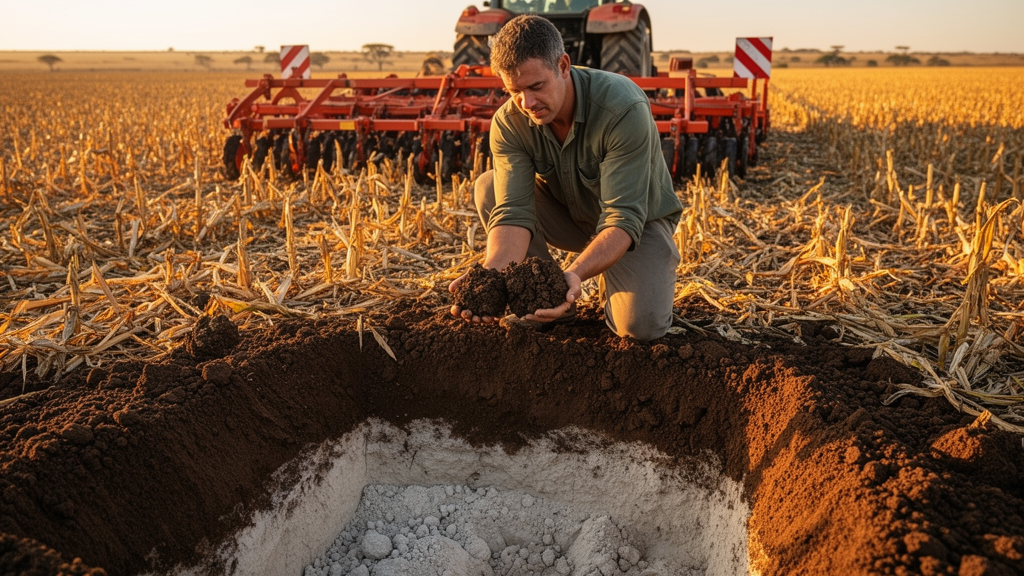
Deep in the Eastern Cape of South Africa, a field experiment that began in 2012 has finally delivered a verdict on one of the most contested questions in modern agriculture: can conservation farming really lock carbon away in the soil profile, or does it merely shuffle it around near the surface? After ten years of continuous no-till, crop rotation and residue management on a Haplic Plinthosol, researchers from the University of Fort Hare and the Agricultural Research Council have shown that the answer is a qualified yes. Conservation agriculture built measurable carbon where roots and residues concentrate, in the top 20 centimetres of the profile, but the deeper 20 to 60 centimetre layers barely responded even after a full decade of practice. The finding, published in Frontiers in Soil Science, carries real weight for climate policy, because subsoil horizons are the most stable carbon reservoirs and the ones that matter most for long-term sequestration.
The stakes could hardly be higher. South African agricultural soils have lost enormous amounts of carbon through erosion on sloping lands, flooding, and the accelerated soil respiration that comes with intensive tillage. Du Preez and colleagues estimated that roughly 58 percent of the country’s topsoils contain less than 0.5 percent soil organic carbon, a level widely regarded as critically degraded. Conventional tillage, insufficient soil cover and the widespread omission of crop rotations are the main culprits. Every pass of an inversion plough mixes crop residues into the soil and exposes protected organic matter to oxygen, driving decomposition and releasing carbon dioxide to the atmosphere. Reversing this decline is therefore not just a matter of fertility; it is a matter of restoring degraded land while mitigating greenhouse gas emissions, a combination that has led the Intergovernmental Panel on Climate Change to identify conservation agriculture as a key management practice for both food security and climate adaptation.
Conservation agriculture rests on three pillars: minimum soil disturbance, permanent soil cover and diversification of plant species. The idea is elegant in its simplicity. By reducing tillage intensity, the practice slows the decomposition of soil organic matter, while residue retention and permanent cover supply a continuous stream of labile carbon and root exudates that feed microorganisms. Those microbes, in turn, decompose the substrates and release nutrients for crops, closing the loop between carbon storage and fertility. Yet the evidence base has been frustratingly incomplete. Most studies in South Africa have been short-term and restricted to surface layers, leaving the long-term effects of conservation agriculture on carbon distribution throughout the profile poorly understood. Powlson and colleagues have warned that apparent carbon gains in surface layers under conservation agriculture are often offset by losses deeper down, producing a vertical redistribution of carbon rather than true sequestration. That warning made a full-profile assessment essential.
The trial at the Phandulwazi Training Centre, established in 2012 at 750 metres altitude in a sub-humid to humid climate with an annual mean temperature of 16.1 degrees Celsius and 750 millimetres of rainfall, was designed to test exactly this. The soil is a sandy loam classified as Avalon in the South African system, Ultisol in USDA Soil Taxonomy and Haplic Plinthosol in the World Reference Base. Before the trial began, the field was under kikuyu grass, with baseline soil organic carbon concentrations of 1.17 percent at 0 to 5 centimetres and 1.07 percent at 5 to 10 centimetres. The experiment used a randomized complete block design with a strip-split-split plot arrangement, comparing no-till against conventional tillage, four crop rotations built around maize, fallow, wheat and soybean, residue retention against removal, and three soil depths of 0 to 20, 20 to 40 and 40 to 60 centimetres. Conventional tillage involved annual soil inversion to 20 centimetres, while no-till plots remained undisturbed, with seeds sown into the previous season’s residue using hand-held hoes. Fertility was standardized at 90 kilograms of nitrogen, 45 kilograms of phosphorus and 60 kilograms of potassium per hectare, and the practices were repeated consistently for ten years.
What makes this study technically distinctive is its multi-fraction approach. Rather than relying on total soil organic carbon alone, which often fails to resolve conflicting outcomes across soil types and management intensities, the researchers measured a battery of carbon pools that behave differently. Labile fractions such as particulate organic matter and permanganate-oxidizable carbon, also known as active carbon, act as sensitive indicators of immediate fertility changes. Recalcitrant pools, including humic acid and fulvic acid, reflect long-term storage and structural resilience. The team also calculated total extractable carbon, non-humified carbon and several humification quotients, including the humification ratio, humification index and degree of humification, which serve as qualitative measures of how far organic matter has progressed toward stable humic forms. Soil samples were collected after wheat harvest in the 2022 cropping season, six months after tillage, using a graduated 7-centimetre auger, and bulk density was measured by the undisturbed soil core method to calculate carbon stocks.
The headline result is that no-till increased soil organic carbon by 0.64 percentage points, representing a 14.06 percent improvement over conventional tillage, with the gains concentrated in the 0 to 20 centimetre layer. Soil organic carbon stocks followed the same pattern, being significantly greater under no-till at the surface but statistically indistinguishable below 20 centimetres. The explanation is biogeochemical: without soil turnover, decomposition rates of organic matter drop, residues accumulate where they fall, and carbon builds up where roots and residues are concentrated. Conventional tillage, by contrast, mixes residues into the soil and accelerates oxidation, which is why its benefits appear as redistribution rather than accumulation. The pattern is consistent with long-term trials worldwide, where carbon gains under reduced tillage tend to stratify near the surface while deeper layers respond far more slowly.
Particulate organic matter told an equally revealing story. The interactive effects of tillage, crop rotation, residue management and depth were significant, with the highest particulate organic matter recorded under conventional tillage with residue retention in the maize-wheat-maize rotation, reaching 19.73 grams per kilogram at 20 to 40 centimetres and 18.07 grams per kilogram at the surface. The lowest values appeared where residues were removed, at 5.54 grams per kilogram under the maize-fallow-maize rotation, and where legumes accelerated decomposition, as in the maize-wheat-soybean rotation. Active carbon was significantly higher under the maize-fallow-soybean rotation at 20 to 40 centimetres, attributed to the fast release of nutrients from legume residues. At 40 to 60 centimetres, however, all treatment combinations were statistically indistinguishable for particulate organic matter, confirming that a decade of conservation agriculture had not yet altered the deepest carbon pools.
The recalcitrant pools delivered the study’s most surprising twist. Conventional tillage increased humic acid concentrations by 25.40 percent at the surface, while no-till increased fulvic acid concentrations by 41.67 percent in the same layer. This contrasts with findings from other regions, and the authors attribute the difference to variations in soil type, sampling depth, rotation and experiment duration, all of which strongly influence humification. No-till appears to promote fulvic acid accumulation by preserving organic matter, protecting microbial life and slowing decomposition, while enhancing root contributions to the soil. Residue retention produced a sufficient humic-to-fulvic acid ratio at the surface, meaning more organic matter had been converted into the more stable humic acids, and a significantly greater degree of humification. Yet the humification index remained below the critical limit of 50 percent in both residue treatments, indicating that surface residues physically protect organic matter from decomposing agents and keep the humification process incomplete.
Principal component analysis, which generated thirteen components of which four with eigenvalues greater than 1 were retained, accounting for 72.06 percent of the variability, identified soil organic carbon, the humification ratio and total extractable carbon as the major drivers of soil organic carbon stock variability. Non-humified carbon and the humification index loaded strongly onto the first component, fulvic acid onto the second, and humic acid with the humic-to-fulvic ratio onto the third. This statistical architecture confirms that the labile and extractable fractions, not the deepest recalcitrant pools, are the ones responding to management, and that monitoring these fractions offers a more robust assessment of conservation agriculture’s effect on carbon storage than any single parameter.
The broader implications are clear. Conservation agriculture, particularly no-till combined with crop rotation and residue retention, reliably improves soil organic carbon and carbon quality indicators in the topsoil, delivering fertility benefits that underpin the reduced input costs and more stable yields reported in South African studies. But the limited changes observed in the 20 to 60 centimetre layers after ten years suggest that conservation agriculture alone may not be sufficient to enhance long-term sequestration in subsoil pools, which are the most stable reservoirs and the ones critical for climate resilience. The authors point to complementary practices, such as rotations with deep-rooting crops, perennials or organic amendments that move carbon inputs deeper into the profile, as necessary interventions to overcome this inertia. For policy makers, the message is equally direct: long-term conservation agriculture trials highlight the role of the practice in carbon sequestration and climate adaptation, pointing to the need for supportive policies, incentives and extension services that encourage widespread adoption, while acknowledging that unlocking the full potential for deeper carbon storage will require targeted interventions and continued monitoring over decades, not years.
Subject of Research: Persistence of soil profile carbon fractions after ten years of tillage, crop rotation and residue management practice in a Haplic Plinthosol of South Africa
Article Title: Persistence of soil profile carbon fractions after ten years of tillage, crop rotation and residue management practice in a Haplic Plinthosol of South Africa
Article References: November, S., Manyevere, A., Elephant, D. E., & Nciizah, A. D. (2026). Persistence of soil profile carbon fractions after ten years of tillage, crop rotation and residue management practice in a Haplic Plinthosol of South Africa. Frontiers in Soil Science, 6, Article 1828936. https://doi.org/10.3389/fsoil.2026.1828936
Image Credits: AI Generated
DOI: 10.3389/fsoil.2026.1828936
Keywords: Persistence, soil, profile, carbon, fractions, years, tillage, crop, rotation, residue, management, practice
Cite Scienmag News
Alan Morgan. (October 15, 2026). Ten Years of No-Till Farming Builds Carbon in South African Topsoil, but Subsoil Stays Stubbornly Unchanged. Scienmag. https://scienmag.com/ten-years-of-no-till-farming-builds-carbon-in-south-african-topsoil-but-subsoil-stays-stubbornly-unchanged/
Alan Morgan. "Ten Years of No-Till Farming Builds Carbon in South African Topsoil, but Subsoil Stays Stubbornly Unchanged." Scienmag, 15 October 2026, https://scienmag.com/ten-years-of-no-till-farming-builds-carbon-in-south-african-topsoil-but-subsoil-stays-stubbornly-unchanged/. Accessed 15 October 2026.
Alan Morgan. "Ten Years of No-Till Farming Builds Carbon in South African Topsoil, but Subsoil Stays Stubbornly Unchanged." Scienmag. October 15, 2026. https://scienmag.com/ten-years-of-no-till-farming-builds-carbon-in-south-african-topsoil-but-subsoil-stays-stubbornly-unchanged/


