


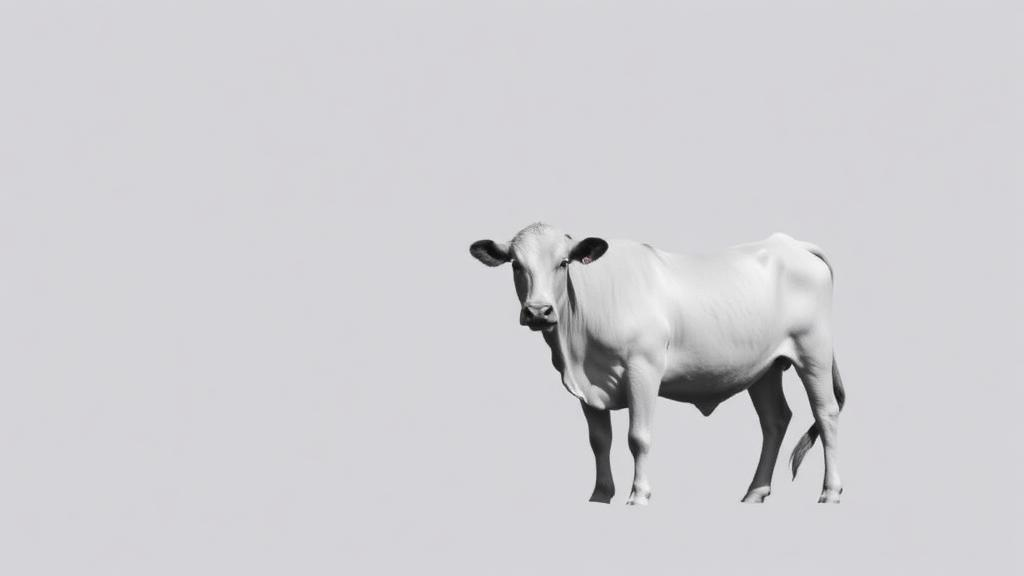
On the semi-arid rangelands of South Africa’s Eastern Cape, a cow’s coat color may quietly decide how much it eats, how hot it gets, and how much weight it gains over a year. A new 12-month field study of 120 communally managed beef cattle has found that animals with lighter, shorter, and smoother coats spent dramatically more of their daytime grazing, carried a lower physiological heat load, and gained more weight than herdmates with darker or denser coats. The findings, published in the journal Pastoralism, suggest that one of the most practical tools for climate-proofing livestock may be visible from a hundred paces away.
The research, led by Mhlangabezi Slayi of the University of Fort Hare together with Siphe Zantsi of the Agricultural Research Council and Lwandiso Mdiya of the University of the Free State, tracked cattle in the Raymond Mhlaba Local Municipality from January to December 2025. Communal cattle production is a cornerstone of rural livelihoods in South Africa, underpinning household food security and asset accumulation, yet these animals graze open rangelands with no artificial cooling, minimal infrastructure, and no nutritional supplementation. As climate change intensifies the frequency and severity of heat stress events across sub-Saharan Africa, the capacity of cattle to adapt behaviourally and physiologically to fluctuating thermal conditions has become a decisive factor in both productivity and welfare.
The study herd consisted of clinically healthy indigenous crossbreds, predominantly Nguni, Afrikaner, and Brahman crosses, aged between three and six years, comprising 74 multiparous cows and 46 castrated oxen. All 120 animals were maintained as a single cohesive herd on a 450-hectare unimproved natural rangeland dotted with shade-providing Acacia karroo canopies. To classify coat characteristics beyond visual appraisal, the researchers shaved 5 by 5 centimeter patches on each animal’s mid-side flank and analyzed the collected hair in the laboratory, measuring the length of 20 randomly sampled strands per animal with digital calipers and counting hair roots under a stereomicroscope to determine density. Cattle were then split into two operational groups: 39 animals with solid white or light-cream coats characterized by short, smooth, flat-lying hair, and 81 animals with black, brown, red, or heavily pigmented dark coats, or any individuals with long or dense hair profiles.
Thermal conditions were recorded at 30-minute intervals during observation sessions using portable weather stations positioned at mean animal height, capturing ambient temperature, relative humidity, wind speed, solar radiation, and black globe temperature measured with a matte-black copper thermometer. From these data the team computed the Temperature-Humidity Index, or THI, a standard biometeorological measure of heat load, classifying environments as thermoneutral below 72, mild heat stress between 72 and 78, moderate heat stress between 79 and 88, and severe heat stress above 88. Midday summer conditions regularly pushed cattle into the moderate bracket, with peak ambient temperatures reaching 32.8 degrees Celsius, mean midday THI values of 84.7, and solar radiation averaging 936 watts per square meter. During localized heatwave events in February, the index peaked at 88.4, placing the animals squarely within the severe heat stress range.
Daytime behaviour was documented twice monthly using focal animal sampling, with four trained observers concurrently tracking the tagged cattle at 10-minute intervals across the 8-hour window from 08:00 to 16:00. Inter-observer reliability, verified through independent parallel logs before the study began, yielded a Cohen’s kappa coefficient of 0.88. The resulting 34,560 distinct focal point entries fed into linear mixed-effects models that treated coat group, hair length, hair density, THI category, and their interaction as fixed effects, with individual animal identity as a random intercept to account for repeated measures. Because coat color, length, and density are physically linked within natural phenotypes, the researchers tested them as separate variables, found variance inflation factors exceeding 5.0, and resolved the multicollinearity by using the integrated coat group as the primary structural effect.
The behavioural results were striking. As THI rose, daytime grazing declined progressively from 59.8 percent of the time budget under thermoneutral conditions to just 40.6 percent during severe heat stress, while resting more than doubled from 11.5 to 22.1 percent and shade-seeking expanded more than ten-fold, from 0.4 to 4.8 percent. Drinking frequency climbed from 1.4 to 3.3 percent, reflecting the intensification of evaporative cooling, and walking increased as animals moved between grazing patches and water points. Grazing and resting behaviours were strongly negatively correlated, and the thermal environment explained the largest component of variation in grazing activity and rectal temperature in the analysis of variance.
Coat phenotype shaped how cattle navigated this thermal gradient. Light-coated cattle spent 54.8 percent of their daytime grazing, compared with 46.9 percent for dark-coated animals, and showed significantly less walking, resting, drinking, and shade-seeking. The physiological data reinforced the behavioural picture: dark-coated cattle recorded higher mean rectal temperatures of 39.4 degrees Celsius versus 38.7, and respiration rates of 49.3 breaths per minute versus 37.2. The biophysical explanation lies in heat exchange. Dark pigments absorb the vast majority of visible and near-infrared solar radiation, converting it into sensible heat at the coat surface, while lighter coats reflect a substantial portion of the incident energy. Hair morphology matters just as much: short, smooth coats minimize the resistance of the boundary layer trapped against the skin, allowing convective air currents to strip heat away, whereas long or dense coats trap warm air and severely impede cutaneous evaporative cooling, the primary pathway for heat dissipation in cattle.
These thermoregulatory differences translated directly into production outcomes. Initial body weights were statistically similar between the groups, but over the full 365-day cycle light-coated cattle reached a final body weight of 425.6 kilograms and a body condition score of 3.41 on the standard 1-to-5 scale, significantly outperforming dark-coated herdmates, which finished at 404.8 kilograms and a condition score of 3.08. Average daily gain over the 12-month period was 0.26 kilograms per day for light-coated cattle and 0.20 kilograms per day for dark-coated cattle. At the individual level, mean grazing activity shared a strong positive correlation with 12-month weight gain and a negative correlation with average core body temperature, confirming that behavioural resilience under heat load preserves long-term energy balance. The researchers note that sustained panting carries heavy metabolic costs, shifting energy away from growth toward basic homeostatic survival, while prolonged heat stress redirects blood flow to the periphery and away from the gut, potentially compromising digestive efficiency.
Significant coat-by-THI interactions for all major traits revealed that responses to microclimatic stress are non-linear and depend on phenotype-by-environment dynamics. Light-coated animals maintained relatively stable grazing activity and core body temperatures well into mild and moderate heat stress categories, effectively widening their thermoneutral buffer, while dark-coated animals showed sharper behavioural drops and steeper physiological escalations as heat load intensified. Thermally adaptive coat characteristics, in other words, raise the specific microclimatic threshold at which disruptive homeostatic adjustments become necessary. Notably, the study found a steady, monotonic decline in grazing across the entire THI spectrum with no evidence of a moderate plateau, a divergence from other extensive systems that the authors attribute to the heightened environmental vulnerability of their semi-arid, high-radiation communal rangeland context, where sparse shade canopies and absent infrastructure allow radiant heat loads to overpower minor behavioural adjustments.
The authors are careful to frame these patterns as robust statistical associations rather than proof of direct causality, since coat phenotypes occurred naturally within existing herds rather than being randomly assigned. Breed composition and sex, which heavily influence baseline metabolic rates and growth patterns, could not be standardized under communal field conditions and remain potential confounders. Monitoring was also restricted to daytime hours, leaving open the question of whether dark-coated cattle compensate by shifting foraging to cooler nocturnal windows, and no quantitative forage or volumetric water intake data were recorded. Nevertheless, the practical implications are considerable. Easily observable external traits such as coat phenotype could offer farmers and extension officers a low-cost criterion for climate-smart livestock selection and grazing management, helping communal pastoral systems identify resilient animals as thermal stress events grow more frequent and intense across sub-Saharan Africa.
Subject of Research: Animal Science and Livestock Production
Article Title: Microclimatic variations in daytime behavioural budgets and growth performance of communal beef cattle with contrasting coat phenotypes
Article References: Slayi, M., Zantsi, S., & Mdiya, L. (2026). Microclimatic variations in daytime behavioural budgets and growth performance of communal beef cattle with contrasting coat phenotypes. Pastoralism: Research, Policy and Practice, 16, Article 17418. https://doi.org/10.3389/past.2026.17418
Image Credits: AI Generated
Keywords: heat stress, cattle, coat color, thermoregulation, communal grazing, climate change, livestock, South Africa, animal behaviour, Temperature-Humidity Index, Microclimatic, variations
Cite Scienmag News
William Thompson. (October 15, 2026). Light Coats, Heavier Cattle: The Simple Trait That Helps Herds Beat the Heat. Scienmag. https://scienmag.com/light-coats-heavier-cattle-the-simple-trait-that-helps-herds-beat-the-heat/
William Thompson. "Light Coats, Heavier Cattle: The Simple Trait That Helps Herds Beat the Heat." Scienmag, 15 October 2026, https://scienmag.com/light-coats-heavier-cattle-the-simple-trait-that-helps-herds-beat-the-heat/. Accessed 15 October 2026.
William Thompson. "Light Coats, Heavier Cattle: The Simple Trait That Helps Herds Beat the Heat." Scienmag. October 15, 2026. https://scienmag.com/light-coats-heavier-cattle-the-simple-trait-that-helps-herds-beat-the-heat/


