


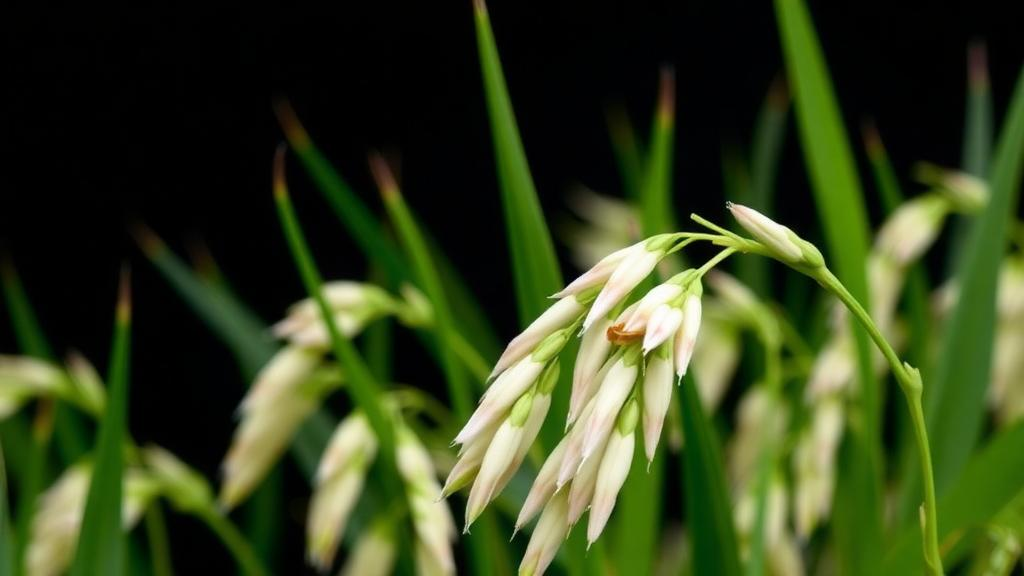
Rice feeds more people than any other staple crop, and the architecture of its grain-bearing panicle is central to how much food each plant can produce. Yet even in one of the most intensively studied crops on Earth, fundamental questions about how reproductive tissues build their photosynthetic machinery have remained unanswered. A research team led by scientists at Guangxi University in Nanning, China, has now dissected one of the strangest and most visually striking anomalies in rice biology: a natural mutant in which the panicle branches, instead of turning green, emerge ghostly white. The study, published in BMC Plant Biology, combines transcriptome and metabolome profiling to trace exactly where the greening program collapses, and the answer reveals a delicate dependency between chloroplast construction and the pigments that protect it.
The mutant, named wpb1 for white panicle branch, was identified as a natural variant in rice. Its most obvious feature is the albino coloration of the panicle branches, the slender axes that carry the developing grains. But the defect is not confined to the reproductive stage. When the researchers examined hybrid progenies carrying the mutation, seedlings segregated for the trait as well, indicating that the underlying genetic lesion interferes with chloroplast development across different tissues and life stages. That pattern of segregation in offspring is a classic signature of a recessive mutation, and it gave the team a reliable genetic handle for tracking the trait through breeding populations.
To understand what was going wrong inside the white tissue, the team turned to transmission-level phenotypic analysis of chloroplast development across defined stages. In wild-type plants, the early stages of panicle development, stages III and IV, are when proplastids, the undifferentiated precursors of chloroplasts, begin to proliferate and commit to building the internal membrane machinery of photosynthesis. In the wpb1 mutant, this proliferation was already limited. Proplastids failed to multiply and expand at the rate seen in green panicles, setting the mutant on a developmental trajectory that diverged early. The consequences became catastrophic later: by stages VI and VII, when wild-type panicle tissues are assembling mature chloroplasts with stacked thylakoid membranes, the mutant tissue showed a complete failure of thylakoid formation. Without thylakoids, there is no grana, no stroma lamellae, and no photosynthetic electron transport chain. The tissue simply cannot green.
What makes the new study more than a description of a broken chloroplast is the integrative approach the authors took. Rather than examining genes or metabolites in isolation, they profiled both simultaneously, comparing young panicles at stage III from green and white plants (samples designated G3 and W3) and again at stage VI (G6 and W6). This two-time-point design allowed them to catch the molecular cascade at the onset of phenotypic divergence and then follow it into full-blown failure. Transcriptomic sequencing revealed thousands of genes whose expression shifted between mutant and wild type, while liquid chromatography–mass spectrometry-based metabolomics captured the chemical consequences of those transcriptional changes. Orthogonal partial least squares discriminant analysis and principal component analysis separated the samples cleanly, confirming that the metabolic state of white panicle tissue is genuinely distinct rather than a subtle variation on the wild-type profile.
The pivotal finding emerged from the earliest time point. At the onset of divergence between green and white panicles, genes involved in carotenoid biosynthesis were significantly downregulated in the mutant. Carotenoids are the yellow and orange accessory pigments that do far more than add color to plant tissue. Among their roles, they perform an indispensable photoprotective function: quenching singlet oxygen and dissipating the energy of excited chlorophyll molecules before those molecules can transfer electrons to oxygen and trigger a cascade of reactive oxygen species. Lutein, one of the major xanthophyll pigments, was among the compounds affected. The loss of carotenoid biosynthesis gene expression therefore meant the developing mutant tissue was building its photosynthetic apparatus without a functioning safety net.
The consequences unfolded exactly as the photoprotection model predicts. With insufficient carotenoids to quench excited chlorophyll and singlet oxygen, the mutant’s photosynthetic apparatus suffered oxidative damage. The team observed a sustained upregulation of reactive oxygen species responses and heat shock responses in the white tissue, the molecular fingerprints of a cell under chronic photooxidative stress. Heat shock proteins are typically induced when proteins begin to misfold, and their persistent activation alongside ROS-responsive genes indicated that the white panicle tissue was mounting a desperate, and ultimately futile, defense. The authors propose a model in which the failure to quench singlet oxygen and excited chlorophyll molecules via the xanthophyll cycle ultimately blocks greening altogether: the tissue accumulates oxidative damage faster than it can assemble functional chloroplasts, and the greening program collapses before it can complete.
Beyond the photoprotection story, the metabolomic data revealed that the mutation rewires core metabolism far more broadly than the chloroplast alone. The researchers documented changes in many central metabolic pathways, including those for alanine and isoprenoids. Isoprenoid metabolism is intimately connected to the plastid because carotenoids, chlorophyll side chains, and a host of hormones and signaling molecules are all built from isoprenoid precursors. A shift in this pathway is therefore not a side effect but part of the systemic reorganization of a cell whose plastids have failed. Alanine metabolism, meanwhile, connects to nitrogen assimilation and the carbon–nitrogen balance of developing tissue, suggesting that the mutant redirects resources in ways that reflect both the loss of photosynthetic capacity and the stress state imposed by ROS accumulation.
The study also situates wpb1 within a growing family of rice albino mutants that have collectively become workhorses for chloroplast biology. The authors note that leaf and whole-panicle albinism has been extensively studied as a model for chloroplast biogenesis, with related mutants including white leaf and panicle (WLP), white stripe panicle (WSP), thermo-sensitive virescent (TSV), and thermo-sensitive chlorophyll-deficient (TCD) lines. What has been poorly understood until now is tissue-specific chloroplast development in reproductive organs, and specifically how panicle branch tissues manage photoprotection under the developmental constraints of the reproductive stage. Panicle branches face a unique environment: they develop inside and then emerge from the flag leaf sheath, experiencing rapid light transitions while carrying the crop’s yield. The wpb1 mutant demonstrates that this tissue depends on the same carotenoid-based photoprotection that guards leaves, but its failure there has distinct developmental dynamics, with proplastid defects visible as early as stage III.
For crop science, the implications run in two directions. First, the identification of a key node where wpb1 disrupts the coordination between photoprotective pigment accumulation and chloroplast development provides a molecular target for understanding, and potentially manipulating, how reproductive tissues balance light harvesting against light damage. Chlorophyll-deficient mutants are not merely curiosities; they are used in hybrid rice seed production, where seedling albinism can serve as a visible marker to identify and remove hybrid offspring, and understanding the genetic basis of such traits makes them easier to deploy or eliminate deliberately. Second, the study adds to the evidence that photoprotection is not an optional accessory to chloroplast biogenesis but a prerequisite for it. A chloroplast that assembles its light-harvesting machinery without carotenoid shielding destroys itself in the process, a lesson that applies well beyond rice.
The work, supported by the Guangxi Natural Science Foundation and other regional and national programs, exemplifies the power of multi-omics approaches to resolve complex developmental phenotypes. By pairing a precise phenotypic timeline with matched transcriptomic and metabolomic snapshots, the team transformed a puzzling white panicle into a coherent mechanistic narrative: a genetic lesion suppresses carotenoid biosynthesis, photoprotection fails, singlet oxygen accumulates, thylakoid assembly never completes, and the tissue remains white. As the authors conclude, the findings identify a key regulatory node where pigment accumulation and chloroplast development must be coordinated, offering new insights into the genetic regulation of photosynthesis in rice panicle branches and a valuable resource for anyone seeking to engineer more resilient photosynthetic tissue in the world’s most important grain crop.
Subject of Research: Genetic and molecular mechanisms of chloroplast biogenesis failure and photoprotection loss in albino rice panicle branches
Article Title: Integrative transcriptome and metabolome analyses to uncover rice panicle branch albinism
Article References: Cai, Z., Ahmad, S., Jin, G., Shen, Y., Zhao, H., Chen, Y., Fan, Y., Zhang, Y., Xiao, B., Wang, Q., Qiu, Y., & Yang, J. (2026). Integrative transcriptome and metabolome analyses to uncover rice panicle branch albinism. BMC Plant Biology. https://doi.org/10.1186/s12870-026-09929-1
Image Credits: AI Generated
DOI: 10.1186/s12870-026-09929-1
Keywords: rice, panicle albinism, wpb1, chloroplast biogenesis, carotenoids, xanthophyll cycle, reactive oxygen species, transcriptomics, metabolomics, thylakoid formation, photoprotection, lutein
Cite Scienmag News
Alan Morgan. (October 10, 2026). Why Some Rice Panicles Turn White: A Single Genetic Fault Disrupts Chlorophyll’s Protective Shield. Scienmag. https://scienmag.com/why-some-rice-panicles-turn-white-a-single-genetic-fault-disrupts-chlorophylls-protective-shield/
Alan Morgan. "Why Some Rice Panicles Turn White: A Single Genetic Fault Disrupts Chlorophyll’s Protective Shield." Scienmag, 10 October 2026, https://scienmag.com/why-some-rice-panicles-turn-white-a-single-genetic-fault-disrupts-chlorophylls-protective-shield/. Accessed 10 October 2026.
Alan Morgan. "Why Some Rice Panicles Turn White: A Single Genetic Fault Disrupts Chlorophyll’s Protective Shield." Scienmag. October 10, 2026. https://scienmag.com/why-some-rice-panicles-turn-white-a-single-genetic-fault-disrupts-chlorophylls-protective-shield/


