


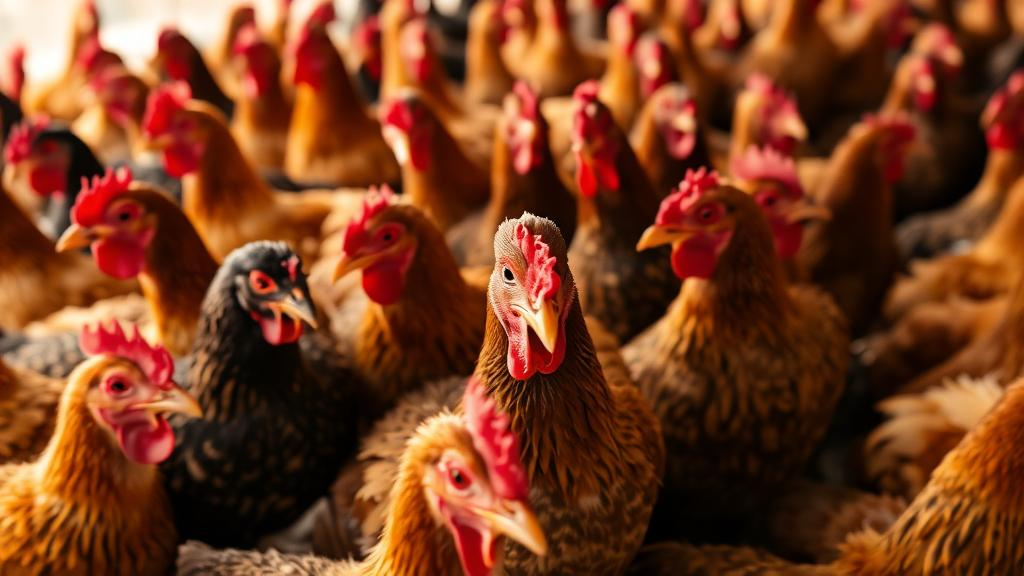
Inside a commercial laying-hen house, thousands of birds move across the floor in a shifting, chaotic mass. To a human observer, trouble announces itself in vague ways: a sudden burst of frantic running, a lethargic stillness, or a dangerous clumping of bodies into one corner that can end in fatal smothering. Traditional computer-vision systems have tried to catch these events by tracking individual birds, but in a densely packed barn the cameras see mostly overlapping bodies. Occlusion is pervasive, identities swap constantly, and the low-resolution CCTV that farms actually deploy makes precise detection nearly impossible. A new study published in Smart Agricultural Technology proposes a radically different approach: stop trying to follow individual hens altogether, and instead monitor the flock as a single collective organism.
The research, led by Dongjin Lee and colleagues at Hanbat National University in collaboration with the Electronics and Telecommunications Research Institute, arrives at a moment when the stakes for poultry welfare have never been higher. According to the OECD-FAO Agricultural Outlook 2025–2034, global poultry consumption is projected to reach 173 million tons by 2034, accounting for roughly 45 percent of total meat-protein consumption. Production has grown by approximately 1,456 percent between 1961 and 2022, making poultry one of the fastest-expanding livestock sectors on the planet. That intensification has come at a cost. Decades of selective breeding have quadrupled the growth rate of modern commercial chickens while altering their behavior, and high-density rearing means birds spend much of their time sitting, with activity declining further as body weight and age increase. Reduced activity raises the risk of lameness and footpad dermatitis, conditions linked to negative emotional states in the animals.
The core insight of the new framework is that the most biologically and economically meaningful events in a hen house are visible at the flock level, not the individual level. The researchers operationalize the flock’s behavioral status into four categories: Normal-Active, Normal-Resting, Abnormal-Activity, and Abnormal-Crowding. Healthy hens are naturally busy animals, devoting roughly 60 percent of their active time to foraging and feeding, and even exhibiting contrafreeloading, the instinct to search for food even when it is freely available. Resting, by contrast, is an essential physiological process that conserves energy and supports memory consolidation. Abnormal-Activity covers erratic movement, collisions, and escape behaviors triggered by stressors ranging from wild-animal intrusion to disease or heat stress. Abnormal-Crowding, the most dangerous category, includes the poorly understood mass-aggregation events known as smothering or piling, which can kill large numbers of birds through crushing.
What makes the system practical is that it requires no manual labeling at all. Conventional supervised models would need domain experts to painstakingly annotate video frames, a process that is costly, slow, and inherently subjective when judging continuous flock movement. Instead, the team extracts two macroscopic statistics from each video sequence: overall activity, computed as the mean percentage of foreground pixels identified by a Mixture-of-Gaussians background-subtraction model, and crowd density, measured as the spatial imbalance of foreground pixels across a three-by-three grid overlaid on the accumulated foreground map. These two numbers, activity and crowding imbalance, are then modeled as a bivariate joint distribution across the entire dataset.
The statistical machinery at the heart of the pseudo-labeling step is elegant in its simplicity. Because activity and density are inherently correlated, active flocks tend to disperse while resting flocks tend to aggregate, the researchers fit the empirical mean and covariance of the two features and use the squared Mahalanobis distance to measure how far each sequence sits from the bulk of routine behavior. A Mahalanobis radius of one defines a central confidence ellipse containing the normal bulk of the distribution, while a univariate cutoff on the crowding feature flags Abnormal-Crowding first. Points beyond the ellipse split by their activity level into Abnormal-Activity or Normal-Resting, and everything inside the ellipse is labeled Normal-Active. The result is a fully automated, deterministic classification of every video sequence into one of the four behavioral states, with no human in the loop.
These statistical pseudo-labels then supervise a semi-supervised anomaly detector built on a Spatio-Temporal Autoencoder, or STAE, constructed from Convolutional LSTM layers. The architecture choice matters. Purely spatial autoencoders capture structural density but miss the temporal dynamics of sudden panic and erratic escape behavior, while models that flatten the spatial dimension lose the distribution cues critical for detecting crowding. The STAE jointly models spatial distributions and inter-frame kinetic dynamics within a single encoder-decoder: stacked 2D convolutions extract per-frame spatial features, ConvLSTM layers preserve those spatial dimensions while modeling temporal transitions, and a symmetric decoder reconstructs the input sequence. Trained exclusively on sequences pseudo-labeled as normal, the network learns to reconstruct routine flock patterns with high fidelity, on the hypothesis that departures from routine will produce larger reconstruction errors.
The experimental evaluation drew on a real commercial poultry-farm archive of 1,869 valid video contact sheets, recorded at 640 by 360 pixels and spanning an aggregate sampling duration of more than 2,400 hours, with 76.7 percent of sheets captured during daytime. The test set was deliberately balanced at 50 percent anomaly prevalence, comprising all 396 abnormal sequences and an equal number of randomly sampled normal ones. On raw RGB input, the proposed STAE achieved the highest observed area under the receiver operating characteristic curve, 0.8442, with an average precision of 0.8585 and an F1-score of 0.8090 at the test-set oracle threshold. It edged out a 2D CNN autoencoder at 0.8419 and outperformed sequential baselines including a CRNN, a spatio-temporal transformer, and a 3D CNN, as well as classic methods like Isolation Forest and One-Class SVM.
The ablation studies delivered some of the most instructive findings. When the input was converted to grayscale, the best-performing architecture shifted from the spatio-temporal STAE to a purely spatial CNN-2D, and AUROC dropped substantially to 0.7544. Adding contrast-limited histogram equalization and Gaussian smoothing degraded performance further, to near-chance levels around 0.53. The interpretation is that rich color cues help spatio-temporal models track fine-grained dynamic correspondences across consecutive frames, and discarding them leaves temporal models with little advantage over spatial ones. Notably, the preprocessing pipeline used for pseudo-labeling, including grayscale conversion and CLAHE, is applied only to generate robust statistical labels; the deep model itself trains on raw RGB frames to preserve fine-grained spatio-temporal semantics. Sensitivity analyses showed that although perturbing the pseudo-labeling parameters changed label agreement substantially, with Cohen’s kappa values ranging from 0.358 to 0.949, the downstream AUROC varied only modestly, between minus 0.0024 and plus 0.0026.
The authors are refreshingly candid about the limits of their results. The reported performance measures consistency with the proposed statistical labeling scheme, not agreement with expert-verified biological ground truth, and the reconstruction-error signal is a detection hypothesis rather than a guarantee that every abnormal event reconstructs poorly. The evaluation used data from a single commercial farm, leaving generalization across layouts, lighting, and camera angles untested, and the balanced test prevalence does not reflect real farm conditions, where anomalies are rare. At the exact oracle threshold, 20.45 percent of normal sheets were flagged as false positives while recall on abnormal sheets reached 81.82 percent, figures that would translate very differently under deployment prevalence. The team also notes that macroscopic indicators may mask micro-level anomalies such as localized feather pecking or individual lethargy from early-stage disease.
Even so, the deployment economics are compelling. The benchmarked model, with roughly 7.3 million parameters, processes a 42-frame contact sheet in about 26 milliseconds of combined preprocessing and GPU inference on consumer hardware, an estimated 38 sheets per second, though the authors caution this is not a measured end-to-end latency. Because the framework is trajectory-free, it removes the need for high-performance object detection and tracking models in large-scale houses, lowering both deployment and operational cost on the low-resolution CCTV that farms already own. The proposed operator workflow presents raw frames, reconstructions, heatmaps, and temporal scores together, requiring persistence across multiple sampled frames before escalation, with known static-structure regions masked to reduce false alarms. Future work will pursue adaptive self-calibrating pseudo-labeling, expert-verified annotations to anchor the statistical labels, multi-environment datasets, and fusion with acoustic and thermal sensors. If those steps succeed, the humble barn camera could become a genuine early-warning system for the welfare of billions of birds.
Subject of Research: Semi-supervised anomaly detection for flock-level welfare monitoring in dense poultry farming
Article Title: Trajectory-free hen flock monitoring using a statistical semi-supervised anomaly detection framework
Article References: Lee, D., Song, S., Yi, H., & Lee, S. (2026). Trajectory-free hen flock monitoring using a statistical semi-supervised anomaly detection framework. Smart Agricultural Technology, 15, Article 102598. https://doi.org/10.1016/j.atech.2026.102598
Image Credits: AI Generated
DOI: Not provided
Keywords: poultry welfare, anomaly detection, computer vision, semi-supervised learning, autoencoder, ConvLSTM, precision livestock farming, pseudo-labeling, Mahalanobis distance, smothering, animal behavior, smart agriculture
Cite Scienmag News
William Thompson. (October 10, 2026). AI Watches the Whole Flock: Trajectory-Free Anomaly Detection for Dense Hen Houses. Scienmag. https://scienmag.com/ai-watches-the-whole-flock-trajectory-free-anomaly-detection-for-dense-hen-houses/
William Thompson. "AI Watches the Whole Flock: Trajectory-Free Anomaly Detection for Dense Hen Houses." Scienmag, 10 October 2026, https://scienmag.com/ai-watches-the-whole-flock-trajectory-free-anomaly-detection-for-dense-hen-houses/. Accessed 10 October 2026.
William Thompson. "AI Watches the Whole Flock: Trajectory-Free Anomaly Detection for Dense Hen Houses." Scienmag. October 10, 2026. https://scienmag.com/ai-watches-the-whole-flock-trajectory-free-anomaly-detection-for-dense-hen-houses/


