


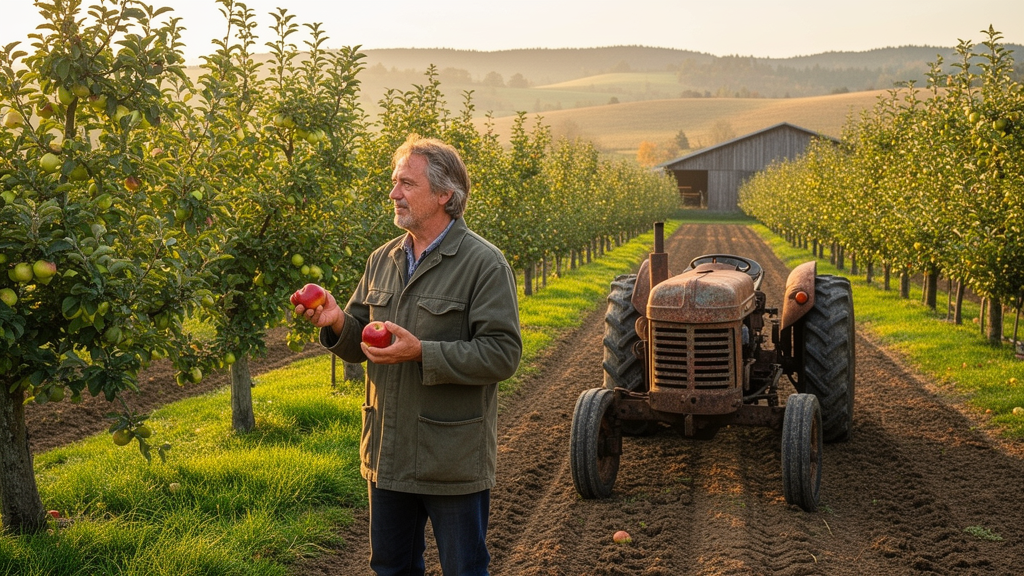
In the steep Himalayan valleys of Jammu and Kashmir, where apple orchards have shaped both the landscape and the livelihoods of generations of farming families, a quiet revolution is underway. Traditional seedling-based orchards, some decades old and sprawling across hillsides, are gradually giving way to compact, high-density plantations that promise earlier returns, better fruit and more efficient use of scarce land and labour. But why do some growers make the leap while others hesitate? A new study published in Discover Sustainability by Imran Ul Amin and colleagues at the Islamic University of Science and Technology, together with Showkat Ahmad Bhat of Symbiosis School of Economics, offers one of the most systematic answers yet, using a well-established psychological framework borrowed from consumer behaviour research to dissect the anatomy of agricultural change.
The research applies the Push-Pull-Mooring framework, a model originally developed to explain why consumers switch service providers, to a setting far removed from mobile phone plans or banking apps: capital-intensive, perennial horticulture in a mountain economy. The framework posits that a person’s decision to abandon an existing practice for a new one is driven by three interacting sets of forces. Push factors are the dissatisfactions that make the status quo untenable. Pull factors are the attractions that make the alternative appealing. Mooring factors are the anchors, both personal and structural, that hold people in place or ease their transition. What makes this application particularly compelling is that switching apple production systems is not a casual decision; an orchard represents a multi-year, often multi-generational investment, and a wrong choice can burden a family for a decade or more.
To capture these dynamics empirically, the team designed a structured questionnaire and administered it to 275 apple growers across Jammu and Kashmir, one of India’s most important apple-producing regions. The study employed a cross-sectional research design with two-stage purposive and judgmental sampling, a strategy appropriate for reaching growers who vary in their exposure to and experience with high-density systems. The researchers then analysed the data using Partial Least Squares Structural Equation Modelling, or PLS-SEM, a statistical technique well suited to testing complex networks of relationships between latent psychological constructs, including the mediating pathways the model proposed. All computations were carried out in Smart PLS, allowing the team to estimate both the direct effects of push, pull and mooring factors and their indirect effects transmitted through behavioural intention.
The results carry a striking headline finding: the push factors, the dissatisfactions with conventional orchards, exert the most significant influence on growers’ intention to switch. These dissatisfactions are concrete and accumulating. Traditional orchards deliver low yields per unit of land, produce fruit of poorer and less uniform quality, demand intensive labour across large canopies, impose long gestation periods before trees bear marketable fruit, and expose growers to escalating risks posed by a changing climate. In other words, the study suggests that the engine of agricultural modernisation in this region is not primarily the allure of the new, but the growing untenability of the old. Farmers are being pushed out of their traditional systems by pain, not merely lured by promise.
That said, the pull factors matter considerably as well. The expected yield gains of high-density systems, the prospect of premium prices for higher-quality fruit, labour efficiency from smaller, more manageable trees, early bearing that shortens the wait for returns, and supportive policy incentives all significantly increase growers’ adoption intention. High-density orchards, which plant dwarfing rootstocks at far closer spacing than traditional seedling trees, can transform the economics of apple farming: more tonnes per hectare, earlier first harvests, easier spraying and pruning, and fruit that meets the quality standards demanded by modern markets. The study’s confirmation that these benefits register strongly in growers’ minds underscores that the technology itself, when well communicated, carries genuine persuasive power.
Between the push and the pull sits the mooring, and here the study reveals the friction in the system. Behavioural inertia, the deep-rooted habit of farming as one’s parents and neighbours farmed, conditions the switching process. So do more tangible constraints: access to inputs such as quality planting material and fertilisers, access to training in the new agronomic techniques that high-density systems demand, and perceptions of financial risk, which loom large given the substantial upfront investment these orchards require. The expected yield gains themselves also condition the switching process, acting as a bridge between aspiration and action. These findings suggest that even when farmers are dissatisfied with the old and enthusiastic about the new, they may remain anchored unless the practical supports for transition are in place.
One of the study’s most important structural findings concerns the role of behavioural intention as a mediator. Push, pull and mooring forces do not act on actual behaviour directly; instead, their effects flow through intention, which in turn is a good predictor of actual use behaviour. This mediating architecture has practical implications. It means that interventions aimed at changing farmer behaviour, whether subsidies, demonstration plots, or extension programmes, work by reshaping intentions, and that understanding and measuring intention is a legitimate and informative proxy for tracking the progress of agricultural modernisation. It also means that policies which address only one side of the equation, for instance by offering incentives without relieving the dissatisfactions of the old system, or by highlighting benefits without removing mooring constraints, may underperform.
In terms of explanatory power, the model accounts for 51 per cent of the variation in behavioural intention and 23 per cent of the variation in use behaviour. The authors characterise this as moderate explanatory relevance for intention and modest relevance for actual behaviour, an honest assessment that reflects the realities of studying human decisions in complex, real-world settings. Intention, after all, is easier to predict than action, particularly when action depends on credit availability, weather, market fluctuations and family circumstances that no psychological model can fully capture. Still, explaining half of the variance in a behavioural intention within a heterogeneous farming population is a substantial achievement, and the 23 per cent explained for use behaviour provides a meaningful foothold for policy design.
The context of the study gives its findings particular weight. The Indian Himalayan region faces a convergence of pressures: shrinking landholdings, ageing orchards, water stress, erratic weather and the steady encroachment of climate change on a crop that defines the regional economy. Apple cultivation in Jammu and Kashmir supports hundreds of thousands of households, and the transition to high-density systems is widely seen as central to keeping the industry viable. Yet the transition is capital-intensive in a region where credit access can be uneven, and it demands new knowledge, from canopy management to rootstock selection, that traditional extension systems have struggled to deliver at scale. By quantifying which forces actually move growers, the study offers mountain economies a diagnostic tool for accelerating modernisation without wasting resources on interventions that behavioural evidence does not support.
For policymakers, the message is a three-part prescription grounded in the data. First, amplify and validate the push: help growers accurately assess the declining productivity and rising risk of their conventional orchards, so that dissatisfaction is grounded in evidence rather than rumour. Second, strengthen the pull: ensure that the demonstrated yield gains, premium market access, early returns and policy incentives of high-density systems are visible, credible and locally attested. Third, and perhaps most critically, cut the moorings: expand access to affordable finance, certified planting material and hands-on training, and design programmes that acknowledge and work with behavioural inertia rather than ignoring it. As the authors note, their findings provide context-specific insights for Himalayan apple-growing regions, but the framework they deploy, and the lesson that switching is a system of forces rather than a single decision, should resonate with anyone working to modernise agriculture in mountain economies around the world.
Subject of Research: Behavioural drivers of apple growers' adoption of high-density sustainable farming systems in the Indian Himalayan region
Article Title: Exploring apple growers’ switching behaviour towards high-density sustainable farming using the push-pull-mooring framework
Article References: Amin, I. U., Bhat, S. A., Seher, N., & Shafi, S. I. (2026). Exploring apple growers’ switching behaviour towards high-density sustainable farming using the push-pull-mooring framework. Discover Sustainability. https://doi.org/10.1007/s43621-026-04856-5
Image Credits: AI Generated
DOI: 10.1007/s43621-026-04856-5
Keywords: high-density apple systems, push-pull-mooring framework, behavioural intention, technology adoption, agricultural modernisation, mountain agriculture, PLS-SEM, Jammu and Kashmir, sustainable farming, apple growers, switching behaviour, climate risk
Cite Scienmag News
Alan Morgan. (October 19, 2026). Why Apple Farmers Switch: New Study Decodes the Push, Pull and Anchors of Sustainable Orchard Change. Scienmag. https://scienmag.com/why-apple-farmers-switch-new-study-decodes-the-push-pull-and-anchors-of-sustainable-orchard-change/
Alan Morgan. "Why Apple Farmers Switch: New Study Decodes the Push, Pull and Anchors of Sustainable Orchard Change." Scienmag, 19 October 2026, https://scienmag.com/why-apple-farmers-switch-new-study-decodes-the-push-pull-and-anchors-of-sustainable-orchard-change/. Accessed 19 October 2026.
Alan Morgan. "Why Apple Farmers Switch: New Study Decodes the Push, Pull and Anchors of Sustainable Orchard Change." Scienmag. October 19, 2026. https://scienmag.com/why-apple-farmers-switch-new-study-decodes-the-push-pull-and-anchors-of-sustainable-orchard-change/


