


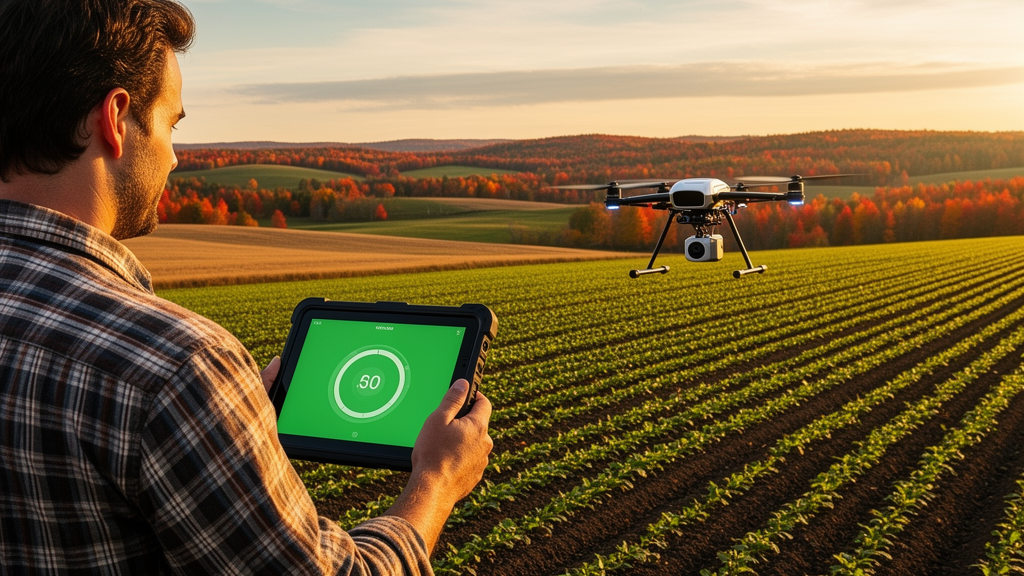
Digital agriculture could transform how Quebec’s farms meet sustainability goals, but a new systematic review finds the province is tapping barely half of the technology’s potential. The study, published in the journal Discover Sustainability, catalogued 14 categories of digital technologies already in use or under investigation across Quebec’s agricultural sector and concluded that, while the tools could be combined in 65 distinct ways to advance sustainable development, only 54 percent of that potential is currently being exploited. The finding turns a familiar narrative on its head: the problem is not a shortage of promising technology, but a shortage of deployment, integration, and understanding of why farmers adopt or reject the tools in the first place.
The research team, led by Sambiani D. Y. Tindjiete and Terence Epule Epule of the Institut de Recherche en Agriculture et Agroalimentaire at the Université du Québec en Abitibi-Témiscamingue, with colleagues from the University of Seychelles, the Université du Québec à Montréal, and the Institut National de la Recherche Scientifique, applied a systematic tracking approach to map where digital technologies intersect with Quebec agriculture. The team screened and analyzed a total of 59 peer-reviewed publications and grey literature reports, a corpus spanning everything from government agency assessments to industry reports. Rather than testing a single tool in a single field, the review took an inventory: which technologies exist in the province, where the scientific attention is concentrated, and which combinations of tools could, in principle, support the province’s sustainable development objectives.
The stocktake documented 14 categories of digital technologies operating within Quebec’s agricultural sector. But the scientific literature is far from evenly distributed across them. Three dominant categories absorbed most of the research attention: web and mobile applications and software accounted for 31 percent of the documented representation, machine learning and sensors for 14 percent, and satellite technologies for 13 percent. That concentration matters, because it signals where innovation energy and funding have flowed, and, by extension, which corners of the digital agriculture landscape remain underexplored. Technologies that could be transformative but attract little research attention risk remaining stuck in pilot-project purgatory, never reaching the farm gate at scale.
What can these technologies actually do for sustainability? The review identified significant potential across five fronts. Digital tools can improve pesticide monitoring, allowing farmers and regulators to track and reduce chemical inputs with greater precision. They can support soil health assessment and conservation, using sensor networks and remote sensing to detect degradation before it becomes irreversible. They can optimize fertilizer management, matching nutrient application to crop need rather than blanket schedules that waste money and leak nitrogen and phosphorus into waterways. They can improve water-use efficiency, an increasingly urgent capability as climate change reshapes precipitation patterns across the province. And they can contribute to biodiversity conservation, for example by mapping habitats and monitoring the ecological footprint of farming practices.
The 65 distinct combinations figure is the study’s most striking quantitative result. The researchers systematically assessed how the 14 technology categories could be paired and grouped to support sustainable development objectives, arriving at 65 possible configurations. If only 54 percent of that potential is currently being exploited, nearly half of the plausible ways digital agriculture could serve sustainability in Quebec remain unrealized. Some of those unexploited combinations likely involve integrating mature tools, such as coupling satellite imagery with machine learning models to predict pest outbreaks, or linking soil sensors with mobile decision-support applications that translate raw data into actionable recommendations. Others may involve technologies that are documented but rarely deployed in combination with anything else, isolated by cost, complexity, or lack of institutional support.
The study, funded through Quebec’s Fonds de recherche du Québec—Société et culture under the Pan-Québec Economic Impacts of Climate Change on Agriculture and Adaptation project, arrives at a moment when the province’s agricultural sector faces intensifying pressure. Climate change is altering growing seasons, pest dynamics, and water availability, while Quebec has made sustainable development a stated priority for its agricultural sector. Digital agriculture, the authors argue, is an important component of sustainable agricultural systems and a promising pathway toward achieving sustainable development goals. But promise and practice are separated by a chasm of practical barriers, and the review’s most important contribution may be its diagnosis of where those barriers lie.
That diagnosis points squarely at the social dimensions of technology adoption. The review reveals important knowledge gaps, particularly regarding the social factors influencing the diffusion and adoption of digital technologies in agriculture. A limited understanding of the factors affecting Quebec farmers’ adoption decisions remains, in the authors’ assessment, a major barrier to maximizing the benefits of digital agriculture. This is a deceptively simple point with profound implications. A sensor that measures soil moisture with laboratory-grade accuracy is worthless if the farmer who owns it does not trust the readings, cannot integrate them into existing workflows, or finds the subscription cost unjustified at current commodity prices. Adoption research has long shown that technology uptake in agriculture depends on cost, perceived usefulness, technical literacy, age, farm size, land tenure, and trust in the institutions promoting the tools, yet the review found these behavioral dimensions underexplored in the Quebec context.
The gap is especially consequential because Quebec agriculture is structurally distinct. The province’s farm sector includes large grain operations in the St. Lawrence valley, dairy farms, and a maple syrup industry of global significance, alongside smaller and diversified operations. The review’s partners, which included La Financière Agricole du Québec, the Producteurs et Productrices de Grains du Québec, Quebec’s maple syrup producers, and the provincial agriculture ministry MAPAQ, reflect that institutional landscape. Technologies that work for a thousand-hectare grain operation may not translate to a mid-sized dairy farm or a sugarbush, and the review suggests that the social and behavioral research needed to understand those differences has not kept pace with the technical research documenting what the tools can do.
The authors argue that addressing these social and behavioral dimensions will be essential for accelerating the transition toward more sustainable, digitally enabled agricultural systems in Quebec. In practical terms, that means research programs that treat farmer decision-making as seriously as they treat sensor calibration, extension services that build trust and technical capacity, and policy frameworks that lower the financial and cognitive barriers to adoption. It also means studying the full diffusion pathway, from initial awareness through trial, adoption, and sustained use, rather than celebrating pilot projects that never scale. The review’s systematic approach, tracking both the technologies and the literature that describes them, provides a baseline against which future progress can be measured.
The broader lesson extends well beyond Quebec. Jurisdictions worldwide are investing heavily in precision agriculture, smart farming, and agricultural artificial intelligence, often with the implicit assumption that technology deployment automatically produces sustainability outcomes. This stocktake suggests otherwise: the binding constraint is frequently not the technology itself but the human systems surrounding it. With 14 technology categories documented, 65 potential sustainability combinations identified, and only 54 percent of that potential exploited, Quebec offers a quantified case study of the gap between what digital agriculture could achieve and what it currently does. Closing that gap, the review makes clear, will require as much investment in understanding farmers as in building tools for them.
Subject of Research: A stocktake of opportunities and knowledge gaps in advancing digital agriculture in Quebec
Article Title: A stocktake of opportunities and knowledge gaps in advancing digital agriculture in Quebec
Article References: Tindjiete, S. D. Y., Epule, T. E., Etongo, D., Peng, C., & Célicourt, P. (2026). A stocktake of opportunities and knowledge gaps in advancing digital agriculture in Quebec. Discover Sustainability. https://doi.org/10.1007/s43621-026-04697-2
Image Credits: AI Generated
DOI: 10.1007/s43621-026-04697-2
Keywords: digital agriculture, precision agriculture, smart farming, Quebec, sustainable development, machine learning, satellite technologies, technology adoption, soil health, agricultural sustainability, stocktake, opportunities
Cite Scienmag News
Alan Morgan. (October 19, 2026). Digital Agriculture in Quebec: Huge Potential, Only Half Exploited. Scienmag. https://scienmag.com/digital-agriculture-in-quebec-huge-potential-only-half-exploited/
Alan Morgan. "Digital Agriculture in Quebec: Huge Potential, Only Half Exploited." Scienmag, 19 October 2026, https://scienmag.com/digital-agriculture-in-quebec-huge-potential-only-half-exploited/. Accessed 19 October 2026.
Alan Morgan. "Digital Agriculture in Quebec: Huge Potential, Only Half Exploited." Scienmag. October 19, 2026. https://scienmag.com/digital-agriculture-in-quebec-huge-potential-only-half-exploited/


