

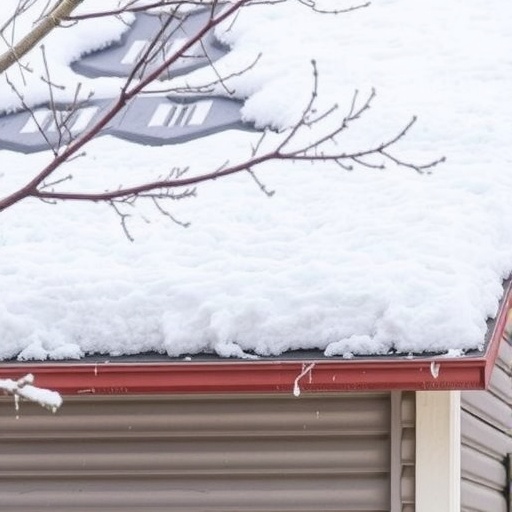
In the intricate realm of winter physics, snow accumulation on structures is a phenomenon far more complex than it appears at first glance. Recent research from the Harbin Institute of Technology in China has unveiled groundbreaking insights into how the natural diversity in snowflake sizes dramatically influences the way snow gathers on rooftops. This new study, published in the prominent journal Physics of Fluids, overturns longstanding assumptions that have dominated engineering models—models that, until now, treated snow as a homogeneous material composed of uniformly sized particles.
The genesis of this research stems from the critical importance of accurately predicting snow loads in cold climate structural design. Traditionally, engineers have relied on simplified models where snow is considered a uniform layer, ignoring the intricate variations in snowflake size and distribution that occur in nature. These simplifications have significant consequences: misestimations of snow accumulation can lead to underestimated structural loads, increasing the risk of ice damming, roof collapse, or other hazardous failures under heavy snowfall.
The Harbin research team approached this problem by integrating the natural heterogeneity of snow into a detailed numerical model that considers particle size distribution, wind dynamics, and turbulence. Through wind tunnel experiments employing silica particles that mimic the physical properties of snowflakes, researchers were able to validate their computational simulations. The results were revelatory and pointed to a nuanced interplay between particle size, wind speed, and roof geometry that dictates snow accumulation patterns far more accurately than prior models.
A particularly striking finding is that larger snow particles tend to accumulate more readily on rooftops than smaller ones. This occurs because the increased mass and surface area of bigger particles grant them greater inertia, enabling them to resist aerodynamic forces and settle more effectively despite turbulent wind conditions. Conversely, smaller snow particles are more susceptible to being carried away or redistributed by wind, leading to less accumulation. This effect is profoundly magnified under higher wind velocities, revealing a complex dependency that engineers must incorporate for precise load assessments.
Moreover, the study reveals the significant effect of roof size and shape in snow accumulation behavior. Contrary to expectations, larger roofs offer more storage capacity for snow particles, resulting in increased snow depths in certain wind and particle size scenarios. Intriguingly, this phenomenon is particularly pronounced for snow particles averaging around 0.5 millimeters in diameter—an insight that could guide architectural choices and snow load calculations for expansive structures.
Replication of realistic snowfall patterns in computational models traditionally requires simulating a vast array of particle sizes, a process that is computationally intensive and prohibitive for routine engineering tasks. To overcome this, the researchers propose using the arithmetic mean equivalent diameter for a composite snow particle size distribution. This simplification retains the accuracy of model predictions while drastically reducing computational demands, opening the door for widespread practical adoption in structural safety assessments.
The authors caution that while the core principles governing the influence of particle size and wind on snow deposition have wide applicability, variations in roof geometry—whether flat, sloped, or curved—introduce additional complexity. Future research aims to explore these geometries in depth, targeting the increasingly modern and intricate architectural designs emerging globally. The goal is to refine prediction tools to support resilient infrastructure in the face of extreme winter weather.
This research stands as a critical advance that merges fundamental fluid dynamics with practical engineering needs. It underscores the vital necessity of incorporating physical heterogeneity—previously neglected in simplified models—into the study of snow transport and deposition phenomena. By doing so, it offers a more realistic and physically faithful representation of snow behavior, paving the way for safer buildings and more informed urban planning.
In essence, this work represents a paradigm shift for cold region engineering, offering a new lens through which to view snow load challenges. The arithmetic mean equivalent diameter metric developed promises to become a key methodological tool, enabling engineers and scientists to balance accuracy with efficiency in their simulations. Such tools are indispensable as the realities of climate variability demand ever more precise and robust infrastructure design.
The implications of this study extend beyond structural engineering. Understanding how particle size affects deposition patterns also has wider relevance in atmospheric science and climatology, particularly in modeling snowpack dynamics and regional hydrology. Each snow crystal’s journey and final resting place on a rooftop tells a broader story about energy exchanges and weather system interactions, underscoring the interconnectedness of microscale physics and large-scale environmental phenomena.
As this research progresses and integrates with evolving architectural practices, policymakers and standards organizations will find it invaluable for updating building codes. The ability to more reliably anticipate snow loads not only prevents structural failures but also optimizes resource allocation, reduces maintenance costs, and enhances public safety amid the increasing unpredictability of winter weather patterns worldwide.
In sum, the work by Qingwen Zhang and colleagues marks a crucial step toward reimagining snow accumulation modeling. It champions the inclusion of natural heterogeneity and dynamic environmental factors, illuminating paths for interdisciplinary collaboration in physics, engineering, and atmospheric sciences. This breakthrough provides the foundation for revolutionary advances that will safeguard our built environment against the nuanced whims of winter.
Subject of Research: Snow accumulation on roofs considering snowflake size and wind effects
Article Title: From transport to deposition: Mapping snow distribution under the particle size effects
News Publication Date: March 10, 2026
Web References:
- DOI link: 10.1063/5.0313684
- Journal: Physics of Fluids
Image Credits: Yu et al.
Keywords: Snow, Snow accumulation, Particle size effects, Roof load, Fluid dynamics, Wind turbulence, Structural safety, Snow deposition modeling, Atmospheric physics


