


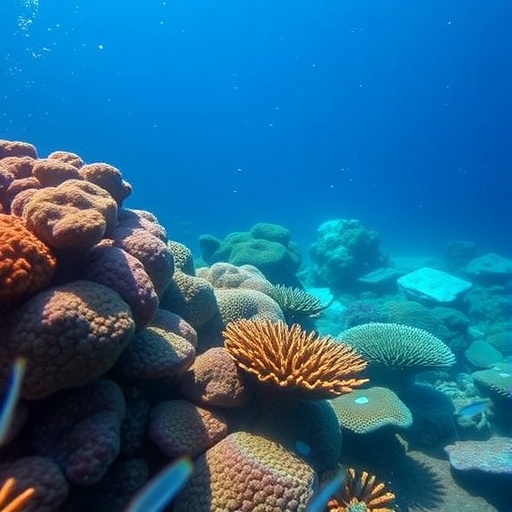
In the face of escalating global temperatures and the rapid bleaching of coral reefs worldwide, new research underscores an urgent call for the acceleration of coral assisted evolution initiatives. This innovative scientific approach aims to enhance corals’ thermal tolerance, arming these vital marine ecosystems with an improved ability to withstand unprecedented marine heatwaves intensified by climate change. Despite promising advancements in understanding coral biology, researchers warn that current rates of development and application fall significantly short of the pace required to combat the accelerating threat.
The groundbreaking study, collaboratively led by Dr. Adriana Humanes of Newcastle University and Dr. Juan Ortiz from the Australian Institute of Marine Science, was published on March 30, 2026, in the esteemed journal Nature Reviews Biodiversity. It brings together insights from 28 leading experts in marine science who collectively highlight the pressing need to transform coral research methodologies. Their evaluation indicates that while assisted evolution presents a beacon of hope, the biological complexities and environmental unpredictability surrounding coral ecosystems require an unprecedented research velocity coupled with strategic implementation to be viable.
Coral assisted evolution revolves around artificially accelerating the natural selection processes that enable coral species to adapt to rising sea temperatures. This method involves selective breeding of corals exhibiting naturally higher heat tolerance, followed by their propagation in controlled or semi-controlled ocean nursery environments. Recent decades have witnessed vital breakthroughs, particularly in elucidating genetic and epigenetic mechanisms that confer heat resilience, yet the translation of these discoveries into scalable interventions remains sluggish compared to the rapidly intensifying oceanic thermal stress.
The core challenge hampering progress is the presence of critical knowledge gaps in coral heat tolerance biology. Understanding the multifaceted genomic adaptations, symbiotic relationships with algae, and microbiome dynamics that collectively influence coral survival during heat stress events is essential. Dr. Ortiz emphasizes that these biological insights are fundamental prerequisites to designing interventions that yield sustainable and transgenerational benefits. Without closing these gaps, efforts risk producing ephemeral solutions that might falter under real-world environmental variability.
To surmount these challenges, the study proposes a comprehensive research agenda centered on nine priority areas poised to catalyze accelerated knowledge generation. Fundamental among these is the imperative to scale up large-scale, field-based experimental platforms. Dr. James Guest from Newcastle University stresses the significance of establishing sprawling experimental hubs in natural reef environments. Such hubs enable simultaneous, multidisciplinary investigations across diverse coral species and life stages, dramatically increasing experimental throughput and ecological relevance. This approach contrasts with conventional laboratory-bound studies that often fail to capture the dynamic oceanic conditions influencing coral resilience.
Long-term and aligned funding mechanisms form the second pillar of the research acceleration strategy. Corals possess intricate life cycles spanning multiple years before reaching reproductive maturity, a temporal scale mismatched by typical research grants that commonly extend for only three annual cycles. Dr. Ortiz highlights this misalignment, arguing that multi-generational studies are indispensable to ascertain whether heightened thermal tolerance observed in initial generations translates into lasting evolutionary advantages. Secure, sustained funding over extended periods would enable researchers to monitor progeny performance and ecological integration under fluctuating environmental pressures.
The third cornerstone recommendation involves the protection and strategic management of experimental coral hubs against extreme climatic perturbations such as storms and marine heatwaves. These field sites harbor live colonies critical for iterative experimentation and genetic stock conservation. Dr. Humanes articulates that losing these stocks to unforeseen disturbances would not only squander substantial financial investments but also undermine the continuity and cumulative knowledge central to achieving breakthrough innovations. Protective measures might include relocating coral specimens to deeper waters during storms or employing geoengineering techniques like cloud brightening during acute thermal events.
Addressing these overarching challenges is crucial as coral reefs continue to suffer from the compounded impacts of anthropogenic climate change, ocean acidification, and widespread pollution. Successfully accelerating coral assisted evolution requires coordinated global efforts that integrate ecological science, cutting-edge genomics, and adaptive management strategies. The scientific consortium behind this research posits that only through a concerted, multi-pronged approach can coral reefs—essential to marine biodiversity and human economies—be effectively shielded from collapse.
The establishment and support for frameworks like the G20 Coral Research and Development Accelerator Platform (CORDAP) underpin this ambitious vision. As Dr. Carla Lourenço from CORDAP explains, innovation in coral conservation demands diverse yet complementary strategies where assisted evolution constitutes a central component among many. CORDAP serves as a pioneering international body committed to funding and fostering multidisciplinary research and development initiatives targeting both tropical and cold-water reef systems, acknowledging the scale and urgency of the coral crisis.
Despite the promising potential of accelerated coral adaptation methodologies, the consensus remains unequivocal: no scientific intervention can replace the paramount necessity to drastically reduce greenhouse gas emissions globally. Limiting future warming is indispensable to preserving the environmental contexts in which coral evolutionary strategies might succeed. This dual approach—combining emission mitigation with intensified research and intervention—is imperative to safeguard coral reefs for future generations.
The current study receives backing from both CORDAP and the Reef Restoration and Adaptation Program (RRAP), signaling robust institutional support for transformative coral science. By identifying and prioritizing essential research themes, advocating for augmented funding structures, and emphasizing ecosystem resilience within intervention frameworks, this work charts a pragmatic pathway to accelerate coral assisted evolution. It is a clarion call for the global scientific and policy communities to act with urgency and scale.
Ultimately, the research emphasizes that the window for effective coral adaptation interventions is narrow, necessitating immediate, coordinated action across scientific disciplines, funding bodies, and marine management sectors. Without such acceleration in our understanding and application of assisted evolution techniques, the globally invaluable coral reef ecosystems face an uncertain future in the face of relentless climatic change.
News Publication Date: 30 March 2026.
Web References: http://dx.doi.org/10.1038/s44358-026-00147-z
References:
Humanes, A. et al. (2026) ‘Accelerating coral assisted evolution to keep pace with climate change’, Nature Reviews Biodiversity.
Cite Scienmag News
Sloane Callahan. (March 30, 2026). Adapting Coral Reef Science: A Crucial Race Against Climate Change. Scienmag. https://scienmag.com/adapting-coral-reef-science-a-crucial-race-against-climate-change/
Sloane Callahan. "Adapting Coral Reef Science: A Crucial Race Against Climate Change." Scienmag, 30 March 2026, https://scienmag.com/adapting-coral-reef-science-a-crucial-race-against-climate-change/. Accessed 3 September 2026.
Sloane Callahan. "Adapting Coral Reef Science: A Crucial Race Against Climate Change." Scienmag. March 30, 2026. https://scienmag.com/adapting-coral-reef-science-a-crucial-race-against-climate-change/


