


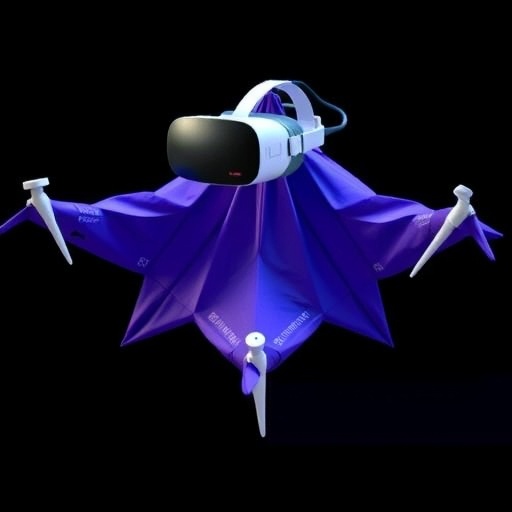
In the evolving landscape of virtual reality (VR), replicating the sense of touch remains a formidable challenge that limits the immersive potential of current systems. While visual simulation has advanced significantly, haptic interaction—how users physically feel and manipulate virtual objects—relies heavily on passive haptic proxies. These proxies are real-world objects held by users to replicate the tactile experience of virtual items. However, conventional passive proxies are constrained by the “one-object-one-model” paradigm, demanding separate physical props for each virtual object. This requirement introduces significant barriers in cost, storage, transport, and setup complexity, especially acute in environments where space and resources are at a premium, such as astronaut training capsules or extravehicular activity simulations.
Addressing these limitations, a pioneering research team from Donghua University has introduced an innovative fabric topological haptic proxy (FTHP), revolutionizing how VR interfaces manage tactile feedback. This groundbreaking approach integrates multi-disciplinary expertise spanning textile science, interaction design, sensing technologies, and machine learning. The core innovation lies in a single, reconfigurable textile platform embedded with origami-inspired topological structures and triboelectric sensing yarns. This synergy allows the fabric to transform dynamically between multiple functional configurations, each serving distinct interaction roles in VR, effectively consolidating the functionality of multiple physical props into one versatile cloth.
One of the most daunting challenges in leveraging fabric for haptic interfaces is controllability. Fabrics are inherently soft and highly deformable, qualities that grant enhanced portability and ergonomic comfort but also introduce uncertainty in shape and touch feedback. Unlike rigid props, the fabric’s pliability means identical shapes can result from many folding sequences, with the material frequently undergoing unintentional twists, collapses, or relaxations. Such inconsistencies create ambiguous tactile boundaries and unreliable sensory data, complicating the recognition of interaction states essential for precise VR control.
FTHP’s breakthrough lies in applying topology-guided deformation principles to tame the fabric’s inherent unpredictability. Researchers engineered the textile’s folding geometry and imposed topological constraints—carefully designed fold lines, connectivity maps, and the strategic partitioning of rigid and flexible segments—ensuring that the continuum of possible deformations collapses into a finite set of stable, repeatable configurations. This approach produces well-defined face, edge, and corner landmarks after folding, reducing ambiguity and enabling users to perform consistent, learnable interaction gestures. Consequently, the fabric behaves less like a chaotic soft matter and more like a deterministic multi-state controller.
Leveraging these controlled topological transformations, the team developed an innovative interaction framework based on three discrete operational states of the fabric. The first state, Flat, acts as a two-dimensional touch input surface facilitating panel navigation, slider adjustments, and continuous parameter control. The Folded state transforms the cloth into simple three-dimensional geometric shapes—such as cubes or prisms—that provide tactile delineations for precise actions like clicking, grasping, sliding, or rotating. Finally, the Transforming state utilizes the act of folding itself to encode commands, where specific folding sequences trigger mode switching or tool selection. This tri-state paradigm embodies the concept of “one cloth, many states,” reducing the dependency on multiple props and streamlining user interactions across diverse tasks.
To translate physical interactions into actionable VR inputs, the fabric integrates triboelectric sensing fibers that detect contact and deformation without the need for bulky external sensors or restrictive camera arrays. The multi-channel sensor network embedded within the textile captures nuanced touch cues in the Flat state, differentiates operational gestures along distinct faces and edges in the Folded state, and sequences dynamic folding motions to decipher command signals in the Transforming state. These raw data streams are decoded by a lightweight convolutional neural network (CNN) trained to classify combinations of fabric state and user action with high fidelity.
Experimental demonstrations of the FTHP system showcase a prototype equipped with seven sensing channels feeding into the CNN decoder, achieving a remarkable average action recognition accuracy of approximately 92.4%. The high precision confirms the system’s robustness in distinguishing diverse interactions across all three states, validating its practical application potential. Furthermore, the foldable design ensures low physical burden and exceptional portability—attributes essential for confined or mobile operational settings such as astronaut training modules or remote human-machine interfaces.
Beyond its immediate VR applications, FTHP’s design philosophy signals a paradigm shift towards scalable, multi-task immersive interfaces. By integrating topology-guided mechanics with embedded sensor intelligence and machine learning, the fabric proxy eliminates the inefficiencies associated with dedicated one-to-one physical props. The resultant versatile textile can be easily deployed, folded, and recalibrated across various interactive scenarios without excessive recalibration or complex setup.
This innovative fusion also suggests exciting future directions beyond virtual reality. Wearable technologies, portable medical simulation devices, and field-deployable human-machine interaction panels could benefit from the adaptable, lightweight, and sensor-rich qualities exemplified by FTHP. The principle of reducing hardware multiplicity in favor of multi-state textile interfaces offers a valuable blueprint for developing compact, reusable, and context-aware tactile controllers across technology domains.
In summary, the fabric topological haptic proxy stands as a testament to the power of interdisciplinary innovation in overcoming the tactile limitations of current VR systems. It transcends traditional passive proxy restrictions by offering a single, fabric-based platform capable of morphing into multiple interaction modalities without compromising sensing fidelity. As VR continues to seek deeper immersion and naturalistic interaction, solutions like FTHP pave the way towards more intuitive, scalable, and accessible haptic experiences, particularly in challenging environments where every gram and centimeter count.
Web References:
https://doi.org/10.1093/nsr/nwag041
Keywords
Virtual reality, haptic proxy, fabric interface, topology-guided deformation, triboelectric sensing, origami-inspired design, machine learning, convolutional neural network, multi-state interaction, wearable haptics
Cite Scienmag News
Grant Pearson. (March 30, 2026). Origami-Inspired Fabric Transforms Single Cloth into Multiple VR Controllers. Scienmag. https://scienmag.com/origami-inspired-fabric-transforms-single-cloth-into-multiple-vr-controllers/
Grant Pearson. "Origami-Inspired Fabric Transforms Single Cloth into Multiple VR Controllers." Scienmag, 30 March 2026, https://scienmag.com/origami-inspired-fabric-transforms-single-cloth-into-multiple-vr-controllers/. Accessed 3 September 2026.
Grant Pearson. "Origami-Inspired Fabric Transforms Single Cloth into Multiple VR Controllers." Scienmag. March 30, 2026. https://scienmag.com/origami-inspired-fabric-transforms-single-cloth-into-multiple-vr-controllers/


