


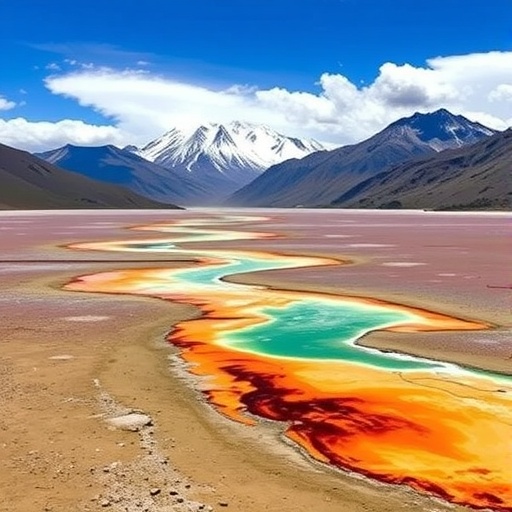
The Tibetan Plateau, often called the roof of the world, has spent more than six decades telling a seemingly reassuring climate story. Since the 1950s, this vast high-altitude region has grown both warmer and wetter, a combination that might lead casual observers to assume that drought, one of humanity’s oldest scourges, is gradually loosening its grip on the region’s grasslands, glaciers and river headwaters. New research reveals that this assumption could not be further from the truth. A study published in the Journal of Geophysical Research: Atmospheres, led by Professor Tianjun Zhou’s team at the Institute of Atmospheric Physics of the Chinese Academy of Sciences, demonstrates that compound hot-dry events—situations in which extreme heat and drought strike simultaneously—continue to pose a serious and growing threat to the Plateau, and that their year-to-year behavior is far from random. Instead, the fate of each summer is being quietly orchestrated by two of the planet’s most powerful climate oscillators: the El Niño-Southern Oscillation, or ENSO, in the tropical Pacific, and the Summer North Atlantic Oscillation, known as the SNAO, in the atmosphere above the North Atlantic.
The paradox at the heart of the study is worth savoring. Wetter conditions in a warming climate do not translate into a world free of water stress. On the contrary, as temperatures continue to climb, the atmosphere’s evaporative demand intensifies, and even regions with enhanced precipitation can suffer periods when soil moisture collapses while temperatures soar. When heat and drought arrive together, their impacts are not merely additive but synergistic. On the Tibetan Plateau, such compound events directly threaten fragile alpine ecosystems and the water resources that feed major Asian rivers. They accelerate the retreat of glaciers and the degradation of permafrost, destabilize high-mountain geomorphic systems, and can raise the odds of secondary disasters such as ice avalanches and landslides. Understanding what drives the annual variation of these compound extremes is therefore not an academic luxury but a matter of practical urgency for the billions of people who depend, directly or indirectly, on the water that drains from this elevated region.
To unravel the puzzle, the research team assembled an impressive observational toolkit. They employed the High-Resolution Near-Surface Meteorological Forcing Data set for the Third Pole region, abbreviated TPMFD, alongside the CN05.1 observational dataset and the ERA5 atmospheric reanalysis produced by the European Centre for Medium-Range Weather Forecasts. With these resources, the scientists mapped the spatial and temporal characteristics of summertime compound hot-dry events across the Plateau in every year since 1979. The high spatial resolution of the data proved essential, because the analysis revealed that the Plateau is not a monolithic entity in climatic terms. Its southwestern, southern, eastern, southeastern and northeastern sectors each respond differently to the same large-scale climate drivers, sometimes in ways that diverge sharply even between adjacent regions.
The first major discovery concerns the long shadow cast by ENSO. The researchers found that sea surface temperature conditions in the tropical Pacific during the preceding winter exert a pronounced influence on compound hot-dry events over the southwestern Tibetan Plateau in the following summer. This lagged teleconnection is a striking example of how climate memory can span oceans and continents. During El Niño years, when anomalously warm water pools in the equatorial eastern and central Pacific, the regional average number of compound hot-dry days over the southwestern Plateau increases by approximately 1.85 days. During La Niña years, when the tropical Pacific cools, the count decreases by about 1.13 days. The modulation scales with the strength of the event: the more intense the ENSO fluctuation, the stronger its fingerprint on Plateau summer extremes.
Delving deeper, the team separated ENSO into its two distinct flavors—the eastern Pacific, or EP, type, in which the warming is centered over the eastern equatorial Pacific, and the central Pacific, or CP, type, where anomalies concentrate farther west. This distinction matters enormously. During EP El Niño years, the number of hot days can increase by more than seven days in parts of the southwestern Plateau, while the regional average count of drought days swells by 11.4 days. The physical mechanism behind this explosive combination involves changes in cloud radiative effects and in clear-sky shortwave radiation. Fewer or thinner clouds allow more solar energy to pour onto the land surface, and even under clear skies the altered atmospheric composition of the teleconnection pattern boosts the incoming shortwave flux. The land surface receives an enhanced energy supply, which translates directly into higher temperatures and greater evaporative stress on already drying soils.
At the opposite end of the spectrum, CP La Niña emerges as the most powerful suppressor of compound hot-dry events on the Plateau. When this flavor of La Niña takes hold, cloud radiative effects and surface albedo conspire to reduce the energy delivered to the land surface. More reflective surfaces bounce more sunlight back to space, and cloudier conditions intercept more of what remains. The result is a cooler, wetter summer in which hot days decline by an average of 6.2 days and drought days by 8.2 days. The contrast between these two ENSO flavors offers a crucial lesson for seasonal forecasting: knowing merely whether an El Niño or La Niña event will occur is not enough. Forecasters must also anticipate which flavor will materialize, because the two can produce opposite outcomes over the Plateau.
While ENSO dominates the southwestern sector, a second climate mode takes center stage over the eastern Plateau: the Summer North Atlantic Oscillation. The SNAO is the summer counterpart of the better-known winter oscillation, describing shifts in the position and strength of the North Atlantic storm track and associated pressure dipoles. The study shows that SNAO-related circulation anomalies, born over the North Atlantic, can trigger Rossby wave trains that propagate eastward along the Eurasian westerly jet stream, carrying their influence as far as the Tibetan Plateau thousands of kilometers away. This pathway represents one of the most elegant examples of atmospheric teleconnection, in which the atmosphere itself acts as a conduit, transferring the memory of North Atlantic conditions across an entire continent in the form of undulating wave patterns in the flow.
Perhaps the most surprising finding within the SNAO story is the pronounced north-south contrast in how the eastern Plateau responds. During the positive phase of the SNAO, compound hot-dry events become more frequent across the eastern Plateau as a whole, but the physics differs from one subregion to the next. In the relatively humid southeastern Plateau, the SNAO-induced circulation suppresses precipitation and thins cloud cover, allowing more solar radiation to reach the surface. Here, changes in cloud radiative effects dominate the warming, essentially a sunlight-driven mechanism. In the relatively arid northeastern Plateau, by contrast, the warming is governed more strongly by changes in downward radiation under clear-sky conditions. In other words, although both regions end up hotter and drier during positive SNAO phases, the energy-balance pathways producing those outcomes are substantially different. For modelers and forecasters, this distinction is far from trivial, because it dictates which processes must be captured accurately to predict extremes in each subregion.
Overlaying all of these teleconnection effects is a local feedback that acts as an amplifier over the southern Plateau’s endorheic region—a closed basin where water leaves the system only by evaporation, not by river outflow. When the soil dries, less water is available for evaporation, so a growing fraction of the incoming surface energy is diverted from the latent heat flux, which would cool the surface, into sensible heat flux, which warms the air directly. The warmer near-surface atmosphere, in turn, intensifies evaporative demand and accelerates further drying of the soil. This self-reinforcing loop between soil moisture and temperature is the classic land-atmosphere feedback, and the study documents how it converts a moderate initial perturbation into a severe compound hot-dry episode over the southern Plateau.
Professor Tianjun Zhou, the corresponding author of the study, frames the achievement as the closing of a critical gap. “This study bridges the gap between large-scale climate drivers and local surface processes,” he notes. “By linking ENSO and SNAO teleconnections with land-atmosphere feedbacks, we now have a more complete physical framework to understand why these compound hot-dry events vary so much from year to year over the Tibetan Plateau.” Lead author Rongyun Pan, a PhD candidate at the institute, emphasizes the non-random character of the variability: the year-to-year swings in compound hot-dry events, the team found, are largely steered by the two major climate modes rather than arising from chaotic noise. The practical implication is tantalizing. Because ENSO and the SNAO are, to some degree, predictable seasons in advance, their signatures can be exploited to improve seasonal forecasts of compound extremes and to sharpen risk assessments for the Plateau’s ecosystems, glaciers and water infrastructure. In a region where warming and wetting proceed hand in hand with intensifying hot-dry threats, anticipating which oscillator will dominate a given summer may soon become as important as watching the rain gauge.
Cite Scienmag News
Russell Cooper. (September 8, 2026). Wetter Tibetan Plateau still suffers hot-dry extremes via ENSO, North Atlantic links. Scienmag. https://scienmag.com/wetter-tibetan-plateau-still-suffers-hot-dry-extremes-via-enso-north-atlantic-links/
Russell Cooper. "Wetter Tibetan Plateau still suffers hot-dry extremes via ENSO, North Atlantic links." Scienmag, 8 September 2026, https://scienmag.com/wetter-tibetan-plateau-still-suffers-hot-dry-extremes-via-enso-north-atlantic-links/. Accessed 8 September 2026.
Russell Cooper. "Wetter Tibetan Plateau still suffers hot-dry extremes via ENSO, North Atlantic links." Scienmag. September 8, 2026. https://scienmag.com/wetter-tibetan-plateau-still-suffers-hot-dry-extremes-via-enso-north-atlantic-links/


