


Thousands of years before clay vessels became an ordinary fixture of human households, the hillsides of the ancient southern Levant were burning on a scale that reshaped entire landscapes. Wildfires stripped vegetation from slopes, rains carved away exposed soils, and enormous volumes of clay-rich sediment were carried down into the Jordan and Dead Sea valleys, where they accumulated in deep, fertile layers. According to a new study by Prof. Amos Frumkin of the Institute of Earth Sciences at the Hebrew University of Jerusalem, this period of environmental turmoil may have done far more than simply redraw the map of where early farming communities could live. It may have provided the dramatic natural demonstration that taught Neolithic people one of humanity’s most transformative lessons: that fire can permanently transform soft clay into hard, durable ceramic. The study, published in the journal Geomorphology, proposes what Frumkin calls the “natural kiln hypothesis,” an idea that reframes the origin of pottery not as a purely human flash of invention, but as a technology learned, at least in part, by imitating nature.
The research reconstructs environmental conditions across two periods of major instability separated by more than 100,000 years. The first is the last interglacial, known in the paleoclimate record as Marine Isotope Stage 5e, which lasted from roughly 129,000 to 116,000 years ago. The second is the early Holocene, between approximately 11,000 and 7,000 years ago, when agricultural communities were becoming firmly established across the region. To compare these intervals, Frumkin drew together an unusually broad range of evidence: fine charcoal particles preserved in ancient lake sediments that record peaks in regional burning, chemical signatures archived in cave formations that document substantial losses of vegetation and soil, and the distribution of archaeological sites that show where people settled as the landscape changed. Together, these records indicate that both periods featured episodes of extensive wildfire followed by severe erosion, with the most intense Holocene episode occurring between roughly 9,500 and 8,200 years ago, precisely the window in which the earliest pottery appears in the Levant.
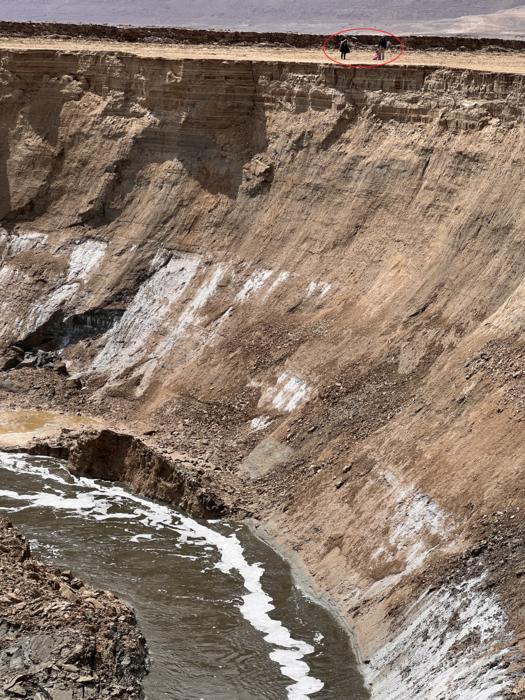
The mechanism linking fire to landscape change is straightforward geomorphology, but its consequences were profound. When intense fires removed the vegetation cover that normally anchors hillslope soils, the exposed ground became vulnerable to rainfall and runoff. In the southern Levant, much of that soil was terra rossa, a reddish, clay-rich earth that develops over limestone bedrock. Once stripped of protective plants, hillsides surrendered this material to the rains, and it was swept into valleys and depressions, including the Jordan Valley and the Dead Sea basin, where it accumulated in deposits that can reach spectacular thicknesses. Far from merely destroying habitable land, this process created new environments where farming could flourish. Large Neolithic settlements increasingly clustered on these fertile redeposited soils, meaning that the very disaster that burned the hills also concentrated people and clay side by side in the valleys below.
It is that juxtaposition of people and freshly deposited clay that lies at the heart of the natural kiln hypothesis. Pottery emerged in the region during roughly the same broad period in which fires, erosion and clay deposition reached their peak. Frumkin proposes that people living in the valleys may have encountered patches of clay that intense wildfires had baked in place, and noticed that heat had transformed the soft, plastic material into something hard and durable. Wildfires burning through accumulations of dry brush, woody debris and clay-rich sediment can generate temperatures in the immediate ground layer that approach the threshold required for ceramic transformation. Observing such naturally fired clay could have provided the conceptual leap behind intentional pottery making: the realization that a process seen in the aftermath of a fire could be reproduced deliberately, under controlled conditions, at the hearth or in a pit.
The hypothesis gains support from earlier petrographic research on some of the region’s oldest ceramics. Thin-section analysis of Yarmukian pottery, one of the earliest ceramic traditions of the southern Levant, shows that these vessels were manufactured from local redeposited terra rossa clay, the very material that would have accumulated around settlements as the surrounding hills eroded. In other words, the earliest potters of the Jordan Valley were already working with the exact raw material that fire and flood had delivered to their doorstep. That correspondence between the geological record of fire-induced erosion and the mineralogical fingerprint of the earliest pottery is precisely the kind of pattern one would expect if environmental disruption and ceramic innovation were genuinely linked, rather than coincidentally adjacent in time.
Perhaps the most intriguing element of the study is a kind of natural experiment run more than a hundred millennia before pottery appeared. During the last interglacial, the southern Levant experienced an even more extreme combination of fires, vegetation loss, erosion and clay deposition than the early Holocene. Yet pottery did not emerge. Frumkin treats this earlier period as a control case: the environment produced many of the same ingredients, but the people of the time lacked the cognitive capacities, sedentary agricultural society, accumulated technological knowledge and social conditions that later Neolithic communities possessed. The comparison suggests that wildfire and clay deposition alone were not sufficient to produce ceramics. Innovation, in this view, required the meeting of environmental opportunity with a society capable of recognizing and exploiting it. Nature could stage the demonstration; only a prepared audience could learn from it.
The broader significance of pottery is difficult to overstate. Once fired vessels entered daily life, they transformed it. Ceramic containers made it far easier to cook, store food and liquids, and ferment products, supporting larger, more settled populations and reshaping economies built around surplus and storage. Decorated vessels and figurines quickly took on cultural and symbolic importance as well, indicating that ceramics acquired meaning far beyond their practical uses almost immediately after their invention. If Frumkin is right, the chain of causation running from climatically driven wildfires, through erosion and valley-floor clay deposition, to the rise of settled communities and finally to the invention of pottery, represents one of the most striking examples in human history of catastrophe opening a door to innovation.
Frumkin is careful to frame the natural kiln hypothesis as speculative and testable rather than proven. The available evidence establishes that major fires, clay deposition and the emergence of pottery occurred within the same broad period, but current dating resolution cannot yet demonstrate the exact sequence of events. He outlines concrete ways the idea could be examined. Future excavations beneath the earliest pottery-bearing layers could search for naturally fire-baked clay, which would constitute direct physical evidence that nature had demonstrated the process before people replicated it. Experimental research could test whether wildfires in the Jordan Valley could realistically heat clay to the roughly 500 to 700 degrees Celsius needed to begin permanently transforming it into ceramic material, by reconstructing fuel loads, burning conditions and the thermal properties of terra rossa deposits. And, as Frumkin notes, the hypothesis faces a clear potential refutation: the discovery of pottery that unambiguously predates the major fire episode would undermine the claim that the fires played a role in the invention.
The proposal does not seek to replace existing explanations for the origin of ceramics. Archaeologists have long argued that pottery emerged through gradual experimentation, driven by social needs such as cooking and storage, or spread through contact between communities. What the natural kiln hypothesis adds is another possible piece of the puzzle, one that places environmental agency back into a story usually told in purely cultural terms. It suggests that environmental catastrophe itself may sometimes create the conditions for technological breakthroughs, not by destroying societies, but by exposing them to new materials, new landscapes and new possibilities they would otherwise never have encountered.
In the end, the study paints a striking picture of the deep past: a Levant alternately scorched and flooded, its hillsides burning and its valleys filling with clay, while farming communities adapted, clustered and ultimately prospered on the wreckage. The fires that stripped those ancient hills may also have reshaped where people lived, how they farmed and, potentially, how they first learned to turn ordinary earth into one of civilization’s most enduring materials. If future fieldwork and experiments bear out Frumkin’s idea, the invention of pottery will join a short and remarkable list of technologies that humanity did not so much invent as learn to imitate from the world around it, after watching nature perform the trick first.
Cite Scienmag News
Gavin Prescott. (September 8, 2026). Wildfires may have inspired the invention of pottery. Scienmag. https://scienmag.com/wildfires-may-have-inspired-the-invention-of-pottery/
Gavin Prescott. "Wildfires may have inspired the invention of pottery." Scienmag, 8 September 2026, https://scienmag.com/wildfires-may-have-inspired-the-invention-of-pottery/. Accessed 8 September 2026.
Gavin Prescott. "Wildfires may have inspired the invention of pottery." Scienmag. September 8, 2026. https://scienmag.com/wildfires-may-have-inspired-the-invention-of-pottery/


