


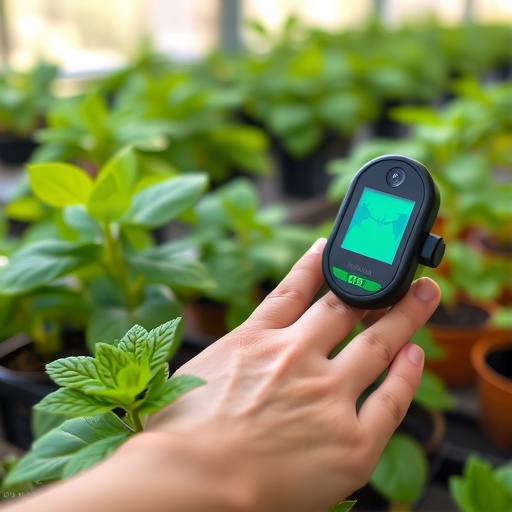
Imagine a wearable smartwatch for plants—capable of real-time monitoring of vital signs before stress becomes visible. Scientists at Tufts University have developed an innovative “tattoo-like” sensor that adheres to plant leaves and a complementary stretchable band for stems, creating a powerful new way to monitor crop health at the physiological level. This breakthrough technology enables farmers to detect early indications of drought, salt stress, and nutrient imbalances, revolutionizing agricultural management.
The adhesive leaf sensor is an ultra-thin, flexible device tailored to the irregular surfaces of leaves. It measures the vapor pressure deficit (VPD)—a critical parameter that describes the air’s drying power and its effect on water loss from plants. When the surrounding air has a high VPD, it aggressively pulls moisture from leaves, causing stomata to close, thus conserving water but simultaneously reducing photosynthesis. Detecting these nuanced moisture exchanges offers an immediate window into plant stress well before physical symptoms like curled leaves emerge.
At the heart of the leaf sensor is a complex interplay of nanomaterials: vanadium pentoxide nanosheets arranged in a layered membrane, topped by a graphene sieve that allows moisture passage. Water molecules convert into ions, generating an ionic current that both powers the sensor and quantifies moisture movement. This ingenious self-powered mechanism harvests energy from evaporative moisture, dispensing with bulky external batteries and enabling continuous, low-power operation in field conditions.
Complementing the leaf sensor is a clever kirigami-inspired band worn around stems. Using the traditional Japanese art of paper cutting, the sensor is patterned to stretch and flex delicately with natural growth and environmental forces like wind. Coated with an ion-conductive eutectogel, it monitors electrical resistance changes as the stem expands or contracts—tracking growth rates or detecting shrinkage under stress conditions. Together, these sensors provide a multi-timescale view of plant health: immediate responses via leaf moisture and slower physiological changes through stem growth.
Field trials on bell pepper plants demonstrated the system’s ability to distinguish healthy crops from those suffering water or salinity stress. Healthy plants showed rhythmic daily VPD cycles, while stressed plants exhibited distinct and divergent moisture patterns. Stem sensor data correlated with growth retardation or shrinkage, validating the dual-sensor design as a comprehensive stress monitoring platform.
The design was meticulously engineered for outdoor robustness. The leaf tattoo tolerates bending and stretching without harming the plant, and the kirigami band evenly disperses mechanical strain to withstand gusty conditions. Beyond moisture and growth, these sensors can be expanded to monitor nutrients and plant hormones—early indicators of disease or nutrient deficiency—heralding a new era of precision agriculture.
Researchers aim to integrate wireless communication protocols like LoRa or Bluetooth to enable real-time data transmission across entire fields. Such scalable networks of “plant wearables” could empower farmers with unprecedented insights, feeding an intimate plant-eye perspective that supplements satellite and drone imagery.
This revolutionary approach not only promises enhanced crop yields and sustainable farming but also deepens our fundamental understanding of plant biology through direct, continuous monitoring in natural environments. As agriculture faces mounting challenges from climate change and resource constraints, these moisture-powered bioelectronics could be vital tools for the future of food security.
Cite Scienmag News
Alan Morgan. (July 9, 2026). Wearable Devices Developed to Monitor Plant Health in Real Time. Scienmag. https://scienmag.com/wearable-devices-developed-to-monitor-plant-health-in-real-time/
Alan Morgan. "Wearable Devices Developed to Monitor Plant Health in Real Time." Scienmag, 9 July 2026, https://scienmag.com/wearable-devices-developed-to-monitor-plant-health-in-real-time/. Accessed 4 September 2026.
Alan Morgan. "Wearable Devices Developed to Monitor Plant Health in Real Time." Scienmag. July 9, 2026. https://scienmag.com/wearable-devices-developed-to-monitor-plant-health-in-real-time/


