


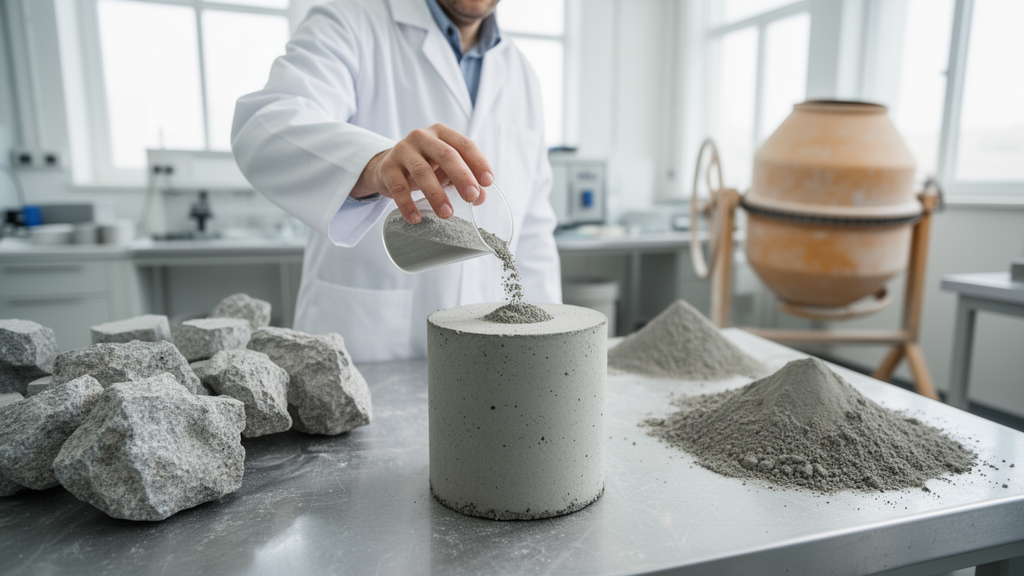
A laboratory experimental program has shown that high-strength concrete can replace up to 35 percent of its Portland cement with a strategic combination of industrial waste powders and still outperform conventional mixes in strength, durability, and environmental impact. The study, published in Scientific Reports, produced nine blended mixtures incorporating silica fume, dealuminated metakaolin, and limestone powder at a constant water-to-binder ratio of 0.30. The ternary blend containing 15 percent silica fume and 5 percent dealuminated metakaolin achieved the highest 28-day compressive strength of the entire program, reaching 84.90 MPa, approximately 39.07 percent above the ordinary Portland cement control mixture at 61.05 MPa. Meanwhile, the quaternary blend 15SF10LS10DK delivered the greatest sustainability benefit, reducing embodied carbon by approximately 31.4 percent while maintaining high-strength performance. The findings suggest that clinker, the emissions-intensive core of cement, can be substantially diluted without sacrificing the mechanical envelope that defines high-strength concrete.
The environmental stakes are considerable. Cement production accounts for roughly 8 percent of total anthropogenic CO2 emissions, with clinker manufacturing requiring approximately 1800 MJ of energy per ton and kiln temperatures reaching about 1450 °C. Producing one ton of Portland cement releases an estimated 0.8 to 0.9 tons of CO2, split between fossil fuel combustion and the calcination of limestone, which alone contributes nearly 60 percent of the total. The dealuminated metakaolin investigated here is itself a waste stream: in Egypt, alum production from domestic kaolin resources generates around 80,000 tons per year of this acidic, silicate-rich residue, which has been disposed of by landfilling or dumping. Acid leaching of metakaolin during alum manufacture increases the material’s reactivity by generating amorphous active silica and raising specific surface area, supporting a meaningful pozzolanic contribution that the researchers sought to exploit within a high-strength binder framework.
The experimental design isolated binder composition as the single variable. Nine mixtures were proportioned in accordance with ACI 211 guidelines, spanning binary, ternary, and quaternary systems with silica fume fixed at 15 percent of binder mass, limestone powder at 10 percent, and dealuminated metakaolin at two levels of 5 and 10 percent. All mixtures used CEM I 52.5 Portland cement, crushed limestone coarse aggregate with a nominal maximum size of 19 mm, natural siliceous sand, and a polycarboxylate-based superplasticizer at a constant 2 percent dosage by binder mass. The control mixture contained 700 kg of cement per cubic meter. Despite the ultrafine powders, workability remained adequate across the program: slump values ranged from 9.8 to 11.2 cm against 12.0 cm for the control, a maximum reduction of 18.3 percent, confirming that the admixture could sustain casting and consolidation even at the low water-to-binder ratio of 0.30.
The mechanical results revealed a clear packing-reaction synergy. The binary blend with 10 percent dealuminated metakaolin reached 83.8 MPa at 28 days, outperforming even the 15 percent silica fume binary at 71.85 MPa and highlighting the higher pozzolanic reactivity of the waste-derived powder, whose reactive aluminosilicate phases consume calcium hydroxide and promote alumina-bearing hydrates such as C–A–S–H. Combining the two ultrafine powders proved most effective: the 15SF5DK ternary peaked at 84.90 MPa, attributed to broadened particle-size distribution, reduced capillary porosity, and intensified consumption of portlandite. Tensile-controlled properties followed coherently. The 10DK binary achieved the highest splitting tensile strength at 5.27 MPa, a 43.60 percent gain, while the 15SF10DK ternary recorded the maximum flexural strength at 12.00 MPa, up 40.68 percent. Scanning electron microscopy showed that dealuminated metakaolin particles are angular and plate-like with rough textures, promoting mechanical interlocking that bridges incipient microcracks under bending stress gradients.
Transport-related properties improved dramatically across all blended systems, indicating a denser microstructure with reduced capillary connectivity. Water absorption fell from 2.37 percent in the control to 1.40 percent in the 15SF10DK ternary, a reduction of up to 40.9 percent. Water penetration depth under 500 kPa pressure dropped from 1.40 cm in the control to 1.00 cm in the optimized quaternary blends, a 29 percent reduction. Sorptivity coefficients followed the same pattern, with the 15SF10DK mixture recording the lowest value at 7.17 × 10⁻6 mm/s0.5, 36 percent below the control. The researchers attribute these gains to combined pore filling, nucleation-driven densification, and secondary hydrate formation that progressively blocks and disrupts continuous transport paths. Notably, the permeability ranking did not exactly mirror compressive strength, since permeability is governed by pore connectivity and tortuosity rather than gel volume alone, and limestone-containing blends proved particularly effective at disrupting pressurized flow paths.
Eight months of immersion in a severe 10 percent sodium sulfate solution exposed a critical divergence between transport refinement and chemical stability. The study identified a transition from an early transport-controlled regime to a later chemistry-governed deterioration phase. Silica fume-rich systems showed superior reliability: the 15SF binary retained 80.9 percent of its strength at 8 months, the highest retention, with net mass loss limited to 0.79 percent at 4 months. In stark contrast, the 10DK binary, despite its high ambient strength and low sorptivity, recorded the worst late-stage degradation, with mass loss climbing from 1.56 percent at 2 months to 5.80 percent at 8 months and strength retention falling to 56.2 percent. The most plausible interpretation is that once sulfate ions penetrate the refined pore network, reactive alumina phases associated with high dealuminated metakaolin dosages promote expansive secondary products such as ettringite and gypsum, driving microcracking and surface scaling. The quaternary blends successfully mitigated this instability, restricting 8-month mass loss to 3.05 and 4.05 percent while preserving high residual strength.
Thermal exposure told a different story, governed by fundamentally different damage triggers. Specimens were oven-dried before heating to limit vapor-pressure buildup and explosive spalling risk, so the measured residual strengths primarily reflect intrinsic binder evolution rather than pressure-driven failure, and internal vapor pressure was not directly monitored. All mixtures showed a non-monotonic response: strength rose up to 300 °C, attributed to moisture evaporation and possible continued hydration of unhydrated cement particles, then declined at 500 °C as binding gels dehydrated and thermally induced microcracking accumulated. The 15SF10DK ternary achieved the highest absolute residual strength at 500 °C, retaining 77.37 MPa, which remained 2.68 percent above its unheated baseline. Ultrasonic pulse velocity corroborated these trends, with the 15SF10DK mixture sustaining 3.56 km/s at 500 °C against 3.26 km/s for the control. SEM–EDX analysis after heating revealed that high-performing blends developed more silica-rich binding phases, with the 15SF10DK mixture exhibiting the lowest Ca/Si ratio in the dataset at 2.21, compared with 4.99 for the control, providing direct chemical evidence of intensive portlandite consumption and interfacial densification.
From a sustainability perspective, the cradle-to-gate embodied carbon analysis quantified the payoff of clinker dilution. The control mixture carried the highest footprint at 594.0 kgCO2e/m3. The quaternary 15SF10LS10DK blend achieved the lowest at 407.3 kgCO2e/m3, a 31.43 percent net reduction, by combining the highest total replacement level with limestone’s low-emission filler role. The analysis adopted a deliberately conservative allocation of 0.15 kgCO2e/kg for the waste-derived dealuminated metakaolin, accounting for mandatory post-processing, drying, milling, and local transport, ensuring the carbon savings were not overstated. The 15SF10DK ternary emerged as a key strength-carbon balance point, pairing the program’s top-tier mechanical performance with a 21.96 percent footprint reduction. The researchers note that absolute values can shift with system boundaries and by-product allocation assumptions, though the relative trends across mixtures remain robust.
Collectively, the findings demonstrate that the optimum binder is exposure-specific rather than universal. For maximum ambient compressive strength, the 15SF5DK ternary represents the best composition; for post-heating residual load capacity, the 15SF10DK ternary delivered the most favorable behavior; for sulfate resistance, the 15SF binary and other silica fume-bearing blends provided the highest durability; and for sustainability and permeability resistance, the quaternary 15SF10LS10DK offered the best overall balance. The study also acknowledges limitations: the sulfate evaluation relied on engineering indicators such as strength retention and mass change rather than direct mineralogical characterization, so the exact deterioration mechanisms cannot be conclusively identified without post-exposure analysis. Future work is recommended to incorporate X-ray diffraction, thermogravimetric analysis, and infrared spectroscopy to resolve phase evolution, alongside investigations of residual modulus, creep, chloride migration, and carbonation kinetics, extending the waste-valorization framework toward broader structural deployment of low-clinker high-strength concrete.
Subject of Research: Integrated mechanical, durability, and sustainability assessment of low-clinker hybrid-blended HSC under sulfate and elevated temperatures exposure conditions
Article Title: Integrated mechanical, durability, and sustainability assessment of low-clinker hybrid-blended HSC under sulfate and elevated temperatures exposure conditions
Article References: Elbauomy, A. K., Fathy, I. N., Elgabry, A., Hamdy, G. A., Sakr, M. R., & Saif, M. S. (2026). Integrated mechanical, durability, and sustainability assessment of low-clinker hybrid-blended HSC under sulfate and elevated temperatures exposure conditions. Scientific Reports, 16(1), Article 33312. https://doi.org/10.1038/s41598-026-64130-6
Image Credits: AI Generated
DOI: 10.1038/s41598-026-64130-6
Keywords: Integrated, mechanical, durability, sustainability, assessment, low-clinker, hybrid-blended, under, sulfate, elevated, temperatures, exposure
Cite Scienmag News
Denise Maddox. (October 26, 2026). Waste powders cut concrete’s carbon footprint while boosting strength and durability. Scienmag. https://scienmag.com/waste-powders-cut-concretes-carbon-footprint-while-boosting-strength-and-durability/
Denise Maddox. "Waste powders cut concrete’s carbon footprint while boosting strength and durability." Scienmag, 26 October 2026, https://scienmag.com/waste-powders-cut-concretes-carbon-footprint-while-boosting-strength-and-durability/. Accessed 26 October 2026.
Denise Maddox. "Waste powders cut concrete’s carbon footprint while boosting strength and durability." Scienmag. October 26, 2026. https://scienmag.com/waste-powders-cut-concretes-carbon-footprint-while-boosting-strength-and-durability/


