

Monday, October 26, 2026
Science
No Result
View All Result
  • Login
  • HOME
  • SCIENCE NEWS
  • CONTACT US
  • HOME
  • SCIENCE NEWS
  • CONTACT US
No Result
View All Result
Scienmag
No Result
View All Result
Home Science News

Turkish Version of First Aid Willingness Questionnaire Passes Initial Validation Tests

October 26, 2026
in Science News
Leah Spencer
By Leah Spencer Scienmag Editorial Profile - School Health
Reading Time: 2 mins read
0
Turkish Version of First Aid Willingness Questionnaire Passes Initial Validation Tests

Turkish Version of First Aid Willingness Questionnaire Passes Initial Validation Tests

65
SHARES
587
VIEWS
Share on FacebookShare on Twitter
ADVERTISEMENT

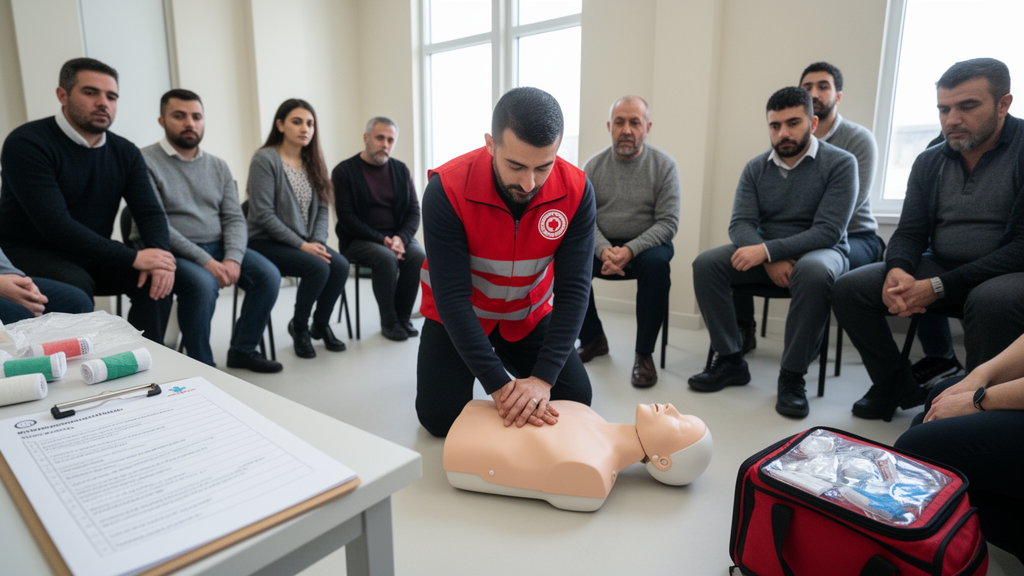
A cross-sectional psychometric study of 470 high school students in Aksaray, Türkiye, reports that the First Aid Willingness Questionnaire for Schoolchildren can be translated and culturally adapted into Turkish while retaining a coherent structure for measuring adolescents’ self-reported readiness to help and the barriers they perceive to providing first aid. The instrument underwent forward and backward translation, review by a panel of 12 experts, and pilot testing with 35 students before formal validation in the larger sample.

Item-level content validity ratios all exceeded 0.83, and the scale-level content validity index reached 0.90, indicating strong expert agreement on the relevance of the items. Exploratory factor analysis was used to derive the underlying structure, which was then evaluated with ordinal confirmatory factor analysis in the same sample. Removing two items produced a 16-item questionnaire organized into three factors: First Aid Willingness, Negative Emotions, and Perceived Knowledge.

The three-factor model showed acceptable fit to the data, with a comparative fit index of 0.95, a Tucker–Lewis index of 0.94, a root mean square error of approximation of 0.06 (90% confidence interval 0.05 to 0.07), and a standardized root mean square residual of 0.06, although the scaled chi-square statistic of 288.09 with 101 degrees of freedom remained statistically significant. Composite reliability ranged from 0.79 to 0.90 across the factors, Cronbach’s alpha from 0.72 to 0.87, and McDonald’s omega from 0.74 to 0.87. Average variance extracted ranged from 0.49 to 0.59, with convergent validity for the Negative Emotions factor described as borderline, while discriminant validity was supported.

Measurement invariance testing showed that configural, threshold, metric, and scalar invariance held across gender, grade level, and perceived family income, meaning the questionnaire functions comparably across these groups for subscale interpretation and latent mean comparisons within the study sample. Strict invariance was supported across grade level and perceived family income but not across gender, so stricter forms of comparison involving equal item residuals are not justified for gender groups in this data.

The authors characterize the findings as preliminary evidence for the Turkish version’s psychometric properties. Because the validation was conducted in a single sample, independent replication is needed, along with evaluation of the questionnaire’s temporal stability, responsiveness to change over time, and external validity against other measures or outcomes. The results support use of the adapted instrument for assessing first-aid willingness among Turkish adolescents in the studied context, but generalization beyond this population awaits further testing.

Subject of Research: Cross-cultural adaptation and psychometric validation of the First Aid Willingness Questionnaire among Turkish adolescents

Article Title: Cross-cultural adaptation, validation, and measurement invariance of the First Aid Willingness Questionnaire (FAWQ) among Turkish adolescents

Article References: Özbey, H., Çalışır, Ö., Bayat, M., Beşiktaş, S., & Roba, A. A. (2026). Cross-cultural adaptation, validation, and measurement invariance of the First Aid Willingness Questionnaire (FAWQ) among Turkish adolescents. PLOS One, 21(10), e0361329. https://doi.org/10.1371/journal.pone.0361329

Image Credits: AI Generated

DOI: 10.1371/journal.pone.0361329

Keywords: first aid, adolescents, questionnaire validation, psychometrics, measurement invariance, confirmatory factor analysis, Turkish students, school health, Cross-cultural, adaptation, validation, measurement

Cite Scienmag News

Leah Spencer. (October 26, 2026). Turkish Version of First Aid Willingness Questionnaire Passes Initial Validation Tests. Scienmag. https://scienmag.com/turkish-version-of-first-aid-willingness-questionnaire-passes-initial-validation-tests/


Leah Spencer. "Turkish Version of First Aid Willingness Questionnaire Passes Initial Validation Tests." Scienmag, 26 October 2026, https://scienmag.com/turkish-version-of-first-aid-willingness-questionnaire-passes-initial-validation-tests/. Accessed 26 October 2026.

Leah Spencer. "Turkish Version of First Aid Willingness Questionnaire Passes Initial Validation Tests." Scienmag. October 26, 2026. https://scienmag.com/turkish-version-of-first-aid-willingness-questionnaire-passes-initial-validation-tests/

Tags: adaptationadolescent first aid readinessadolescentsassessment of first aid knowledge and attitudesbarriers to providing first aid among studentsconfirmatory factor analysiscross-culturalcross-sectional psychometric validationcultural adaptation of medical questionnairesExploratory and Confirmatory Factor Analysisfirst aidFirst Aid Willingness Questionnairemeasurementmeasurement invariancepsychometric properties of health questionnairespsychometricsquestionnaire validationscale validity and reliabilityschool healthschool-based health intervention toolstranslation and validation of health assessment toolsTurkish adaptation of health behavior surveysTurkish studentsvalidation
Share26Tweet16
Previous Post

Fuzzy Color Maps and Modified YOLOv5 Sharpen Small Face Detection

Next Post

Exercise Is Linked to Less Procrastination in Students, But Only When They Sleep Well

Related Posts

Exercise Is Linked to Less Procrastination in Students, But Only When They Sleep Well
Science News

Exercise Is Linked to Less Procrastination in Students, But Only When They Sleep Well

October 26, 2026
Fuzzy Color Maps and Modified YOLOv5 Sharpen Small Face Detection
Science News

Fuzzy Color Maps and Modified YOLOv5 Sharpen Small Face Detection

October 26, 2026
CT-measured body fat predicts achievable pocket depth for implanted chemo ports
Medicine

CT-measured body fat predicts achievable pocket depth for implanted chemo ports

October 26, 2026
Waste powders cut concrete’s carbon footprint while boosting strength and durability
Technology and Engineering

Waste powders cut concrete’s carbon footprint while boosting strength and durability

October 26, 2026
Cats on vegan diets show lower overweight rates in large survey
Medicine

Cats on vegan diets show lower overweight rates in large survey

October 26, 2026
Scoping review maps multi-level barriers and fixes in healthcare access for autistic children
Medicine

Scoping review maps multi-level barriers and fixes in healthcare access for autistic children

October 26, 2026
Next Post
Exercise Is Linked to Less Procrastination in Students, But Only When They Sleep Well

Exercise Is Linked to Less Procrastination in Students, But Only When They Sleep Well

  • Mothers who receive childcare support from maternal grandparents show more optimized

    Mothers who receive childcare support from maternal grandparents show more parental warmth, finds NTU Singapore study

    27656 shares
    Share 11059 Tweet 6912
  • University of Seville Breaks 120-Year-Old Mystery, Revises a Key Einstein Concept

    1061 shares
    Share 424 Tweet 265
  • Bee body mass, pathogens and local climate influence heat tolerance

    682 shares
    Share 273 Tweet 171
  • Researchers record first-ever images and data of a shark experiencing a boat strike

    546 shares
    Share 218 Tweet 137
  • Groundbreaking Clinical Trial Reveals Lubiprostone Enhances Kidney Function

    531 shares
    Share 212 Tweet 133
Science

Embark on a thrilling journey of discovery with Scienmag.com—your ultimate source for cutting-edge breakthroughs. Immerse yourself in a world where curiosity knows no limits and tomorrow’s possibilities become today’s reality!

RECENT NEWS

  • Exercise Is Linked to Less Procrastination in Students, But Only When They Sleep Well
  • Turkish Version of First Aid Willingness Questionnaire Passes Initial Validation Tests
  • Fuzzy Color Maps and Modified YOLOv5 Sharpen Small Face Detection
  • CT-measured body fat predicts achievable pocket depth for implanted chemo ports

Categories

  • Agriculture
  • Anthropology
  • Archaeology
  • Athmospheric
  • Biology
  • Biotechnology
  • Blog
  • Bussines
  • Cancer
  • Chemistry
  • Climate
  • Earth Science
  • Editorial Policy
  • Marine
  • Mathematics
  • Medicine
  • Pediatry
  • Policy
  • Psychology & Psychiatry
  • Science Education
  • Science News
  • Social Science
  • Space
  • Technology and Engineering

Subscribe to Blog via Email

Enter your email address to subscribe to this blog and receive notifications of new posts by email.

Join 5,151 other subscribers

© 2025 Scienmag - Science Magazine

Welcome Back!

Login to your account below

Forgotten Password?

Retrieve your password

Please enter your username or email address to reset your password.

Log In
No Result
View All Result
  • HOME
  • SCIENCE NEWS
  • CONTACT US

© 2025 Scienmag - Science Magazine

Discover more from Science

Subscribe now to keep reading and get access to the full archive.

Continue reading