


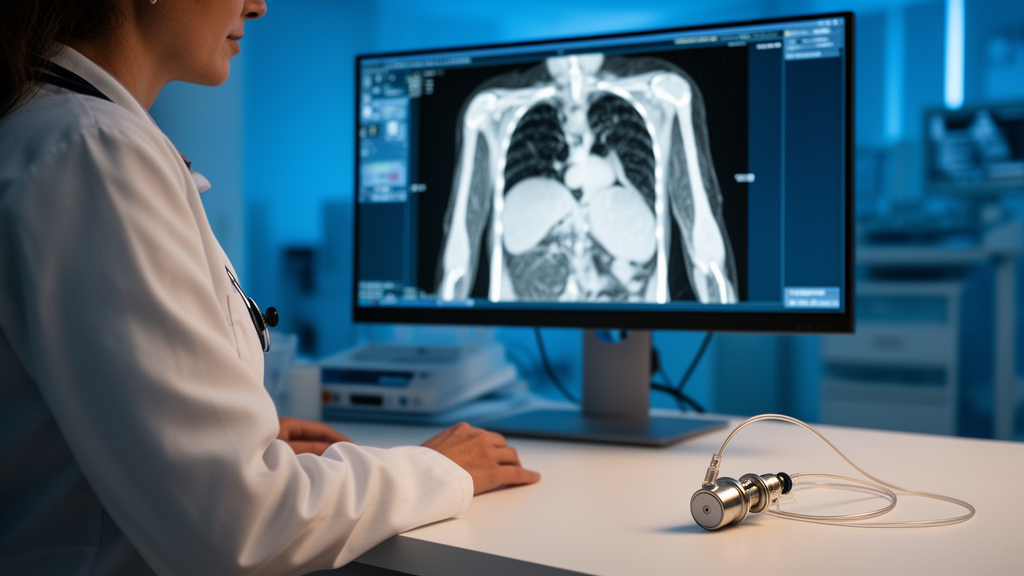
A 3D-printed measuring device has, for the first time, turned a largely guesswork step in cancer surgery into a number on a scale. In a prospective single-arm trial at Zigong Third People’s Hospital in Sichuan, China, 37 patients undergoing totally implantable venous access port (TIVAP) implantation between September 2025 and February 2026 had their subcutaneous pocket depth quantified with a handheld instrument built by the research team using stereolithography 3D printing and medical-grade biocompatible photosensitive resin. The device works on the vernier caliper principle, pairing a main scale with a sliding probe, and was verified against standard precision calipers on blocks of 1 to 10 mm thickness, with measurement error held within ±0.5 mm. Before each operation it was disinfected by 30-minute immersion in 10% povidone-iodine solution, a protocol chosen because the heat-sensitive resin cannot withstand autoclave sterilization, then rinsed three times with sterile saline.
The clinical problem the device addresses is deceptively simple. TIVAPs are the standard vascular access route for long-term chemotherapy, nutritional support and transfusion in patients with malignant tumors, offering lower infection risk and longer maintenance intervals than peripheral catheters. Yet systematic reviews place TIVAP-related complications at 1.8% to 14.4%, with port extrusion, poor wound healing and catheter-related infection among the most common late events. Pocket depth is a critical anatomical factor: a pocket that is too shallow can compress the port against the skin, predisposing to ischemic necrosis and extrusion, while one that is too deep raises procedural difficulty and hematoma risk. Clinical consensus recommends a depth of at least 5 mm of soft tissue coverage, but in practice surgeons have relied on empirical visual estimation, with substantial variability between operators.
What makes the new study striking is not only the measuring tool but what the measurements revealed about the patients. The team correlated intraoperative pocket depth with preoperative nutritional anthropometric indicators collected within 48 hours of surgery: waist circumference, body mass index, and maximum abdominal fat thickness measured by CT, identified at the thickest layer of abdominal wall fat and recorded to the nearest 0.1 mm. Maximum abdominal fat thickness showed the strongest correlation with achievable pocket depth, with a Pearson coefficient of r = 0.803 (95% CI 0.64–0.89, p < 0.001), explaining 64.4% of the variance in depth. Waist circumference followed closely at r = 0.775, and BMI at r = 0.703, while weight showed a moderate correlation of r = 0.514. Pocket depth had no significant association with albumin, hemoglobin or glucose levels.
From the regression analysis the researchers derived a simple prediction equation: Pocket Depth (mm) = 2.50 + 0.103 × Maximum Abdominal Fat Thickness (mm). The authors stress that this equation reflects the anatomical limitation imposed by the availability of subcutaneous tissue, not the surgical target of ≥5 mm. In patients with poor nutritional status and little subcutaneous fat, even optimal technique may leave the achievable depth at only 2 to 3 mm. The most sobering figure in the study is that 8 of 37 patients, 21.6%, had abdominal fat thickness below 10 mm, and every one of them ended with a pocket depth of 3 mm or less despite the surgical goal of at least 5 mm.
To translate the correlation into a usable threshold, the team performed receiver operating characteristic analysis for predicting a deep pocket of ≥5 mm. After 1,000-iteration bootstrap internal validation, the optimism-corrected AUC was 0.942 (95% CI 0.860–1.000), with an optimal cut-off of 14.5 mm of abdominal fat thickness, yielding 91.3% sensitivity and 85.7% specificity. Waist circumference and BMI also showed strong discriminative value, with AUCs of 0.918 and 0.925 respectively. Stratifying patients into five depth groups produced a clear dose-response pattern: mean abdominal fat thickness rose from 8.7 ± 4.7 mm in the ≤3 mm depth group to 43.4 mm in the single patient with depth ≥7 mm, with waist circumference and BMI following the same gradient (all p < 0.001).
On that basis the authors propose an exploratory, hypothesis-generating risk stratification: abdominal fat below 10 mm indicates high risk of a shallow pocket with achievable depth ≤3 mm; 10 to 25 mm indicates moderate risk with achievable depth of 4 to 5 mm; above 25 mm indicates low risk with achievable depth ≥6 mm. They are explicit that this framework does not recommend shallower pockets for malnourished patients. Rather, it identifies people who may benefit from enhanced postoperative monitoring or nutritional optimization before or after implantation. They also caution that no port extrusion occurred in this 30-day cohort, so labeling these patients as high-risk for extrusion is a theoretical extrapolation from the established biomechanical principle that insufficient soft tissue coverage predisposes to device erosion, pending confirmation in long-term follow-up.
The safety results provide the necessary foundation for these exploratory findings. The primary endpoint was device-related adverse events at 30-day follow-up, and none occurred (0%, 95% CI 0%–8.1% by the Rule of Three for zero events in 37 patients). The total complication rate was 2.7% (1/37): a single perioperative episode of puncture-site bleeding in a patient bridged to low molecular weight heparin for pulmonary embolism, who required suture hemostasis after five minutes of compression failed. An independent endpoint adjudication committee determined the event was unrelated to the measuring device. No postoperative infections, thromboses, hematomas, wound-healing problems, port extrusions, rotations or dysfunctions were recorded during the 30-day window, and follow-up reached 100% of enrolled patients.
The device itself proved practical in the operating room. It was applied successfully in all 37 surgeries without equipment failure, damage or sterilization problems, with a median measurement time of 20 seconds (interquartile range 15–25 seconds), adding negligible time to the procedure. All intraoperative measurements were taken by a single senior surgeon following a standardized protocol after pocket creation and before port insertion, which minimized variability but, as the authors acknowledge, does not establish formal interobserver reliability. Disinfection validation was thorough for an early feasibility study: printed samples cultured after three disinfection cycles showed no bacterial growth, and after 20 repeated cycles the device retained its precision within ±0.05 mm error, though the team notes that long-term degradation beyond 20 cycles and microbiological endpoints in clinical reuse remain untested.
Several design features of the surgery are worth noting alongside the measurement results. The team prioritized arm ports, using ultrasound-guided puncture of the basilic vein, because of pneumothorax concerns with chest wall ports; 81.1% of patients received arm ports and 18.9% chest wall ports. The protocol used a modified zero-tunnel oblique incision of about 2.5 cm, avoiding the subcutaneous tunnel of the traditional double-incision technique, and layered cosmetic suturing with 4-0 and 6-0 absorbable stitches to reduce incision tension. First venous puncture succeeded in 75.7% of patients, with nine requiring secondary attempts or site changes due to spasm or failure, all resolved without severe complications. Subgroup analysis showed the correlation between fat thickness and depth held in male patients (r = 0.805) and was unaffected by port type (interaction p = 0.685).
The authors frame the work firmly as an early feasibility study, sized according to FDA guidance recommending 20 to 40 patients to detect device-related adverse events with incidence ≥10%, and they list the limitations candidly: a small sample, single-surgeon measurements, a 30-day safety endpoint with three-month and long-term follow-up still ongoing, a small chest wall port subgroup (n = 7), and the absence of prospective trial registration before enrollment. They also note that abdominal fat thickness served as a surrogate for systemic nutritional status rather than a direct measure of local subcutaneous thickness at the implantation site, and suggest high-resolution ultrasound could refine prediction while reducing CT radiation exposure. Beyond oncology, they argue the approach offers a methodological reference for other subcutaneous device fields, including cardiology for pacemakers and endocrinology for insulin pumps, calling for clinicians to look beyond weight and BMI toward body composition when planning implantation. External validation in larger multicenter cohorts, randomized comparison against visual estimation, and trials of preoperative nutritional intervention are the stated next steps.
Subject of Research: Nutritional anthropometric indicators predict achievable pocket depth in totally implantable venous access port implantation: a prospective study with 3D-printed measurement device
Article Title: Nutritional anthropometric indicators predict achievable pocket depth in totally implantable venous access port implantation: a prospective study with 3D-printed measurement device
Article References: Hu, M., Chen, X., He, X., Hao, C., Tong, X., & Han, Y. (2026). Nutritional anthropometric indicators predict achievable pocket depth in totally implantable venous access port implantation: a prospective study with 3D-printed measurement device. Frontiers in Oncology, 16, Article 1898363. https://doi.org/10.3389/fonc.2026.1898363
Image Credits: AI Generated
DOI: 10.3389/fonc.2026.1898363
Keywords: Nutritional, anthropometric, indicators, predict, achievable, pocket, depth, totally, implantable, venous, access, port
Cite Scienmag News
Nathaniel Bowman. (October 26, 2026). CT-measured body fat predicts achievable pocket depth for implanted chemo ports. Scienmag. https://scienmag.com/ct-measured-body-fat-predicts-achievable-pocket-depth-for-implanted-chemo-ports/
Nathaniel Bowman. "CT-measured body fat predicts achievable pocket depth for implanted chemo ports." Scienmag, 26 October 2026, https://scienmag.com/ct-measured-body-fat-predicts-achievable-pocket-depth-for-implanted-chemo-ports/. Accessed 26 October 2026.
Nathaniel Bowman. "CT-measured body fat predicts achievable pocket depth for implanted chemo ports." Scienmag. October 26, 2026. https://scienmag.com/ct-measured-body-fat-predicts-achievable-pocket-depth-for-implanted-chemo-ports/


