


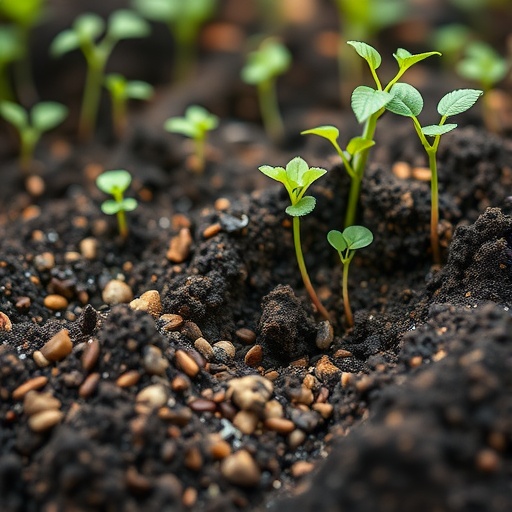
A new study is drawing attention to a hidden twist in the climate system: warming may not simply reduce the amount of carbon stored in soils. Instead, the fate of soil organic carbon could depend strongly on how much rain an ecosystem receives—and the response may be nonlinear. In research published in Communications Earth & Environment, Chen, Jiang, Xu and colleagues report that precipitation plays a decisive role in how warming influences soil carbon accumulation, with microbial residues emerging as a key pathway. The finding challenges the common assumption that warmer conditions produce a predictable decline in soil carbon everywhere.
Soils are among the planet’s largest carbon reservoirs, storing more carbon than the atmosphere and vegetation combined. Much of this carbon enters the ground through plant roots, fallen leaves and other organic material. Microorganisms then break down these compounds, using some for energy and transforming the rest into new biological material. When microbes die, their cell walls and molecular fragments can become part of the stable organic matter that remains in soil. These microbial residues are increasingly recognized as an important source of long-lived soil carbon, sometimes contributing more to persistent carbon storage than undecomposed plant material itself.
The study’s central message is that warming affects this process through a complex interaction between temperature, water availability and microbial activity. Higher temperatures generally accelerate chemical reactions and microbial metabolism. In a warm but sufficiently wet soil, that acceleration could increase the breakdown of organic matter and stimulate microbial growth. More microbial growth can eventually produce more microbial residues, potentially increasing the formation of soil organic carbon. But if warming is accompanied by drying, microbes may become water-limited, plant inputs may decline and the production of residues may weaken. The result is not a simple upward or downward response, but a precipitation-dependent pattern.
That pattern is described as nonlinear, meaning that a small change in rainfall does not necessarily produce a small, proportional change in carbon accumulation. Under one level of precipitation, warming could reduce soil carbon because decomposition and carbon losses outpace the formation of stable residues. Under another, slightly wetter condition, the same warming could have a much smaller effect—or potentially support greater accumulation through enhanced microbial processing. This kind of threshold-like behavior matters because global climate models often represent temperature and moisture effects in broad, simplified terms, even though real soils respond to the combination of both.
Microbial residues provide a particularly important link between short-term biological activity and long-term carbon storage. Living microorganisms rapidly process organic compounds, but their remains can bind to minerals or become protected inside soil aggregates. These physical and chemical protections can slow further decomposition, allowing carbon to persist for years, decades or longer. Warming may therefore influence soil carbon not only by changing how quickly microbes consume organic matter, but also by altering which microbial products are generated, how efficiently they are stabilized and whether environmental conditions allow them to remain in the soil.
Precipitation controls several of these steps at once. Water affects microbial mobility, the diffusion of dissolved organic compounds and the contact between enzymes and their substrates. It also changes oxygen availability: wet soils can become oxygen-poor, while dry soils may restrict microbial activity through dehydration. Rainfall influences plant productivity as well, determining how much fresh carbon enters the soil through roots and litter. By modifying both carbon supply and microbial processing, precipitation can redirect the balance between carbon gains and losses. The study’s emphasis on this interaction suggests that rainfall regimes may be just as important as warming itself when scientists estimate the future capacity of soils to store carbon.
The implications extend beyond academic soil science. If warmer climates cause soil carbon to respond differently in dry, moderately wet and very wet ecosystems, then regional climate projections could miss important feedbacks between land and atmosphere. A reduction in soil carbon can release more carbon dioxide, reinforcing warming. Conversely, greater stabilization of carbon in microbial residues could create a modest natural counterweight, although it would not cancel the effects of fossil-fuel emissions. Understanding where and when that stabilization occurs is essential for evaluating nature-based climate strategies, including improved land management, restoration and soil conservation.
The findings also highlight why soil carbon cannot be treated as a single, uniform pool. Carbon that is easily decomposed behaves differently from carbon associated with minerals or protected within aggregates. Likewise, carbon formed from microbial residues may respond differently from carbon that remains in recognizable plant fragments. Future assessments will need to distinguish among these pools and account for local precipitation patterns, rather than applying one global temperature response. The work by Chen and colleagues points toward a more mechanistic approach in which climate, microbial ecology and soil chemistry are considered together.
As climate change reshapes rainfall as well as temperature, the study offers a timely warning against straightforward predictions. Warming will not act on soil carbon in isolation, and the same increase in temperature may produce contrasting outcomes in different landscapes. The decisive factor may be whether microbial communities have enough water to transform organic inputs into residues that can be protected underground. By placing precipitation and microbial remains at the center of the story, the research reveals a possible reason why soil-carbon projections remain uncertain—and why the future of the planet’s underground carbon reserves may depend on the increasingly unpredictable rhythm of rain.
Cite Scienmag News
Morgan Morrow. (August 21, 2026). Warming drives nonlinear soil carbon accumulation through microbial residues, depending on precipitation. Scienmag. https://scienmag.com/warming-drives-nonlinear-soil-carbon-accumulation-through-microbial-residues-depending-on-precipitation/
Morgan Morrow. "Warming drives nonlinear soil carbon accumulation through microbial residues, depending on precipitation." Scienmag, 21 August 2026, https://scienmag.com/warming-drives-nonlinear-soil-carbon-accumulation-through-microbial-residues-depending-on-precipitation/. Accessed 4 September 2026.
Morgan Morrow. "Warming drives nonlinear soil carbon accumulation through microbial residues, depending on precipitation." Scienmag. August 21, 2026. https://scienmag.com/warming-drives-nonlinear-soil-carbon-accumulation-through-microbial-residues-depending-on-precipitation/


