


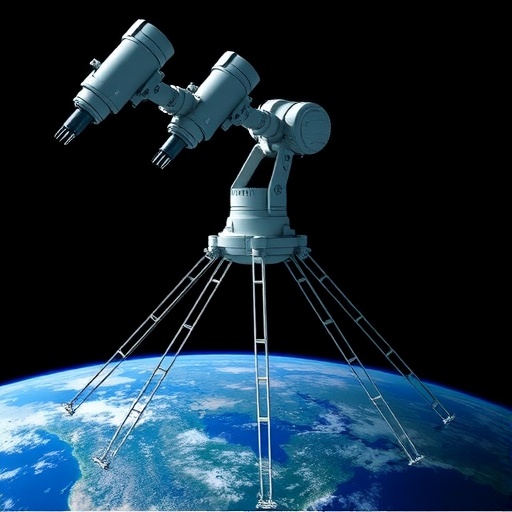
Space robots may soon move through the demanding environment outside an orbital station with greater autonomy, thanks to a new motion-planning method that combines rapid path searching with advanced mathematical optimization. Researchers from the Unmanned Systems Research Institute at Northwestern Polytechnical University have developed a hierarchical planning framework for space-based redundant manipulators—robotic arms with more joints than are strictly required to position their tools. The system is designed for tasks such as monitoring spacecraft surfaces, inspecting equipment, and tracking visual targets during extravehicular operations. These missions require a robot to navigate around obstacles while maintaining a precise camera view, obeying joint and torque limits, and remaining dynamically stable. The study was published in Space: Science & Technology under the title “Hierarchical Motion Planning Method for Space Redundant Manipulators with End-Task Constraint.”
The challenge is far more complex than simply telling a robotic arm where to move. A space manipulator performing visual inspection must coordinate its position, velocity, acceleration, and applied torque while avoiding structures that may be located directly along its route. At the same time, the end effector—often carrying a camera or inspection instrument—must preserve a required line of sight to a target. The robot may need to keep the target within a limited field of view while moving through a high-dimensional configuration space. Because these requirements interact nonlinearly, the resulting problem is a non-convex optimal-control task, meaning that the system may contain many possible solutions but only some are safe, physically achievable, and efficient.
Existing planning approaches each solve part of the problem, but neither is ideal on its own. Sampling-based methods such as the Rapidly-exploring Random Tree, or RRT, can search large spaces quickly and are effective at finding collision-free routes. However, the paths they produce may contain unnecessary bends, abrupt changes, or motions that violate the robot’s dynamic capabilities. Optimization-based methods can refine a trajectory and enforce complex physical constraints directly, but they are often highly dependent on their initial guess. If the starting trajectory is poor, the optimization process may converge slowly, become trapped in an undesirable solution, or fail altogether. The new approach addresses this weakness by using one method to rapidly discover a feasible route and another to transform that route into a smooth, executable motion.
The proposed architecture divides planning into two connected levels. At the kinematic level, the researchers developed a goal-biased RRT, known as GB-RRT, which gives additional sampling preference to areas near the desired target. This bias helps the algorithm focus its search rather than exploring the configuration space entirely at random. The method also uses greedy pruning to remove redundant waypoints after a route has been found. Collision detection is performed with axis-aligned bounding boxes and the Separating Axis Theorem, a geometric technique that determines whether two three-dimensional bodies overlap. Together, these strategies allow the robot to identify a collision-free joint-space path while reducing the computational effort normally associated with random exploration.
The resulting path is not used directly as the final command sequence. Instead, the researchers smooth it through cubic spline interpolation, producing a continuous reference trajectory for joint angles and their derivatives. This step is critical because a path made from isolated waypoints may be geometrically safe but mechanically unrealistic. Sudden changes in direction can create excessive angular velocities, accelerations, or actuator torques. A cubic spline provides a mathematically smooth curve that can serve as a high-quality warm start for the second planning stage. In this way, the optimization process begins with a trajectory that is already close to feasible, rather than attempting to construct a useful motion from an arbitrary initial guess.
At the dynamic level, the method converts the original nonlinear problem into a sequence of more manageable convex optimization problems. Obstacle-avoidance requirements are reformulated as linear inequalities involving joint angular velocities through a velocity-damping approach. This allows the system to maintain a safe separation from obstacles while expressing the restriction in a form that optimization solvers can handle efficiently. The end-effector line-of-sight condition is linearized using quaternion differentiation, which provides a compact way to represent three-dimensional orientation without the singularities associated with some angle-based descriptions. The manipulator’s dynamic equations are also approximated through first-order Taylor expansion around the current trajectory.
Because a single linear approximation may become inaccurate when the robot moves too far from its current solution, the researchers use successive linearization. After each optimization step, the trajectory is updated and the constraints are linearized again around the new estimate. Trust-region constraints limit how far the solution can move during each iteration, preserving the accuracy of the local approximation. This combination of warm-start initialization, repeated convexification, and trust-region control allows the system to handle kinematic, dynamic, collision-avoidance, line-of-sight, and actuator constraints in a unified process. The result is a sequential convex programming framework that can progressively refine the initial path into a smooth trajectory suitable for execution.
The researchers tested the approach on a seven-degree-of-freedom space-redundant manipulator in both static and dynamic target-monitoring scenarios. In the first experiment, the robot had to observe a stationary target while avoiding an obstacle positioned along its mandatory route. The optimized motion successfully passed around the obstacle and respected the specified end-effector viewing requirement. The objective function reached its optimum after 17 iterations. Throughout the motion, the line-of-sight angle remained within a 30-degree field of view, demonstrating that the manipulator could move without losing the target from its camera’s permitted observation range.
A second experiment required the manipulator to track a moving target, creating a more demanding combination of spatial coordination and visual control. The algorithm converged after 18 iterations and generated a trajectory that maintained the target-monitoring condition while satisfying the principal motion constraints. The researchers observed brief saturation of the driving torque at the third joint during certain moments, highlighting the difficulty of balancing target tracking with actuator limitations. Nevertheless, the line-of-sight requirement remained effectively satisfied. The complete solution process required 112.7 seconds for the static scenario and 122.9 seconds for the dynamic one, showing that the method can solve complex planning problems while retaining a structured path toward convergence.
The results suggest that hierarchical planning could provide an important foundation for more autonomous space robotics. A manipulator operating outside a station cannot rely on continuous human intervention for every obstacle, target movement, or unexpected change in geometry. It must generate motions that are not only collision-free but also physically executable and compatible with the mission’s visual objectives. By combining the exploratory strength of GB-RRT with the precision of sequential convex programming, the new framework reduces the weaknesses of both approaches. The researchers’ method could eventually support autonomous inspection, external equipment monitoring, and other robotic operations in orbit, where reliable motion planning is essential and communication delays make real-time human control difficult.
News Publication Date: 2 July 2026
Web References: https://doi.org/10.34133/space.0471
References: Space: Science & Technology, “Hierarchical Motion Planning Method for Space Redundant Manipulators with End-Task Constraint,” DOI: 10.34133/space.0471.
Keywords
Space robotics, robotic manipulators, motion planning, Rapidly-exploring Random Tree, sequential convex programming, autonomous inspection, obstacle avoidance, line-of-sight control, space stations, orbital robotics
Cite Scienmag News
Denise Maddox. (August 21, 2026). Hierarchical Motion Planning Guides Redundant Space Manipulators Under End-Task Constraints. Scienmag. https://scienmag.com/hierarchical-motion-planning-guides-redundant-space-manipulators-under-end-task-constraints/
Denise Maddox. "Hierarchical Motion Planning Guides Redundant Space Manipulators Under End-Task Constraints." Scienmag, 21 August 2026, https://scienmag.com/hierarchical-motion-planning-guides-redundant-space-manipulators-under-end-task-constraints/. Accessed 4 September 2026.
Denise Maddox. "Hierarchical Motion Planning Guides Redundant Space Manipulators Under End-Task Constraints." Scienmag. August 21, 2026. https://scienmag.com/hierarchical-motion-planning-guides-redundant-space-manipulators-under-end-task-constraints/


