


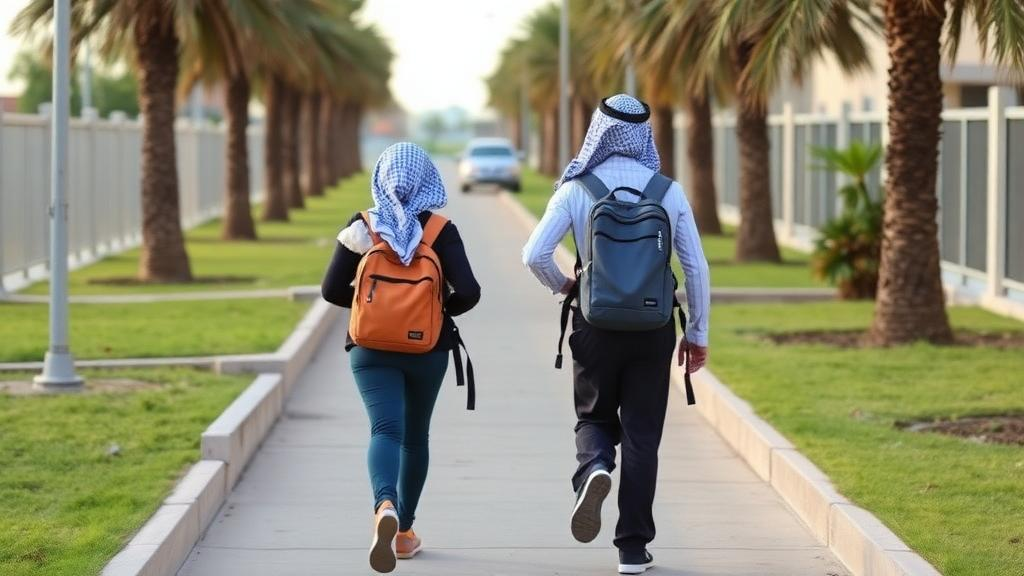
Only about one in eight Saudi adolescents gets enough exercise to meet global health guidelines, but a new study suggests that something as simple as walking or cycling to school could meaningfully shift those odds. The research, published in BMC Public Health, analyzed data from nearly 5,600 students across five Saudi cities and found that those who actively commuted to school on most days of the week were significantly more likely to meet the World Health Organization’s physical activity recommendations than their peers who relied on cars or buses. The finding arrives at a moment when physical inactivity among young people has become one of the most pressing and stubborn public health challenges in the Gulf region and far beyond it.
The World Health Organization recommends that children and adolescents accumulate an average of at least sixty minutes of moderate-to-vigorous physical activity, or MVPA, every day across the week. That threshold matters because regular MVPA during adolescence is tied to healthier cardiovascular profiles, stronger bones, better mental health outcomes, and a reduced lifetime risk of obesity, type 2 diabetes, and other metabolic diseases. Yet meeting that bar is remarkably rare. In this study’s sample, just 12.6 percent of adolescents managed to hit the recommendation, a figure that echoes broader surveillance data showing that the majority of teenagers worldwide fall short of minimum activity levels. Public health researchers have spent years searching for interventions that are cheap, scalable, and capable of embedding exercise into daily routines rather than requiring separate gym time, and active commuting has long been one of the most attractive candidates.
The new research was led by Abdulrahman I. Alaqil of King Faisal University and Mohummed H. Alkhraiji of King Saud University, who conducted a cross-sectional survey of students at forty public intermediate schools spread across five Saudi cities: Riyadh, Jeddah, Dammam, Khamis Mushait, and Tabuk. Of the 5,900 students sampled, 5,588 had complete data for the primary analyses, an unusually large and geographically diverse dataset for studies of this kind in the region. The questionnaire was based on the Global School-based Student Health Survey, a standardized instrument developed through collaboration between the WHO and other international bodies, which allowed the researchers to capture how often each student had walked or cycled to school over the previous seven days.
Methodologically, the study made some deliberate and consequential choices. Active commuting frequency was sorted into three categories: none, meaning zero days of the week; some days, meaning one to four days; and most or all days, meaning five to seven days. Meeting the physical activity recommendation was operationally defined as engaging in at least sixty minutes of MVPA on all seven days of the week. The authors are careful to note that this is a more stringent, study-specific criterion than the WHO’s actual guideline, which is framed as an average across the week rather than a daily requirement. In other words, the study set a high bar for both the exposure and the outcome, which makes the positive association they found all the more striking. If walking to school on most days is linked to hitting a stricter-than-official activity target, the real-world effect on meeting the actual guideline is likely to be at least as favorable.
The statistical analysis used multivariable logistic regression, a technique that estimates the odds of an outcome while adjusting for other variables that could confound the relationship. Here, the models controlled for sex, city, and age, and the standard errors were clustered by school, an important technical step that accounts for the fact that students within the same school share environments, policies, and cultural norms that might otherwise inflate the apparent statistical significance of the results. The researchers also used likelihood ratio tests to formally examine whether the association between active commuting and meeting the recommendation differed by sex or by city.
The headline result was clear. Adolescents who actively commuted to school on most or all days of the week had significantly higher odds of meeting the physical activity recommendation compared with those who never did, with an adjusted odds ratio of 1.66 and a 95 percent confidence interval of 1.35 to 2.03, a result that was highly statistically significant at p less than .001. In practical terms, near-daily active commuting was associated with roughly two-thirds higher odds of hitting the activity target, even after accounting for age, sex, and geographic location. Just as revealing was what the study did not find: commuting actively on only one to four days per week showed no association with meeting the recommendation at all. The dose-response pattern suggests that consistency is the active ingredient. A sporadic walk to school, it appears, is not enough to move the needle; the benefit emerges only when the behavior becomes habitual, woven into the structure of nearly every school day.
The sex-stratified results add an important layer of nuance. The formal test for an interaction between active commuting and sex approached but did not reach conventional statistical significance, with a p-value of .068. However, when the association was examined separately within each group, it was significant among boys, with an adjusted odds ratio of 1.90 and a confidence interval of 1.54 to 2.35, but not among girls, where the estimate was 1.32 with a confidence interval spanning 0.87 to 2.01, crossing the null. The authors are appropriately cautious in their interpretation, noting that the formal interaction test did not reach significance and that the difference between the strata should be treated as suggestive rather than definitive. Still, the pattern is consistent with a substantial body of literature showing that girls and boys often face different barriers to physical activity, and that interventions which work for one sex do not automatically transfer to the other.
Why might the association be weaker among girls? The study itself does not measure the mechanisms, but the authors point to the need for sex-responsive strategies in future work. In Saudi Arabia and many other contexts, girls’ opportunities for active travel can be constrained by factors ranging from cultural norms and safety perceptions to urban design features such as sidewalk quality, shade, and traffic density. Heat is another plausible factor in a country where summer temperatures regularly exceed levels comfortable for walking, and where the timing of the school run may coincide with the hottest part of the day. Any of these forces could dampen the relationship between commuting mode and total activity, either by reducing how much girls actually walk when they report doing so, or by limiting the compensatory activity that commuting might otherwise free up. Disentangling these possibilities will require prospective designs and, ultimately, intervention trials rather than cross-sectional snapshots.
One of the more surprising null findings concerned geography. Despite substantial variation in the overall prevalence of active commuting across the five cities studied, the association between commuting and meeting the activity recommendation did not differ significantly by city, with a likelihood ratio test yielding a p-value of .981. In other words, wherever a student lived, the relationship between near-daily active commuting and hitting the exercise target held up. That consistency strengthens the case that the finding reflects a general behavioral mechanism rather than some idiosyncrasy of a particular urban environment, and it suggests that the strategy could plausibly be scaled across diverse settings without needing to be reinvented city by city.
The authors are careful about the limits of their design. Cross-sectional data capture a single moment in time, which means the study can establish association but not causation. It remains possible, for instance, that adolescents who are already more active and health-conscious are also more likely to choose to walk to school, rather than walking to school itself driving higher activity levels. The stringent seven-day MVPA criterion, while defensible, also means the study’s outcome measure is stricter than the official WHO guideline, and results might look different under an average-based definition. Self-reported questionnaires introduce the possibility of recall and social desirability bias, particularly for something as routine as the school commute. And the sample, drawn from public intermediate schools, may not generalize to private schools or to other age groups.
Even with those caveats, the implications are hard to ignore. The authors conclude that habitual, near-daily active commuting is independently associated with meeting physical activity recommendations among Saudi adolescents, and they frame it as a promising, scalable target for future intervention research, with direct relevance to school-transport policy and urban design. The policy levers are familiar from successful programs elsewhere in the world: safer walking routes, traffic calming near schools, shaded and connected sidewalks, cycling infrastructure, and school-level programs that normalize and celebrate the active commute. In a country undergoing rapid urban transformation, the moment to embed such infrastructure may be now. What this study adds is evidence, from a large and diverse sample, that the humble walk to school is not a trivial habit but a potentially decisive one, provided it happens most days of the week. Turning that association into confirmed causation, and extending its benefits equitably to girls, is the task the researchers say must come next.
Subject of Research: The association between active commuting to school and meeting physical activity recommendations among Saudi adolescents
Article Title: Is active commuting to school associated with meeting physical activity recommendations among Saudi adolescents? A cross-sectional study
Article References: Alaqil, A. I., & Alkhraiji, M. H. (2026). Is active commuting to school associated with meeting physical activity recommendations among Saudi adolescents? A cross-sectional study. BMC Public Health. https://doi.org/10.1186/s12889-026-29980-9
Image Credits: AI Generated
DOI: 10.1186/s12889-026-29980-9
Keywords: active commuting, physical activity, adolescents, Saudi Arabia, WHO guidelines, public health, cross-sectional study, sex differences, MVPA, school transport, urban design, BMC Public Health
Cite Scienmag News
Ophelia Keating. (October 18, 2026). Walking to School Could Help Saudi Teens Hit Exercise Targets, Study Finds. Scienmag. https://scienmag.com/walking-to-school-could-help-saudi-teens-hit-exercise-targets-study-finds/
Ophelia Keating. "Walking to School Could Help Saudi Teens Hit Exercise Targets, Study Finds." Scienmag, 18 October 2026, https://scienmag.com/walking-to-school-could-help-saudi-teens-hit-exercise-targets-study-finds/. Accessed 18 October 2026.
Ophelia Keating. "Walking to School Could Help Saudi Teens Hit Exercise Targets, Study Finds." Scienmag. October 18, 2026. https://scienmag.com/walking-to-school-could-help-saudi-teens-hit-exercise-targets-study-finds/


