


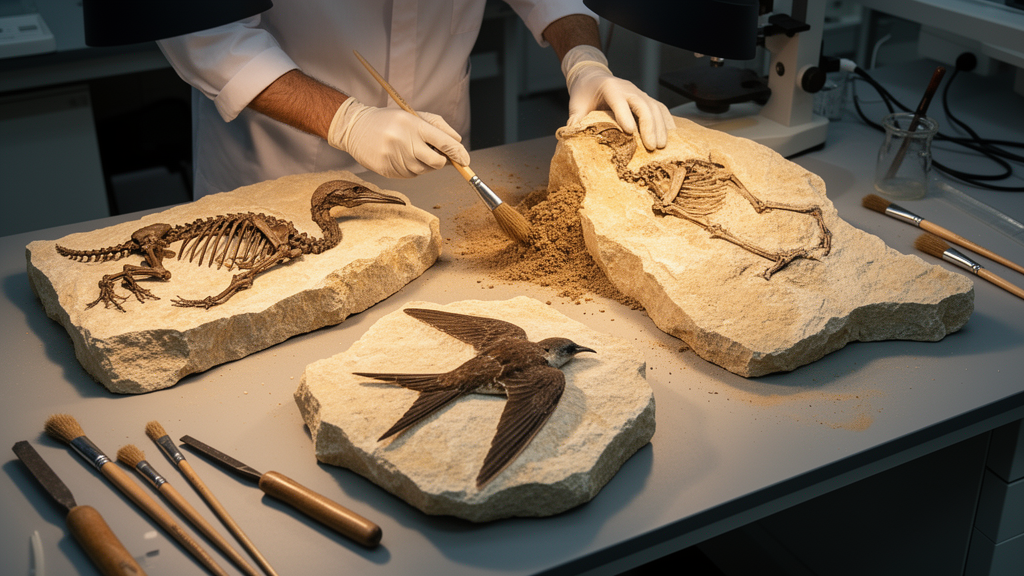
Eleven and a half million years ago, a slow-moving river snaked across the Allgäu region of southern Germany, its channels teeming with fish, turtles, giant salamanders and the hominids that would one day make the site famous. Today that river system is the Hammerschmiede clay pit near Pforzen, one of Europe’s most remarkable fossil sites and the place where the great ape Danuvius guggenmosi was unearthed. A new study in the Swiss Journal of Palaeontology adds a soaring cast of characters to the site’s roster: a previously unknown short-beaked cormorant, a strange hawk unlike any other bird of prey, a tiny swift, new remains of a huge darter, and a loon the size of no living relative. Together they paint a vivid picture of a Miocene river richer in fish than almost any European locality known from this poorly sampled slice of time.
The fossils come from two stratigraphic levels, HAM 4 and HAM 5, dated to roughly 11.58 and 11.62 million years ago, at the very dawn of the Tortonian stage. This interval sits in a notorious gap of the European avian record: while early Miocene bird faunas are comparatively well documented, sites from the later Middle and early Late Miocene have yielded only scrappy, hard-to-identify remains. Birds make up just 3.6 percent of catalogued fossils at HAM 4 and 1.6 percent at HAM 5, yet their diversity is striking, and several of the taxa found there have never been reported from any other Miocene locality in Europe.
The star of the new study is Bavaricarbo brevirostris, a cormorant whose name literally means the short-beaked Bavarian cormorant. In the size of its wing and leg bones it matches the extant Cape cormorant, Phalacrocorax capensis, but its skull tells a different story. The partial rostrum, just over 50 millimeters long as preserved, is proportionally much shorter than that of any comparable living cormorant, and the lower jaw is unusually deep. The species is known from numerous bones, including coracoids, humeri, a carpometacarpus, tibiotarsi and tarsometatarsi, making it one of the more abundant birds at the site and allowing an unusually detailed anatomical comparison with both fossil and modern relatives.
Those anatomical details place Bavaricarbo firmly on the stem of the cormorant family tree, outside the group containing all living species. Stem group cormorants retain a more convex and proximally shorter bicipital crest on the humerus, a deeper brachial fossa, and a differently positioned linea intermuscularis on the coracoid, a ridge that separates the attachment sites of two major flight muscles. As long ago as 1933, the paleornithologist Kálmán Lambrecht argued that these differences reflect evolutionary changes in the pectoral musculature of cormorants, with the supracoracoideus muscle, which elevates the wing, shrinking over time while the coracobrachialis caudalis, which retracts and pronates it, expanded. Because modern studies show a trade-off between diving depth and flight performance in cormorants, the authors suggest that stem group species like Bavaricarbo foraged in shallower waters than most of their modern counterparts.
Bavaricarbo brevirostris is also the youngest stem group cormorant ever found, and its existence has real consequences for how scientists date the rise of the modern cormorant radiation. Molecular clocks place the split between cormorants and their sister group, the darters, at about 28 million years ago, and the divergence of the small genus Microcarbo from all other living cormorants at roughly 16 million years ago. The Hammerschmiede fossils postdate that second split by about five million years, yet Bavaricarbo still sits outside the crown group. This means that archaic, stem lineage cormorants persisted in Europe for millions of years after modern cormorant lineages had already arisen, probably on a southern continent, and were swimming and diving alongside their evolutionary successors.
Indeed, alongside Bavaricarbo the site has yielded bones of a second, much smaller cormorant the size of the living pygmy cormorant, tentatively assigned to the genus Microcarbo. Then there is the darter Anhinga pannonica, already known from Hammerschmiede but now represented by richer material, including the first partial tarsometatarsus ever described for the species and skull fragments that echo the distinctive spear-like bill of modern snakebirds. At an estimated 3.3 kilograms, the darter dwarfed both cormorants. Rounding out the fish-eaters is a fragmentary humerus of a loon, or diver, a bird far smaller than any of the twenty-plus living species and comparable only to an undescribed Middle Miocene loon from the nearby Steinheim Basin. Loons favor lakes and seas rather than rivers, which may explain why this remains the rarest of the site’s waterbirds.
Not every new species stayed in the water. A single distal end of a tarsometatarsus, the fused lower leg bone of birds, revealed Mioaetus pforzenensis, a hawk-sized raptor named after the municipality of Pforzen and comparable in size to a male ornate hawk-eagle. Its foot bone is genuinely bizarre: the second toe’s trochlea, the pulley-like articular surface at the base of the toe, is deflected sharply toward the sole of the foot, and the fourth trochlea is unusually wide. No other accipitrid shows this combination. The researchers considered whether the specimen had been squashed during fossilization, but the bones at Hammerschmiede are not plastically deformed, and the anomalous features are intact. Intriguingly, the plantar deflection of these trochleae faintly recalls the osprey, a dedicated fish-hunter, hinting that this ancient raptor may also have snatched prey from the river.
Perhaps the most charming addition to the Miocene skies is a 9.9-millimeter humerus of a tiny swift, tentatively referred to Apus gaillardi, a species originally described from the late Middle Miocene of La Grive-Saint-Alban in France. This makes it one of the earliest known members of the typical swifts, the tribe Apodini that includes the familiar common swift of European cities. Like its relative, the Hammerschmiede swift was minute, the size of today’s white-rumped or plain swifts, and distinctly smaller than the modern European swift. Since even earlier stem group swifts from the early Cenozoic were smaller still, the authors note that miniaturization appears to be the ancestral condition for the entire swift family, with the larger modern species representing a later evolutionary trend.
The sheer density of fish-eating birds at Hammerschmiede, at least two cormorants, a darter, a loon and possibly Mioaetus itself, speaks to a river system of extraordinary productivity. Taphonomic work suggests that many of the fish remains accumulated as predator deposits, and certain layers of HAM 4 are packed with phosphatic concretions interpreted as fossilized bird guano. A single metric ton of this sediment is estimated to contain 1.6 million fragments of mostly juvenile fish, drawn from a fauna of thirteen species ranging from tiny gobies and loaches to pikes and giant salmonids reaching 1.3 meters in length. The piscivorous birds span weight classes from about 0.7 to 3.3 kilograms, likely partitioning prey by size, while sharing the river with five piscivorous mammals, predatory turtles and a giant salamander.
For paleontologists, the message is clear: the early Late Miocene, long dismissed as a dull stretch of the European bird record, was anything but. Sites like Hammerschmiede, with its unique fluviatile setting and relentless excavation campaigns, are proving that unusual and entirely new lineages were flying, diving and hunting across the continent at the very time when our own ancestors’ relatives walked its banks. Future digs and the study of material already collected promise to keep rewriting this neglected chapter of avian evolution, one exquisitely preserved bone at a time.
Subject of Research: Avian fossils, including two new bird species, from the early Late Miocene Hammerschmiede hominid site in southern Germany
Article Title: A new short-beaked stem group cormorant ( Phalacrocoracidae ), an unusual new hawk ( Accipitridae ), a small swift ( Apodidae ), and other avian remains from the early Late Miocene hominid Fossil-Lagerstätte Hammerschmiede, southern Germany
Article References: Mayr, G., Lechner, T., & Böhme, M. (2026). A new short-beaked stem group cormorant (Phalacrocoracidae), an unusual new hawk (Accipitridae), a small swift (Apodidae), and other avian remains from the early Late Miocene hominid Fossil-Lagerstätte Hammerschmiede, southern Germany. Swiss Journal of Palaeontology, 145, 927-941. https://doi.org/10.3897/sjp.145.200204
Image Credits: AI Generated
Keywords: Hammerschmiede, Miocene, cormorant, Phalacrocoracidae, paleontology, Accipitridae, swifts, Anhinga pannonica, Gaviiformes, Germany, Tortonian, stem group birds
Cite Scienmag News
Gavin Prescott. (October 18, 2026). Miocene Treasure Trove in Germany Yields New Cormorant, Odd Ancient Hawk and One of the Oldest Swifts. Scienmag. https://scienmag.com/miocene-treasure-trove-in-germany-yields-new-cormorant-odd-ancient-hawk-and-one-of-the-oldest-swifts/
Gavin Prescott. "Miocene Treasure Trove in Germany Yields New Cormorant, Odd Ancient Hawk and One of the Oldest Swifts." Scienmag, 18 October 2026, https://scienmag.com/miocene-treasure-trove-in-germany-yields-new-cormorant-odd-ancient-hawk-and-one-of-the-oldest-swifts/. Accessed 18 October 2026.
Gavin Prescott. "Miocene Treasure Trove in Germany Yields New Cormorant, Odd Ancient Hawk and One of the Oldest Swifts." Scienmag. October 18, 2026. https://scienmag.com/miocene-treasure-trove-in-germany-yields-new-cormorant-odd-ancient-hawk-and-one-of-the-oldest-swifts/


