


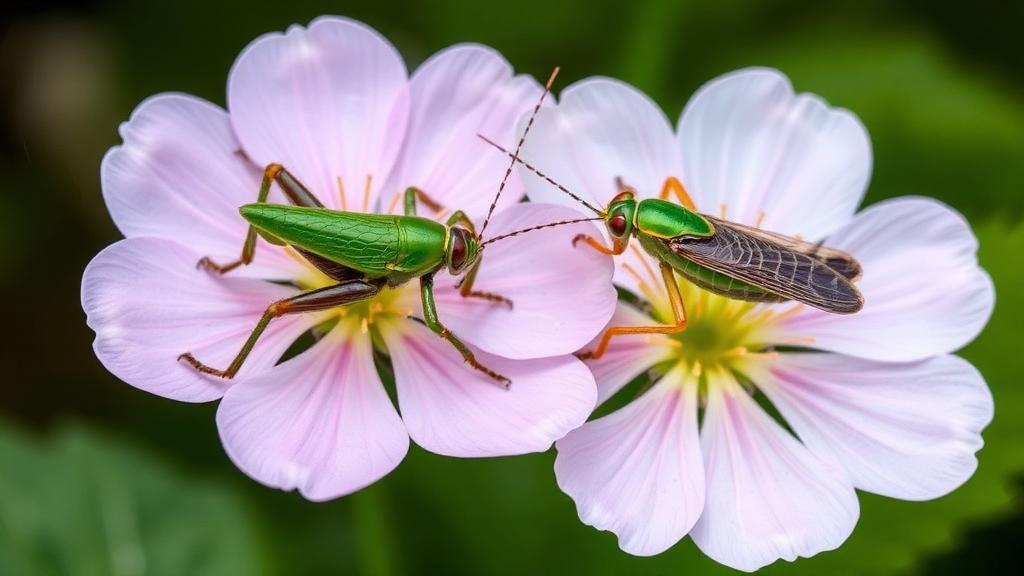
Grasshoppers, crickets, and katydids have long been dismissed as occasional, unremarkable visitors to flowers, the kind of incidental encounters that field biologists note in passing and then forget. A sweeping new dataset from Southeast Asia suggests that this reputation is badly outdated. In a study published in the Journal of Orthoptera Research, researchers compiled 247 documented incidences of flower visitation involving 58 orthopteran taxa and 71 genera of flowering plants, adding 104 new incidences and 17 previously unrecorded flower-visiting orthopteran taxa to the scientific record. The findings point to a hidden world of insect-flower interactions unfolding in the canopies, understories, and shrublands of one of the most biodiverse regions on Earth.
The order Orthoptera comprises roughly 30,000 valid extant species, divided into the suborder Caelifera, which includes grasshoppers, and the suborder Ensifera, which includes crickets and katydids. In most studies of flower-visiting arthropods, orthopterans are excluded from analyses because they are rarely encountered or are not considered effective pollinators. Yet sporadic reports from around the world have documented these insects on flowers for decades, and some researchers have postulated that regular flower visitation may be an important precursor for orthopteran-plant mutualism through pollination services. The new study, building on a pivotal 2017 report that documented 41 orthopteran species visiting flowers of 35 plant species in Southeast Asia, argues that these insects are not rare flower visitors at all, but simply overlooked.
To reconstruct the bipartite network between orthopterans and the flowers they visit, the researchers drew on photographic records collected between late 2017 and mid-2024 across Singapore, the Philippines, Sabah in Borneo, Brunei Darussalam, Bach Ma National Park in Vietnam, and Johor State in Peninsular Malaysia. Both adults and nymphs were photographed as evidence of the visitor and the visited flowers, a technique particularly important when either the insects or the plants could not be collected. The interaction network was visualized using the plotweb function in the bipartite package in R, but with a crucial twist: rather than arranging taxa to minimize crossings, the researchers positioned the orthopterans according to their relative placements in the most recent orthopteran phylogenies, allowing the network to reveal which evolutionary lineages are most floriphilic.
The results are striking. Ensiferans, the katydids and crickets, account for 45 of the 58 flower-visiting taxa, or 78 percent of all orthopteran taxa observed on flowers, far outpacing the 13 caeliferan taxa, or 22 percent. Among the ensiferans, the subfamily Phaneropterinae stands out as the most prominent flower visitor, with 21 taxa representing 36 percent of all flower-visiting orthopteran taxa and 45 percent of all records, or 110 incidences. The genera Phaneroptera, Nisitrus, and Conocephalus were the top three genera observed visiting the most diverse genera of flowers, with Phaneroptera alone documented on flowers from 20 genera across 7 families. Among the caeliferans, only taxa from the subfamilies Pyrgomorphinae, Acridinae, Oxyinae, Catantopinae, and Cyrtacanthacridinae were observed on flowers, with the grasshopper genera Xenocatantops and Valanga recorded visiting the greatest number of flower genera.
Flowers of the family Asteraceae were the most visited, with 16 genera documented, followed by Fabaceae with 11 genera. Some genera, such as Sphagneticola, Ageratum, Prexalis, and Bidens, were visited by 10 to 15 orthopteran taxa each. Notable non-Asteraceae genera include Costus, visited by seven orthopteran taxa, Dillenia by six, Claoxylon by five, and Lantana by seven. The researchers also analyzed floral traits of the visited plants, finding that flowers occurring in clusters or inflorescences, head or capitulum forms, and solitary forms were the most frequently visited, accounting for 32.4, 15.5, and 14.1 percent of visited flower taxa respectively. White and yellow flowers dominated the color palette, at 25.4 and 21.1 percent, and radially symmetrical flowers were visited far more often than bilaterally symmetrical ones, at 73.2 versus 21.1 percent.
The phylogenetic arrangement of the network reveals patterns that would be invisible in a standard affiliation web. Phaneropterinae katydids, which are generalist flower visitors found across habitats ranging from open grasslands to different forest types, were documented visiting orchids, panicles of Cinnamomum, clusters of Caryota mitis, and the petals of Costus. Some species are more specialized, such as the mangrove-associated Holochlora signata, observed visiting the flowers of the mangrove tree Bruguiera cylindrica. The researchers note that Phaneropterinae can occur in high abundance and diversity in the forest canopy, where they are often only encountered at light traps, making their flower-visiting behavior particularly difficult to observe and document. Advances in non-invasive canopy sampling methods, such as macro-camera traps, may address this in the future, particularly during rare mass flowering events in dipterocarp forests.
Not every orthopteran lineage appears to be floriphilic. The absence of any record of flower-visiting Gryllacrididae in the dataset was unexpected, given that gryllacrids were the first orthopterans shown to pollinate flowers. Even during synchronous flowering events in the forest understory where gryllacrids tend to inhabit, no flower visitation was observed. Similarly, predominantly herbivorous katydids from the subfamilies Pseudophyllinae and Mecopodinae, close relatives of Phaneropterinae, do not appear to visit flowers. Small crickets from the families Trigonidiidae and Mogoplistidae, by contrast, are opportunistic feeders that dwell among the leaves and branches of herbs, shrubs, and understory trees where flowers are most accessible, and more records of these crickets visiting flowers were documented.
The researchers caution that floral traits alone do not explain why Asteraceae and Fabaceae dominate the visited flower list. Many of these taxa are free-flowering and tend to dominate their habitats, with genera such as Bidens, Prexalis, Neptunia, and Mimosa easily dominating ground vegetation and being highly invasive in some parts of the world, including Southeast Asia. Experimental work has demonstrated that more Phaneroptera individuals visit patches of vegetation with higher abundances of these flowers. Coincidentally, many of the flower genera are also attractive to butterflies, and some taxa have been deliberately planted to attract butterflies in managed parks and gardens, leading to increased encounters with flower-visiting orthopterans. The preference for radially symmetrical flowers may suggest that flower-visiting orthopterans are typically opportunistic and generalist florivores or pollinators, though Phaneroptera exhibit a specific preference for flowers over leaves, as shown by a series of experimental studies.
The color preference for white and yellow flowers is congruent with findings that generalist flower-visiting dipterans preferentially visit white and yellow flowers and colored traps, and behavioral experiments have shown that grasshoppers approach yellow targets more frequently than other colors. The ecological significance of this color preference among orthopterans remains unclear. Only slightly more plant taxa with terminal flowers were frequented compared to those with axillary flowers, and the researchers suggest that flower location may inform the visitor’s accessibility to resources and risk of exposure to predation, though these considerations are also dependent on other floral traits such as size, color patterns, wavelengths outside the human visible spectrum, and plant height.
Despite the insights offered, the researchers are careful not to overinterpret the data. They recommend caution against drawing too much inference at present owing to the unresolved phylogenetic relationships between the taxa involved and the incompleteness of the current dataset. Questions about whether these orthopterans help with pollination or cause more florivory damage to the plants remain open, and future studies combining cost-benefit analysis of both pollination and florivory by orthopterans are crucial to better understand their ecological roles. With many species from Southeast Asia still undescribed, with unknown natural history, and with a vast part of the region remaining unexplored and understudied, the researchers conclude that we are still extremely far from understanding the actual diversity of flower-visiting orthopterans. Continued natural history research, they argue, is essential for a more comprehensive understanding of these insects and their ecological impacts in the region.
Subject of Research: research news
Article Title: Improving and reconstructing data about the network between Orthoptera and flowers in Southeast Asia
Article References: Tan, M. K., Salvador, J. A. G., Nuñeza, O. M., Muhammad, A. A., Abdullah, N. A., Wahab, R. A., Baroga-Barbecho, J. B., Yap, S. A., Vu, T. T., Truong, T. C. T., Pham, T. H., Japir, R., & Chung, A. Y. C. (2025). Improving and reconstructing data about the network between Orthoptera and flowers in Southeast Asia. Journal of Orthoptera Research, 34(1), 135-142. https://doi.org/10.3897/jor.34.137349
Image Credits: AI Generated
Keywords: Improving, reconstructing, data, network, between, Orthoptera, flowers, Southeast, Asia, scientific research
Cite Scienmag News
Gavin Prescott. (October 18, 2026). Grasshoppers and Katydids Are Secretly Southeast Asia’s Busiest Flower Visitors. Scienmag. https://scienmag.com/grasshoppers-and-katydids-are-secretly-southeast-asias-busiest-flower-visitors/
Gavin Prescott. "Grasshoppers and Katydids Are Secretly Southeast Asia’s Busiest Flower Visitors." Scienmag, 18 October 2026, https://scienmag.com/grasshoppers-and-katydids-are-secretly-southeast-asias-busiest-flower-visitors/. Accessed 18 October 2026.
Gavin Prescott. "Grasshoppers and Katydids Are Secretly Southeast Asia’s Busiest Flower Visitors." Scienmag. October 18, 2026. https://scienmag.com/grasshoppers-and-katydids-are-secretly-southeast-asias-busiest-flower-visitors/


