


A striking new tarantula has emerged from the misty slopes of Mount Nimba in Guinea, and with it comes a cascade of firsts for West African arachnology. The species, formally named Selenogyrus foordi, represents not only a spider new to science but also the first record of the subfamily Selenogyrinae from Guinea, the first published in vivo photographs of any selenogyrine spider, and the description of a genus so poorly studied that it had received essentially no revisionary attention since the nineteenth century. The discovery, published in African Invertebrates, is based on type material of both sexes collected at two sites on Mount Nimba, a renowned African biodiversity hotspot where numerous new spiders have been described during the present century.
The genus Selenogyrus has a convoluted taxonomic history stretching back to 1897, when Pocock described it to house two new species from Sierra Leone: S. caeruleus, the type species, based on a female, and S. aureus, based on a male. In the same work, Pocock also transferred Hapalopus africanus, described from the Ivory Coast by Simon in 1887, into Selenogyrus. What Pocock overlooked, however, was that Simon had already indirectly moved that species to the genus Cyclosternum in 1892, another genus to which it clearly did not belong. Both Cyclosternum and Hapalopus are New World genera possessing urticating setae, and Hapalopus also carries a patterned abdomen, making the African species an obvious misfit in either. For the next nine decades, the genus received no revisionary attention at all, with only scattered illustrations appearing in broader comparative works.
The most significant advance in the taxonomy of Selenogyrus came in 1990, when Smith provided expansive redescriptions of S. aureus and S. caeruleus, described a new species, S. austini, based on a single female from Sierra Leone, and established the subfamily Selenogyrinae to house the genus. Smith’s subfamily was founded predominantly on one remarkable feature: the intercheliceral stridulatory apparatus, a sound-producing structure furnished on the prolateral face of the chelicerae with a clavate stridulatory lyra. Since Smith’s work, the only taxonomic illustrations in the literature were reproductions of earlier drawings by Schmidt in 1993 and 2003, making no novel contributions. The World Spider Catalog currently recognises four species, three from Sierra Leone and one from the Ivory Coast, all known from a single sex, and the species known from females are in urgent need of review.
Against this backdrop, the new species from Mount Nimba stands out as a genuine breakthrough. The holotype male was collected at Keoulanta on Mount Nimba at 515 metres above sea level in November 2017, while the paratype female came from Seringbara on the same massif, from gallery forest at 599 metres, collected in October 2008. The male measures 26.7 millimetres in total length including chelicerae, with a carapace length of 12.0 millimetres, while the female is considerably larger at 52.3 millimetres total length with a carapace of 20.0 millimetres. Both specimens are deposited in the Royal Museum for Central Africa in Tervuren, Belgium, and the article was registered in ZooBank prior to publication in accordance with the International Code of Zoological Nomenclature.
The diagnosis of the new species rests on precise anatomical differences. Males of S. foordi can be distinguished from S. aureus by the thinner apical taper of the embolus, the filiform sperm-transfer structure of the palpal bulb, which tapers strongly in its apical third, whereas in S. aureus the embolus is wider at the apex. In life, the new species also shows darkened femora and white markings on the distal third of the tibiae, while S. aureus has femora with a golden tinge and lacks white tibial markings. Females of S. foordi can be separated from S. africanus, S. austini, and S. caeruleus by the medially flared receptacles of the spermathecae, the paired sperm-storage structures that flare prolaterally and retrolaterally in the middle before tapering gently to the apex, each with a single indistinct lobe and no neck constriction.
The technical description of the holotype male reveals a spider built to the classic theraphosid blueprint but with distinctive proportions. The fovea is deep and procurved, the maxilla carries 100 to 150 cuspules covering roughly 32 percent of the proximal edge, and the labium bears 200 to 220 cuspules. Tarsi I, II, and IV are fully scopulate, and the metatarsal scopulae extend over 85 percent of metatarsus I but only 17 percent of metatarsus IV. The leg formula is 4,1,2,3, starting with the longest leg. Tibia I carries a paired tibial apophysis, the mating-spine structure used in copulation, in which the retrolateral branch is longer than the prolateral branch, the latter bearing two prolateral megaspines situated medially and almost as long as the branch itself. The palpal bulb has a weakly developed tegular hood, and the embolus carries weakly developed prolateral superior, retrolateral superior, and apical keels, with the two superior keels apically fused.
Perhaps the most remarkable aspect of the study is the application of micro-computed tomography to the type material. The researchers dehydrated the structures in graded ethanol from 70 to 95 percent, stained them with a one percent Lugol’s iodine solution for 24 hours, washed them in pure acetone, air-dried them, and fixed them gently with tape on a carbon stick. The samples were scanned with a Tescan XRE UniTOM system at 70 keV and 2 watts, with exposure times of 500 to 700 milliseconds, voxel sizes between 0.97 and 1.52 micrometres, and a total of 2000 projections. The resulting models were reconstructed, segmented, and meshed in specialised software, producing detailed three-dimensional visualisations of the palpal bulb and tibial apophysis that complement the conventional light-microscope photographs made with a Leica DMC500 digital camera mounted on a Leica MZ16A stereomicroscope.
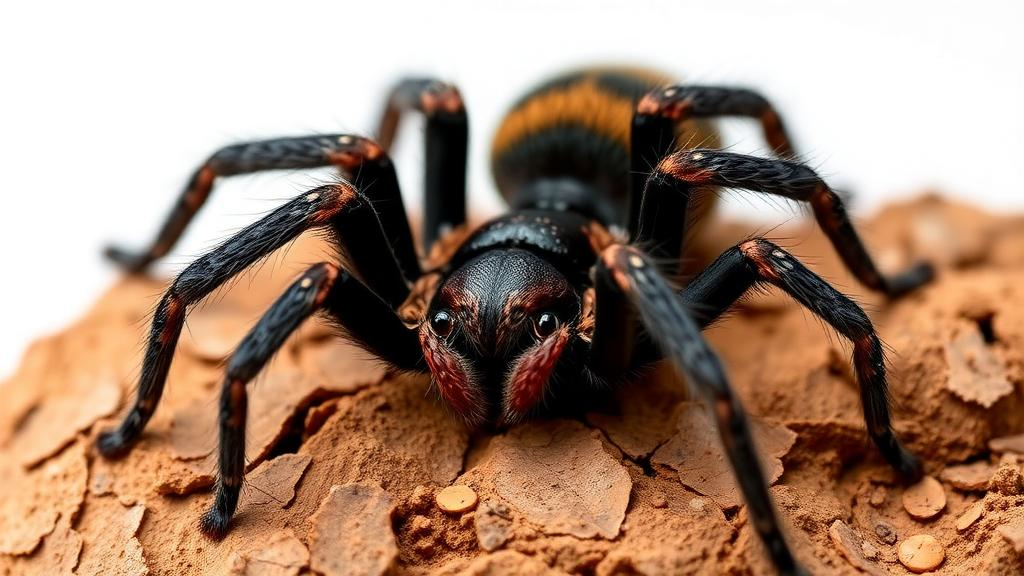
The in vivo colouration of the new species is nothing short of spectacular, and the photographs published with the study are, to the authors’ knowledge, the first published photographs of a living selenogyrine spider. The male displays a carapace with turquoise pubescence, alternating radial bands of fawn and dark green, and lateral margins with bands of sepia-coloured bristles. The chelicerae carry tawny-brown bristles, the endites bear long red-brown bristles apically, and the palp is dark brown with a white blotch at the tip. The femora are dark brown with long brown bristles ventrally, the tibiae are brown in the proximal half and white in the distal half, and the abdomen is dark brown with a slightly coppery sheen. The female, by contrast, is overall black with orange-red hairs densely distributed on the legs, a dramatic contrast that makes the two sexes instantly recognisable in the field.
The stridulatory apparatus that defines the subfamily is present in both sexes of the new species, with the prolateral face of the chelicera furnished with a clavate stridulatory lyra. This sound-producing structure, located between the chelicerae, was the predominant basis on which Smith established Selenogyrinae in 1990, and its confirmation in the new species reinforces the subfamily’s placement. The specific epithet foordi is an eponym honouring the late Stefan Foord, who lived from 1971 to 2023, in recognition of his significant contributions to African arachnology and in remembrance of his kind and collaborative spirit, a fitting tribute from colleagues who knew him well.
Beyond the new species, the study also records Selenogyrus aureus from Guinea for the first time, based on four males collected in pitfall traps in the rainforest of the Massif du Ziama Biosphere Reserve between April and July 1998. This makes S. aureus, originally described from Sierra Leone, the second known species of the genus for Guinea. The researchers provide photomicrographs of the palpal bulb of the S. aureus holotype male, held in the Natural History Museum in London, to assist in identification, but withhold a full description since that work is being undertaken separately by a colleague. With S. foordi known only from Mount Nimba and S. aureus now confirmed from the Ziama massif, Guinea emerges as a country harbouring two of the world’s five recognised selenogyrine species, a remarkable concentration for a subfamily that, until now, was known almost exclusively from a handful of century-old specimens scattered across European museum collections.
Subject of Research: Zoology
Article Title: Selenogyrus foordi , a new species and the first record of the subfamily Selenogyrinae Smith, 1990 from Guinea ( Araneae , Theraphosidae )
Article References: Sherwood, D., Henrard, A., & Van Den Spiegel, D. (2024). Selenogyrus foordi, a new species and the first record of the subfamily Selenogyrinae Smith, 1990 from Guinea (Araneae, Theraphosidae). African Invertebrates, 65(2), 37-48. https://doi.org/10.3897/afrinvertebr.65.128284
Image Credits: AI Generated
DOI: 10.3897/afrinvertebr.65.128284
Keywords: tarantula, spider, new species, Guinea, Mount Nimba, Theraphosidae, Selenogyrinae, taxonomy, biodiversity, West Africa, Selenogyrus, foordi
Cite Scienmag News
Margaret Porter. (October 18, 2026). New tarantula species from Mount Nimba marks first record of selenogyrine spiders in Guinea. Scienmag. https://scienmag.com/new-tarantula-species-from-mount-nimba-marks-first-record-of-selenogyrine-spiders-in-guinea/
Margaret Porter. "New tarantula species from Mount Nimba marks first record of selenogyrine spiders in Guinea." Scienmag, 18 October 2026, https://scienmag.com/new-tarantula-species-from-mount-nimba-marks-first-record-of-selenogyrine-spiders-in-guinea/. Accessed 18 October 2026.
Margaret Porter. "New tarantula species from Mount Nimba marks first record of selenogyrine spiders in Guinea." Scienmag. October 18, 2026. https://scienmag.com/new-tarantula-species-from-mount-nimba-marks-first-record-of-selenogyrine-spiders-in-guinea/


