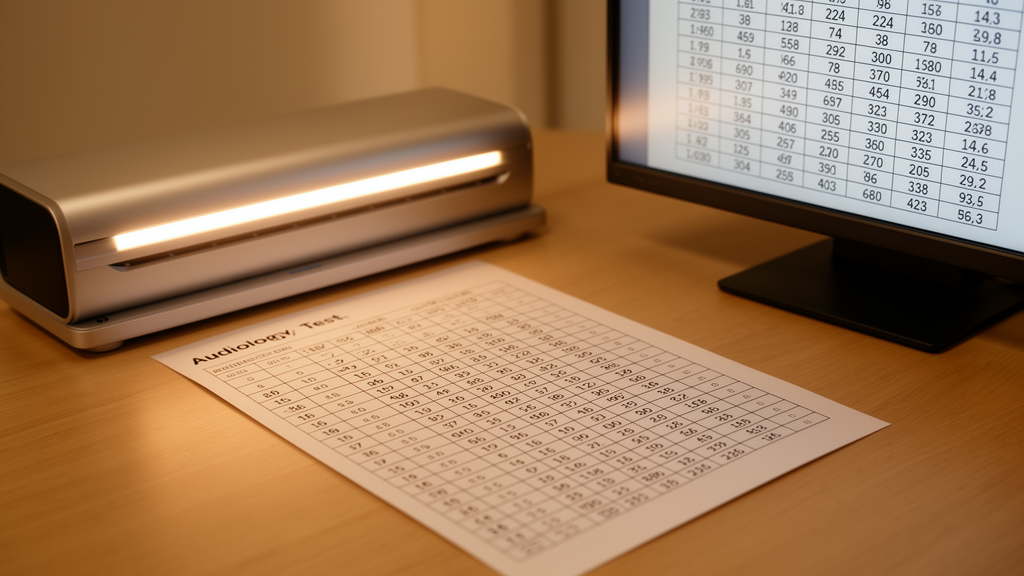
Yet the data that researchers need most to study and prevent hearing impairment—pure tone audiometry, speech reception thresholds, and word recognition scores—often sits locked inside electronic medical records as image files. A team in South Korea has now built an automated pipeline that reads those images directly, using a voting-based optical character recognition approach that reaches an overall image-level accuracy of 97.60 percent on 2,000 hearing test reports. The study, published in Scientific Reports by Doyoung Kwon, Da Jung Jung, Jigon Son, and colleagues including Kyu-Yup Lee, addresses a gap that existing automated methods have largely ignored.
Prior work on extracting audiometric data has concentrated almost exclusively on the graphical audiogram, in which hearing thresholds appear as symbols and curves plotted on frequency–intensity axes. Those graph-based methods, which combine convolutional neural networks, object detection, and OCR, work well because audiogram plots are highly standardized. But many audiometers and electronic medical record systems also export results as a numerical table of threshold values, and that table-formatted modality had not been addressed by automated extraction methods—forcing researchers to transcribe the numbers by hand.
The new method, called Voting OCR or VOCR, deliberately targets this complementary data format. Because the values in a table are already discretized, the task reduces to robust character recognition rather than geometric inference of symbol positions relative to axes. The researchers used the open-source Tesseract OCR engine with its publicly available pretrained LSTM recognition model, entirely without training or fine-tuning.
All accuracy improvements came from image preprocessing, multi-candidate generation, and the voting mechanism rather than supervised learning on audiometric data, which means none of the validation images were used to train anything. The dataset consisted of audiometric reports from 710 patients who visited a medical institution between January 16, 2013, and November 8, 2018, compiled into 2,000 report images used exclusively for validation. The study was approved by the Institutional Review Board of Kyungpook National University Hospital, which waived informed consent, and all patient data were anonymized and de-identified.
Notably, the reports were generated electronically as digital PDF files and converted to raster images, so the images processed were computer-generated rather than scans of paper printouts—an important detail when weighing how the method might perform elsewhere. The pipeline begins with cell boundary detection. Because the report format is standardized, the system first locates the table region from approximate coordinates, then applies Canny edge detection with hysteresis thresholds of 50 and 200 to identify the black horizontal and vertical lines that delineate each cell.
Pixel histograms are generated for both the width and height dimensions, and the distinct peaks produced by the table lines pinpoint cell boundary coordinates even with minor misalignments. The semantic role of every cell—ear side, conduction type, frequency—is determined by its position in the recovered grid rather than by recognizing separate text labels, since the layout is fixed. When a report with a different layout arrives, the table region and its structure are re-specified once, after which the same positional mapping applies.
The voting stage is where VOCR earns its name. For each cell, the system generates multiple OCR candidates using OpenCV-based image augmentation: four transformed candidates per cell produced by dilation with 3×3 and 2×2 kernels, opening with a 2×2 kernel, and closing with a 3×3 kernel, plus additional candidates created by isolating individual characters. Otsu binarization, preceded by a 7×7 Gaussian blur, separates characters from the background robustly across brightness variation, and contour detection with bounding-box refinement extracts each glyph.
All candidates are then processed by OCR, and a majority-vote mechanism selects the final value, with a penalty applied when a candidate's character length differs from the expected length. The voting rate—the level of agreement among candidates—doubles as a built-in confidence score. Before any of that, VOCR strips away the symbols that trip up conventional OCR.
In the speech reception threshold and word recognition sections, the unit labels "dB" and "%" are displayed alongside the numbers and sometimes overlap with them in the image. The symbol-removal step performs horizontal histogram analysis to count characters and measure their widths, then applies width-based rules to detect overlap: for cells with one or two detected characters, a first character wider than a 28-pixel threshold signals an overlapping symbol, while for cells with three or more characters the penultimate character's width is tested. A bounding box is then used to crop away the symbol region, with 20 pixels of padding added to keep the cropped images consistent for OCR processing.
The performance gains are striking under the study's strict all-or-nothing evaluation criterion, in which a single incorrect cell anywhere in a report caused that image to be counted as a failure. Basic OCR achieved an overall image-level accuracy of just 24.95 percent, whereas VOCR reached 97.60 percent—a difference confirmed as statistically significant by McNemar's test on the paired per-image outcomes (continuity-corrected χ² of 1451.0, p<0.001). Region by region, VOCR achieved 99.95 percent accuracy for pure tone audiometry, up from 77.95 percent for basic OCR; 98.95 percent for speech reception threshold, up from 31.60 percent; 98.05 percent for word recognition score percentages, up from 31.60 percent; and 99.80 percent for word recognition stimulus levels, up from 33.55 percent.
All comparisons were statistically significant, and VOCR did not produce a worse result than basic OCR on any of the 2,000 images in any region—every change was an improvement. The voting rate metric also functions as a triage tool for human reviewers. At a 100 percent voting rate, meaning unanimous agreement among all OCR candidates, the pure tone audiometry section produced a 0 percent error rate, and error rates in the other sections remained close to zero.
Lowering the threshold to 75 and 50 percent increased error rates slightly across all sections. This graded reliability signal means data collectors can focus their manual review on the small subset of cells with low consensus, rather than re-checking everything—a workflow the authors argue is well suited to multi-center studies where reports from different institutions must be standardized. Adapting VOCR to a new report format requires no retraining, only three configuration steps: specifying the table region, defining its row and column structure, and confirming the expected value type for each column, steps the team plans to expose through a web-based interface.
The authors are candid about the limitations. The method was developed and validated on 2,000 reports from a single institution sharing one standardized table layout, so its accuracy on reports from other institutions with different structures has not yet been evaluated. The symbol-removal and overlap-detection steps rely on the fixed per-character pixel widths of the monospaced fonts used in these reports, with thresholds tuned accordingly, and the method has not been validated for proportional variable-width fonts.
Performance on scanned or photographed paper reports, which introduce additional noise and geometric distortion, also remains unassessed. Extensions to other tabular medical data such as tinnitograms, impedance audiometry, spirometry tables, and vital-sign records are prospective and were not tested in this study. Even so, the demonstrated jump from roughly one-in-four to better than 97 in 100 fully correct report extractions—achieved without any model training—suggests that voting-based OCR could meaningfully lower the cost of assembling the large audiometric datasets that hearing research has long needed.
Subject of Research: Automated extraction of audiometric data from medical record images using voting optical character recognition
Article Title: Development of an automated method for audiometric data extraction and analysis using voting optical character recognition
Article References: Kwon, D., Jung, D. J., Son, J., Shon, B., Lee, Y. J., Jeong, S., & Lee, K.-Y. (2026). Development of an automated method for audiometric data extraction and analysis using voting optical character recognition. Scientific Reports, 16(1), Article 34045. https://doi.org/10.1038/s41598-026-62755-1
Image Credits: AI Generated
DOI: 10.1038/s41598-026-62755-1
Keywords: audiometry, optical character recognition, voting OCR, hearing loss, electronic medical records, pure tone audiometry, speech reception threshold, word recognition score, Tesseract, medical data extraction, otolaryngology, machine learning
Cite Scienmag News
Blake Davidson. (October 27, 2026). Voting OCR Reads Hearing Test Tables with 97.6 Percent Accuracy. Scienmag. https://scienmag.com/voting-ocr-reads-hearing-test-tables-with-97-6-percent-accuracy/
Blake Davidson. "Voting OCR Reads Hearing Test Tables with 97.6 Percent Accuracy." Scienmag, 27 October 2026, https://scienmag.com/voting-ocr-reads-hearing-test-tables-with-97-6-percent-accuracy/. Accessed 28 October 2026.
Blake Davidson. "Voting OCR Reads Hearing Test Tables with 97.6 Percent Accuracy." Scienmag. October 27, 2026. https://scienmag.com/voting-ocr-reads-hearing-test-tables-with-97-6-percent-accuracy/