


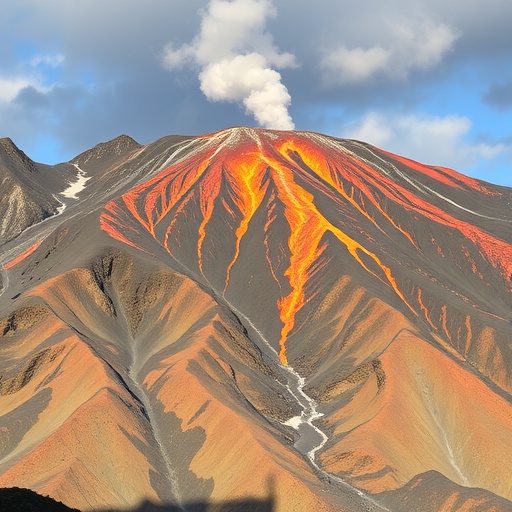
In a groundbreaking study published in Nature Communications, researchers Zhao, Zhang, Algeo, and colleagues have unveiled compelling evidence linking volcanic activity and the weathering of basaltic rocks to a pivotal climatic cooling event during the Ordovician period. This research not only sheds light on the intricate mechanisms driving Earth’s ancient climate systems but also provides a nuanced understanding of how geological processes interplay to shape global climate on geological timescales.
The Ordovician period, occurring roughly 485 to 443 million years ago, is known for one of the most profound climatic shifts in Earth’s history—a dramatic cooling that ultimately set the stage for a major glaciation event. For decades, scientists have debated the primary forces behind this climatic transition. The new study offers a detailed exploration of how volcanism and basalt weathering contributed as interconnected factors triggering this global cooling.
At the heart of the investigation lies the crucial role of volcanic eruptions during the Ordovician. Volcanism is known to inject vast quantities of gases and aerosols into the atmosphere, which can impact climate both rapidly and over extended periods. Zhao and colleagues utilized geochemical proxies derived from sedimentary rock records to reconstruct the intensity and timing of volcanic activity. Their findings suggest a phase of intensified basaltic volcanism that delivered copious basaltic lava flows across landscapes, fundamentally altering atmospheric chemistry.
Basalt, a mafic volcanic rock, weathers relatively quickly compared to other lithologies, releasing key elements such as calcium and magnesium ions into surface waters. This weathering process acts as a powerful carbon sink through enhanced chemical reactions that remove atmospheric carbon dioxide (CO₂). The study highlights how the widespread basalt weathering, fueled by pervasive volcanic basalt exposure, dramatically accelerated the drawdown of CO₂ from the atmosphere, contributing to lower global greenhouse gas concentrations.
By leveraging sophisticated modeling techniques alongside empirical data, the researchers have elucidated the feedback mechanisms in play. Volcanic emissions initially introduced greenhouse gases and aerosols, modifying radiative forcing, but the subsequent intensified weathering acted as an overcompensating negative feedback. The net effect was a persistent reduction in atmospheric CO₂, promoting cooler global temperatures over millions of years.
Importantly, this research integrates multidisciplinary approaches, combining stratigraphic analysis, isotope geochemistry, and climate modeling. This methodology allowed the team to construct a fine-resolution temporal framework pinpointing the synchronization between volcanic pulses and episodes of enhanced weathering. The tight coupling between these events presents a compelling narrative for how geosphere-atmosphere interactions drive large-scale climate transitions.
The study also expands our understanding of the carbon cycle’s sensitivity to tectonic and volcanic processes during deep time. It emphasizes that the Earth’s long-term climate stability depends heavily on surface rock composition and tectonic regimes that control the extent and nature of weatherable lithologies exposed to atmospheric and hydrospheric conditions. These insights bear implications for interpreting other ancient climate events beyond the Ordovician.
Furthermore, Zhao et al. reveal that the Ordovician cooling was not merely a consequence of declining volcanic CO₂ emissions, which conventionally might be expected as volcanism wanes, but rather a nuanced balance between volcanic gas release and basalt weathering intensity. The dynamic interplay likely generated episodic perturbations in atmospheric chemistry, facilitating the cooling phase with a complex temporal pattern.
This research also challenges prior assumptions that volcanic activity invariably leads to rapid warming due to greenhouse gas emissions. It introduces a novel perspective suggesting that under certain geological conditions—particularly with abundant basalt exposure—volcanic activity can paradoxically initiate climatic cooling through geochemical weathering pathways.
The authors underscore the broader relevance of their findings to current climate science. While timescales differ vastly, the fundamental processes of basalt weathering and atmospheric CO₂ regulation are ongoing today, particularly in regions with active tectonics and volcanic basalt provinces. Understanding how these natural processes have influenced Earth’s climate in the past enhances predictive models of future climate dynamics.
What sets this study apart is its integration of high-precision isotopic records, including excursions in strontium and lithium isotopes, which trace weathering intensity and hydrothermal activity with remarkable detail. Such geochemical fingerprints provided robust proxies that validate the link between volcanic pulses and intensified basalt weathering, supporting the thesis with solid empirical evidence.
Moreover, the study’s climate models offer compelling simulations that align closely with geological data, reinforcing the reliability of these interpretations. The synergy between data-driven insight and theoretical modeling establishes a pioneering framework for exploring paleoclimates through a geochemical lens.
The profound Ordovician climatic cooling had major repercussions for life on Earth, including the diversification and eventual decline of many marine species. By elucidating the driving forces behind this climatic shift, the study informs evolutionary biology, highlighting how external geophysical factors can instigate environmental stressors that shape biospheric trajectories.
Zhao and colleagues have opened new avenues for exploring the links between mass volcanic events, planetary carbon cycles, and climate regulation. Their work paves the way for future research to interrogate other geological intervals of climatic upheaval, such as the Permian-Triassic transition or the Paleocene-Eocene Thermal Maximum, under a similar integrative framework.
In conclusion, the study “Volcanism and basalt weathering drove Ordovician climatic cooling” offers a paradigm shift in understanding the complex interactions between Earth’s interior processes and surface climate. It emphasizes the critical roles of geological substrates and volcanic activity in modulating atmospheric greenhouse gases and, consequently, global temperatures over profound timescales.
The results underscore Earth’s capacity for rapid and sustained environmental change in response to geological phenomena, highlighting a delicate balance that has shaped the planet’s habitability. As we refine our grasp of Earth’s climatic past, such research is instrumental for forecasting future climate trajectories in an era marked by anthropogenic influences.
Cite Scienmag News
Violet Maxwell. (December 12, 2025). Volcanism, Basalt Weathering Fueled Ordovician Cooling. Scienmag. https://scienmag.com/volcanism-basalt-weathering-fueled-ordovician-cooling/
Violet Maxwell. "Volcanism, Basalt Weathering Fueled Ordovician Cooling." Scienmag, 12 December 2025, https://scienmag.com/volcanism-basalt-weathering-fueled-ordovician-cooling/. Accessed 4 September 2026.
Violet Maxwell. "Volcanism, Basalt Weathering Fueled Ordovician Cooling." Scienmag. December 12, 2025. https://scienmag.com/volcanism-basalt-weathering-fueled-ordovician-cooling/


