


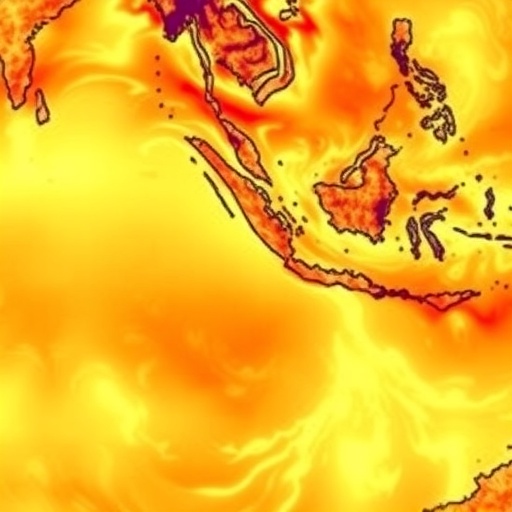
Woods Hole, Massachusetts—A new study suggests that the climate systems of the tropical Indian and Pacific oceans have been unusually disconnected in recent decades, with human-caused greenhouse gas emissions now driving a disruption more exceptional than anything seen in the past four centuries. The research, published in Nature Communications by scientists at the Woods Hole Oceanographic Institution, combines coral records, tree rings, stalagmites, modern observations, and climate-model simulations to reconstruct how the two ocean basins influenced one another from the early 1600s to the present. The findings reveal that volcanic eruptions can temporarily weaken the normally strong relationship between Indian and Pacific climate variability. They also indicate that the modern breakdown, which became especially apparent after the 1980s, is fundamentally different in scale and persistence from earlier disruptions caused by natural events.
The Pacific and Indian oceans are not isolated climate engines. Their tropical atmospheres and upper oceans are connected through large-scale circulation patterns that transport heat, moisture, and momentum across thousands of kilometers. Under typical conditions, variations in the tropical Pacific—including changes associated with El Niño and La Niña—help shape rainfall, winds, sea-surface temperatures, and atmospheric pressure across the Indian Ocean. This inter-basin coupling is one reason scientists can use Pacific conditions to anticipate climate behavior in parts of the Indian Ocean region. But the relationship is not fixed. Ocean temperatures, atmospheric circulation, volcanic aerosols, and greenhouse-gas-driven changes can all alter the strength and timing of these connections, potentially making climate prediction more difficult.
The challenge has been determining whether the recent decoupling is truly extraordinary. Instrumental observations of ocean temperatures and atmospheric circulation are relatively short, extending back only several decades with the quality and geographic coverage required for detailed analysis. That record is long enough to identify a striking change since the late twentieth century, but too brief to establish how often similar events occurred in the deeper past. To overcome this limitation, the researchers turned to paleoclimate archives. Corals preserve chemical signatures of past seawater temperatures and rainfall, tree rings record the effects of seasonal moisture and temperature, and stalagmites capture changes in precipitation as they grow layer by layer inside caves. Together, these natural archives provide indirect but valuable evidence of tropical climate variability before satellites, ocean buoys, and modern weather stations existed.
The reconstructed record shows that the Indian and Pacific oceans generally moved in concert through most of the past 400 years. This coupling did not mean that the basins were identical or that every climate event affected them in precisely the same way. Instead, it reflected a recurring statistical relationship in which fluctuations in one basin were commonly associated with predictable responses in the other. That connection became markedly weaker during the period from approximately 1810 to 1850, when the two regions displayed a different pattern of variability. Climate-model experiments covering the past millennium support the researchers’ conclusion that a sequence of major tropical volcanic eruptions was the principal cause of this early nineteenth-century disruption.
Large eruptions can influence climate by injecting sulfur dioxide high into the stratosphere, where it reacts with water vapor to form sulfate aerosols. These tiny particles reflect incoming sunlight and temporarily cool the planet’s surface, while also modifying atmospheric circulation. The cooling is not geographically uniform. Because tropical eruptions affect the distribution of solar energy across the atmosphere and ocean, they can reorganize winds, monsoons, convection, and the movement of heat between the tropics and higher latitudes. Those changes may interrupt the mechanisms that normally transmit Pacific climate signals into the Indian Ocean. The simulations indicate that the degree of decoupling depended on both eruption strength and the background climate state, meaning that identical volcanic forcing would not necessarily produce identical effects at different times.
This volcanic history provides a crucial benchmark for interpreting the present. The recent weakening of Indian-Pacific co-variability began to stand out in observations during the 1980s, but unlike the nineteenth-century event, it has unfolded alongside sustained human-caused warming. Greenhouse gas emissions are heating the atmosphere and ocean, changing the vertical structure of the tropical atmosphere, altering ocean stratification, and influencing the location and intensity of major circulation systems. As the upper ocean warms and becomes more strongly separated from cooler deeper waters, the pathways through which climate signals travel can change. The authors argue that these anthropogenic influences are now overwhelming the Pacific’s traditional influence on Indian Ocean variability, producing a breakdown that is unusually persistent and exceptional in the context of the reconstructed record.
The implications extend far beyond an academic debate about ocean statistics. Connections between the Pacific and Indian oceans help climate scientists estimate the likelihood of drought, floods, heat waves, monsoon failures, and unusually heavy rainfall across densely populated regions. If the Indian Ocean no longer responds to Pacific conditions in the expected way, forecasting systems that rely on established relationships may lose accuracy. A Pacific event that once offered an early warning of Indian Ocean rainfall or temperature anomalies may now provide a weaker or less reliable signal. This matters for agriculture, water management, disaster preparedness, public health, and coastal planning, especially in countries whose economies and food supplies are closely tied to seasonal monsoon behavior.
The study also emphasizes that the Indian Ocean should not be treated merely as a passive recipient of Pacific climate signals. It is a vast heat reservoir capable of storing and releasing enormous amounts of energy, and its own internal dynamics can produce climate effects that develop independently of conditions in the Pacific. Changes in sea-surface temperature, ocean currents, atmospheric convection, and regional winds can combine to create an Indian Ocean response that diverges from the pattern scientists would expect based on Pacific variability alone. Recognizing this independence will be essential as climate change intensifies. Models and forecasting tools that examine each ocean basin separately may miss critical feedbacks, while models that assume a stable connection between the basins could underestimate the likelihood of unexpected regional climate extremes.
By combining evidence from centuries of natural climate archives with simulations of the last millennium and modern observations, the researchers say they can place recent changes in a much longer context. The results do not suggest that volcanic eruptions and greenhouse warming operate in exactly the same way. Volcanic forcing produces a relatively abrupt, temporary shock, while rising greenhouse gas concentrations create a persistent alteration of the climate system. Yet the historical record shows that the Indian-Pacific relationship is sensitive enough to be disrupted when the global circulation is strongly disturbed. The modern era appears especially unusual because a long-lasting human influence is now reshaping that relationship after centuries of broadly consistent coupling. The researchers conclude that understanding the independent behavior of the Indian Ocean will be vital for predicting how tropical climate variability evolves in a warming world.
News Publication Date: August 26, 2026
Web References: Woods Hole Oceanographic Institution, https://www.whoi.edu/ ; Nature Communications article, https://www.nature.com/articles/s41467-026-76705-y
References: DOI: 10.1038/s41467-026-76705-y
Cite Scienmag News
Violet Maxwell. (August 26, 2026). Volcanic Eruptions, Warming Climate Disrupt Indian-Pacific Ocean Connections. Scienmag. https://scienmag.com/volcanic-eruptions-warming-climate-disrupt-indian-pacific-ocean-connections/
Violet Maxwell. "Volcanic Eruptions, Warming Climate Disrupt Indian-Pacific Ocean Connections." Scienmag, 26 August 2026, https://scienmag.com/volcanic-eruptions-warming-climate-disrupt-indian-pacific-ocean-connections/. Accessed 4 September 2026.
Violet Maxwell. "Volcanic Eruptions, Warming Climate Disrupt Indian-Pacific Ocean Connections." Scienmag. August 26, 2026. https://scienmag.com/volcanic-eruptions-warming-climate-disrupt-indian-pacific-ocean-connections/


