Wednesday, October 28, 2026
Science
No Result
View All Result
  • Login
  • HOME
  • SCIENCE NEWS
  • CONTACT US
  • HOME
  • SCIENCE NEWS
  • CONTACT US
No Result
View All Result
Scienmag
No Result
View All Result
Home Science News Technology and Engineering

Voids and grain structure jointly weaken nanocrystalline steel in simulations

October 28, 2026
in Technology and Engineering
Denise Maddox
By Denise Maddox Scienmag Editorial Profile - Mechanical Engineering
Reading Time: 2 mins read
0
Voids and grain structure jointly weaken nanocrystalline steel in simulations

Voids and grain structure jointly weaken nanocrystalline steel in simulations

65
SHARES
587
VIEWS
Share on FacebookShare on Twitter
ADVERTISEMENT

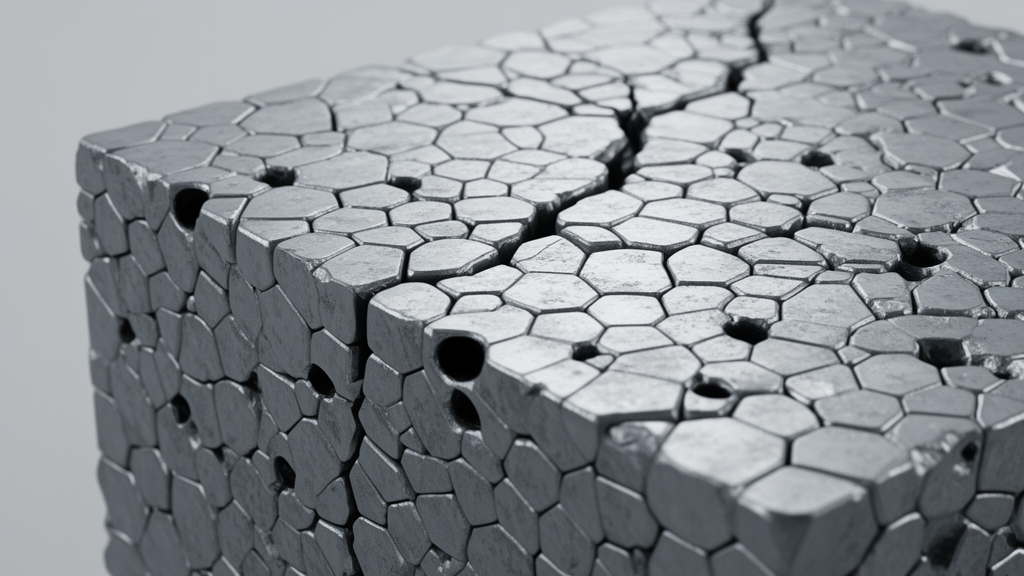
Nanovoids and grain morphologies introduced by laser powder bed fusion can substantially weaken an idealized nanocrystalline steel, according to a simulation and machine-learning study published in Discover Materials on 27 October 2026. Researchers led by Mahshad Fani, Oluwatimilehin Akinloye, Yingtao Liu, and Shuozhi Xu combined molecular statics simulations with a deep neural network surrogate model and a gradient-boosting comparison model to probe the ultimate hydrostatic tensile strength (UHTS) of a body-centered-cubic Fe80Cr16Ni4 ternary solid solution, an idealized chemistry inspired by the Fe–Cr–Ni matrix of 17-4 PH stainless steel.

The team constructed 180 atomistic structures by systematically varying four parameters: grain morphology, with equiaxed and columnar grains; grain size, spanning 10, 12.5, 15, 17.5, and 20 nanometers; void shape, either spherical or irregular; and void location, either in the grain interior or at a grain boundary. Porosity was held fixed at 0.5 percent across all samples, isolating the effects of geometry and placement rather than the amount of missing material.

The simulations showed that the mere presence of a void reduced UHTS by 17.8 to 34.8 percent relative to void-free baselines. The highest mean strength values appeared near a grain size of 17.5 nanometers, within the grain-size range associated with previously reported Hall–Petch to inverse Hall–Petch crossover behavior. In columnar nanocrystals, voids sitting at grain boundaries reduced UHTS by 3.6 to 11.0 percent more than voids located within grain interiors, indicating that boundary placement carries an extra strength penalty in that morphology. Equiaxed nanocrystals, by contrast, were insensitive to void location.

Void shape mattered only in a specific setting: within grain-boundary-associated equiaxed nanocrystals, irregular voids yielded 2.4 to 5.3 percent lower UHTS than spherical voids of the same porosity. To rank the importance of the different parameters, the researchers applied SHAP analysis to their model outputs. Void presence emerged as the dominant descriptor, accounting for 51.8 percent of the explained influence, followed by grain morphology and grain size, with void location and void shape acting as secondary factors. According to the authors, this ranking confirms that grain and void characteristics jointly govern hydrostatic strength in these Fe80Cr16Ni4 nanocrystals.

The study is a computational analysis of an idealized model chemistry rather than a test of printed 17-4 PH components, and the article is being shared early as a peer-reviewed, accepted manuscript that remains subject to further edits before the final version of record.

Subject of Research: Machine-learning-guided atomistic simulations of void and grain effects on the strength of nanocrystalline Fe80Cr16Ni4 steel

Article Title: Atomistic and machine-learning analysis of void and grain effects on the strength of nanocrystalline 17-4 PH steel with simplified chemistry

Article References: Fani, M., Akinloye, O., Liu, Y., & Xu, S. (2026). Atomistic and machine-learning analysis of void and grain effects on the strength of nanocrystalline 17-4 PH steel with simplified chemistry. Discover Materials. https://doi.org/10.1007/s43939-026-01047-x

Image Credits: AI Generated

DOI: 10.1007/s43939-026-01047-x

Keywords: nanocrystalline steel, 17-4 PH stainless steel, molecular statics, deep neural network, SHAP analysis, grain boundaries, nanovoids, laser powder bed fusion, Hall-Petch, hydrostatic strength, Fe80Cr16Ni4, machine learning

Cite Scienmag News

Denise Maddox. (October 28, 2026). Voids and grain structure jointly weaken nanocrystalline steel in simulations. Scienmag. https://scienmag.com/voids-and-grain-structure-jointly-weaken-nanocrystalline-steel-in-simulations/


Denise Maddox. "Voids and grain structure jointly weaken nanocrystalline steel in simulations." Scienmag, 28 October 2026, https://scienmag.com/voids-and-grain-structure-jointly-weaken-nanocrystalline-steel-in-simulations/. Accessed 28 October 2026.

Denise Maddox. "Voids and grain structure jointly weaken nanocrystalline steel in simulations." Scienmag. October 28, 2026. https://scienmag.com/voids-and-grain-structure-jointly-weaken-nanocrystalline-steel-in-simulations/

Tags: 17-4 PH stainless steeldeep neural networkeffects of void shape and location on steel propertiesFe80Cr16Ni4gradient boosting models in material analysisgrain boundariesgrain morphology influence on metal strengthgrain size optimization in nanocrystalline metalsHall-Petchhydrostatic strengthlaser powder bed fusionlaser powder bed fusion porosity impactMachine learningmachine learning for structural property predictionmolecular staticsmolecular statics simulations in materials sciencenanocrystalline steelNanocrystalline steel weakening mechanismsnanovoidsnanovoids and grain boundaries in steelSHAP analysissimulation-based study of steel microstructuretensile strength of BCC Fe-Cr-Ni alloysvoid effects in additive manufacturing
Share26Tweet16
Previous Post

Machine learning mirrors finite element physics to predict photoionization in quantum dot rings

Next Post

Raman Spectroscopy Emerges as a Fingerprinting Tool for Seafood Authenticity and Safety

Related Posts

AI Learns to Design Lignin Foams From Pictures and Predicts Their Strength
Technology and Engineering

AI Learns to Design Lignin Foams From Pictures and Predicts Their Strength

October 28, 2026
Deep learning sharpens ultra-low-dose PET/MR scans in Alzheimer’s disease feasibility study
Medicine

Deep learning sharpens ultra-low-dose PET/MR scans in Alzheimer’s disease feasibility study

October 28, 2026
Crisis, not consensus, drives the evolution of urban design theory
Technology and Engineering

Crisis, not consensus, drives the evolution of urban design theory

October 28, 2026
Fuzzy inference system flags sepsis risk in real time on cloud warehouse
Medicine

Fuzzy inference system flags sepsis risk in real time on cloud warehouse

October 28, 2026
Machine learning moves to the heart of 6G networks in new systematic review
Technology and Engineering

Machine learning moves to the heart of 6G networks in new systematic review

October 28, 2026
Wire EDM unlocks Haynes 230 superalloy machining with optimized cutting rate and surface finish
Technology and Engineering

Wire EDM unlocks Haynes 230 superalloy machining with optimized cutting rate and surface finish

October 28, 2026
Next Post
Raman Spectroscopy Emerges as a Fingerprinting Tool for Seafood Authenticity and Safety

Raman Spectroscopy Emerges as a Fingerprinting Tool for Seafood Authenticity and Safety

  • Mothers who receive childcare support from maternal grandparents show more optimized

    Mothers who receive childcare support from maternal grandparents show more parental warmth, finds NTU Singapore study

    27656 shares
    Share 11059 Tweet 6912
  • University of Seville Breaks 120-Year-Old Mystery, Revises a Key Einstein Concept

    1061 shares
    Share 424 Tweet 265
  • Bee body mass, pathogens and local climate influence heat tolerance

    682 shares
    Share 273 Tweet 171
  • Researchers record first-ever images and data of a shark experiencing a boat strike

    546 shares
    Share 218 Tweet 137
  • Groundbreaking Clinical Trial Reveals Lubiprostone Enhances Kidney Function

    531 shares
    Share 212 Tweet 133
Science

Embark on a thrilling journey of discovery with Scienmag.com—your ultimate source for cutting-edge breakthroughs. Immerse yourself in a world where curiosity knows no limits and tomorrow’s possibilities become today’s reality!

RECENT NEWS

  • Cancer therapies converge on shared heart injury pathways, prompting a dynamic surveillance framework
  • RNA methyltransferase NSUN2 stabilizes PARP9 transcript to drive breast cancer growth and immune escape, study finds
  • Linalool reshapes microbial networks during cigar tobacco fermentation, study finds
  • Retrospective study wrongly claimed prospective validation, letter warns

Categories

  • Agriculture
  • Anthropology
  • Archaeology
  • Athmospheric
  • Biology
  • Biotechnology
  • Blog
  • Bussines
  • Cancer
  • Chemistry
  • Climate
  • Earth Science
  • Editorial Policy
  • Marine
  • Mathematics
  • Medicine
  • Pediatry
  • Policy
  • Psychology & Psychiatry
  • Science Education
  • Science News
  • Social Science
  • Space
  • Technology and Engineering

Subscribe to Blog via Email

Enter your email address to subscribe to this blog and receive notifications of new posts by email.

Join 5,151 other subscribers

© 2025 Scienmag - Science Magazine

Welcome Back!

Login to your account below

Forgotten Password?

Retrieve your password

Please enter your username or email address to reset your password.

Log In
No Result
View All Result
  • HOME
  • SCIENCE NEWS
  • CONTACT US

© 2025 Scienmag - Science Magazine

Discover more from Science

Subscribe now to keep reading and get access to the full archive.

Continue reading