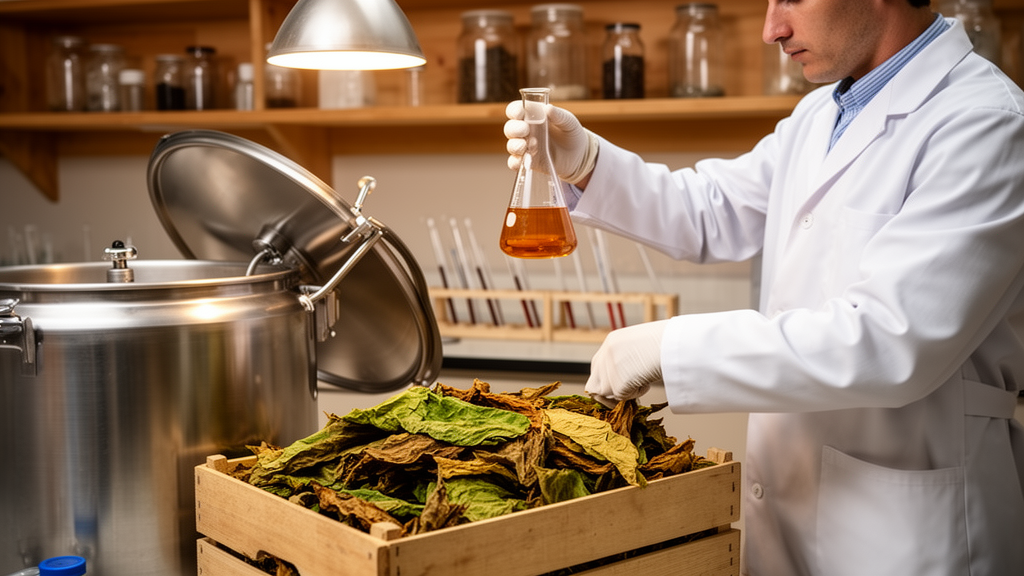
Mold contamination is one of the persistent threats to solid-state fermentation, the process used to develop the flavor and aroma of cigar tobacco. Spoilage organisms can destabilize the fermentation, generate off-flavors and compromise product safety. Synthetic preservatives such as sodium dehydroacetate are commonly deployed against this problem, but they carry drawbacks, including ecological instability in the microbial community and chemical residues in the finished product. A study published in Chemical and Biological Technologies in Agriculture examined whether a natural alternative, the plant-derived compound linalool, could steer the fermentation in a different direction, and mapped in detail how the two approaches diverge at the level of microbial communities and metabolism.
The research team, led by Lanmei Zhao, Yuru Wen and Mengxue Sun, with Can Lyu and Jian Liu among the co-authors, built its analysis on an integrated multi-omics framework. The approach combined volatile and non-targeted metabolomics, amplicon sequencing and metagenomics, applied to a cigar tobacco solid-state fermentation model. Rather than measuring a single endpoint, the design tracked the ecological and metabolic trajectories of linalool-treated fermentations against both chemical preservation and untreated controls across successive fermentation cycles.
The findings on the chemical preservative were striking. Sodium dehydroacetate was associated with a centralized co-occurrence structure in the microbial network, meaning that a small number of microbial groups dominated the interaction pattern. It also produced distinct functional profiles and, critically, a late-stage accumulation of off-flavor precursors. Total acids reached 1619.07 micrograms per kilogram and nitrogen-containing heterocycles reached 5763.58 micrograms per kilogram, both significantly higher than in the control group, with P values below 0.05. In this boom-bust pattern, the bacteria Pseudomonas and the fungus Aspergillus emerged as central nodes in the network, and their co-occurrence with amino acid metabolism was linked to the late-stage buildup of metabolites.
Linalool treatment produced a markedly different picture. The microbial co-occurrence architecture under linalool was more modular and less centralized, suggesting a community organized into distinct functional groups rather than one dominated by a few hub organisms. The metabolic effects were phase-dependent. In the early fermentation cycles, the researchers observed enrichment of specific metabolites, including long-chain fatty acid methyl esters such as methyl hexadecanoate, which reached 527.65 micrograms per kilogram, a level significantly higher than the control at P below 0.05. The alkaloid biosynthesis pathway was also enriched during this early phase.
Alongside these metabolic shifts, the linalool condition showed a positive co-occurrence between the bacterium Pantoea and the fungus Diaporthe, together with the enrichment of biofilm-associated functions annotated to the ko02026 pathway.
As fermentation progressed into the mid-to-late cycles, a different microbial consortium came to the fore under linalool treatment. The temporal pattern, with early enrichment of fatty acid methyl esters and alkaloid biosynthesis followed by later activity in fatty acid and aromatic pathways, points to a staged sequence of metabolic events rather than a single uniform response.
One of the most consequential findings concerned the relationship between linalool-associated secondary metabolic pathways and potential spoilage bacteria. The study reported that these pathways were negatively correlated with the spoilage organisms, providing molecular-level associations consistent with a role for linalool in microbial modulation.
The authors frame their conclusions carefully. The study indicates that linalool-mediated treatment was associated with a shift in microbial community structure from a centralized to a more modular co-occurrence pattern. This shift, they write, offers insights into microbial and metabolic modulation and provides a basis for further evaluation of plant-derived strategies to reduce chemical inputs in cigar tobacco solid-state fermentation. The language of association is deliberate.
The article, published open access on 15 October 2026, is part of a growing body of work applying integrated omics to cigar tobacco fermentation.
Subject of Research: Multi-omics analysis of how linalool modulates microbial community structure and metabolism during cigar tobacco solid-state fermentation compared with chemical preservation.
Article Title: Multi-omics insights into linalool-mediated modulation of microbial metabolism during cigar tobacco solid-state fermentation
Article References: Zhao, L., Wen, Y., Sun, M., Lyu, C., & Liu, J. (2026). Multi-omics insights into linalool-mediated modulation of microbial metabolism during cigar tobacco solid-state fermentation. Chemical and Biological Technologies in Agriculture. https://doi.org/10.1186/s40538-026-01126-4
Image Credits: AI Generated
DOI: 10.1186/s40538-026-01126-4
Keywords: linalool, cigar tobacco, solid-state fermentation, microbial ecology, multi-omics, metabolomics, metagenomics, biocontrol, sodium dehydroacetate, off-flavor precursors, microbial co-occurrence, natural preservatives
Cite Scienmag News
Morgan Morrow. (October 28, 2026). Linalool reshapes microbial networks during cigar tobacco fermentation, study finds. Scienmag. https://scienmag.com/linalool-reshapes-microbial-networks-during-cigar-tobacco-fermentation-study-finds/
Morgan Morrow. "Linalool reshapes microbial networks during cigar tobacco fermentation, study finds." Scienmag, 28 October 2026, https://scienmag.com/linalool-reshapes-microbial-networks-during-cigar-tobacco-fermentation-study-finds/. Accessed 28 October 2026.
Morgan Morrow. "Linalool reshapes microbial networks during cigar tobacco fermentation, study finds." Scienmag. October 28, 2026. https://scienmag.com/linalool-reshapes-microbial-networks-during-cigar-tobacco-fermentation-study-finds/