


A recent study conducted by Associate Professor Mikimasa Omori from Waseda University examines the potential link between predictable visual stimuli and early indications of autism spectrum disorder (ASD) among children. With social communication impairments and restricted and repetitive behaviors being hallmark symptoms of ASD, early identification is crucial for effective intervention strategies. However, the complexities surrounding the diagnosis of ASD have made this a challenging endeavor for parents and healthcare providers alike. The comprehensive approach taken in this research sheds light on innovative avenues for ASD detection that extend beyond traditional social-focused assessments.
The study’s primary goal was to explore how children, particularly those exhibiting potential traits of ASD, engage with repetitive versus random movements in visual stimuli. Previous research has indicated that children diagnosed with ASD tend to demonstrate a pronounced preference for non-social stimuli compared to typically developing (TD) peers. This significant finding raises questions regarding the underlying causes of such preferences. Omori’s research aims to dig deeper into these preferences, focusing on how they evolve over crucial developmental stages.
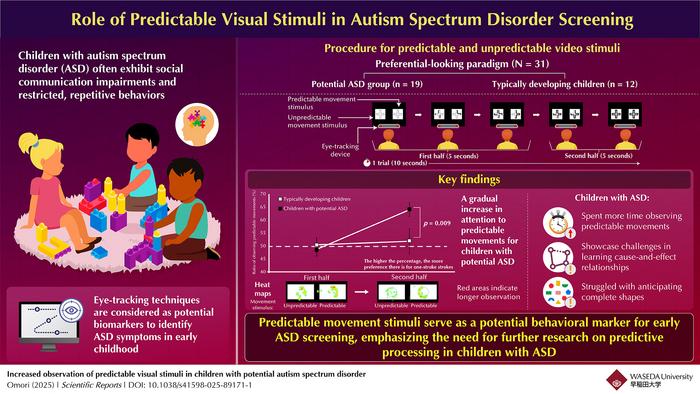
In this innovative study, an eye-tracking methodology was employed to measure the amount of time children spent observing various types of movements presented in visual stimuli. Participants included children identified as having potential ASD and a control group of typically developing children. The eye-tracking technology enabled researchers to collect precise data on gaze duration and patterns, opening new doors for understanding the visual and cognitive preferences of children at risk for ASD.
The stimuli presented to the children consisted of pairs of geometric visuals, one depicting predictable repetitive movements and the other featuring unpredictable, random movements. This approach allowed researchers to systematically compare observation durations among participants, thereby identifying potential behavioral markers for ASD. The results revealed a striking trend: children with potential ASD exhibited a greater tendency to focus on predictable movements than their TD counterparts. This phenomenon suggests a possible correlation between attention to predictable stimuli and the characteristics of ASD-related repetitive behaviors.
Interestingly, while TD children displayed a relatively stable observation pattern, those with potential ASD exhibited an increasing focus on predictable movements as the stimulus presentation continued. This gradual escalation in engagement highlights a potential developmental trajectory unique to children on the autism spectrum. The research indicates that this preference could be linked to difficulties in learning about cause-and-effect relationships, as well as challenges in anticipating the outcomes of visual inputs, thereby aligning with the disorder’s repetitive behavior traits.
Crucially, the implications of these findings extend beyond academic interest; they signal a potential shift in screening practices for early detection of ASD. The study proposes that traditional methods, which often fixate on social communication deficits, may benefit from integration with new visual stimulus assessments. Identifying preferences for predictable visual patterns could serve as a valuable early indication of ASD, particularly for children as young as three years old who may otherwise be overlooked.
Omori discusses the transformative impact of this approach, emphasizing that it could significantly improve early detection rates for children who remain undiagnosed until later stages of development. Traditional evaluations often fail to capture the complex profiles of children with ASD, leading to delays in securing necessary interventions. An early detection protocol incorporating eye-tracking assessments could provide healthcare professionals with a more efficient means of identifying at-risk children, facilitating timely support and resources.
Moreover, the adaptability of the testing procedure presents further advantages. The study suggests that the non-verbal nature of the eye-tracking task could be suitable for children as young as 18 months. This adaptation aligns seamlessly with existing developmental check-up protocols in Japan, where routine evaluations occur around 18 and 36 months. By introducing a brief observation task during these assessments, healthcare providers could harness this innovative approach to better identify children at-risk for ASD, thereby promoting timely intervention strategies.
Overall, this pivotal research not only contributes valuable insights into the sensory and behavioral nuances associated with ASD but also illuminates practical pathways for enhancing diagnostic methodologies. The combination of eye-tracking technology and a focus on predictable visual stimuli provides a multifaceted perspective on how children with ASD interact with their environments. By advancing our understanding of sensory processing and preference patterns, this study underscores the pressing need for ongoing research into predictive processing in children with autism.
These insights may eventually lead to a broader understanding of individualized interventions that can be tailored to the unique sensory needs of children with ASD. By fostering deeper comprehension and appreciation of how these children perceive and relate to their surroundings, we stand to make meaningful progress in supporting their developmental journeys.
The research carried out by Omori and his team illustrates a significant leap forward in the exploration of early detection strategies for ASD. By emphasizing the role of visual stimuli and employing cutting-edge eye-tracking technology, they have opened up new avenues for understanding the complexities surrounding autism. This work could ultimately guide healthcare professionals in their quest to identify and nurture the strengths of children with autism, equipping them with the tools needed for future success.
As the scientific community continues to strive for advancements in autism research, the findings presented in this study will undoubtedly contribute to a growing body of literature aimed at improving lives and outcomes for children diagnosed with ASD and their families.
This research serves as a poignant reminder of the importance of ongoing inquiry and innovation in the realm of developmental psychology, offering hope for a future where early detection and intervention become not just possible, but standard practices. Through collaborative efforts and a commitment to understanding the unique expressions of autism, we can aspire to create a more inclusive world for all children.
Cite Scienmag News
Courtney Benton. (April 8, 2025). Visual Cues: A Promising Early Indicator of Autism Spectrum Disorder in Children. Scienmag. https://scienmag.com/visual-cues-a-promising-early-indicator-of-autism-spectrum-disorder-in-children/
Courtney Benton. "Visual Cues: A Promising Early Indicator of Autism Spectrum Disorder in Children." Scienmag, 8 April 2025, https://scienmag.com/visual-cues-a-promising-early-indicator-of-autism-spectrum-disorder-in-children/. Accessed 3 September 2026.
Courtney Benton. "Visual Cues: A Promising Early Indicator of Autism Spectrum Disorder in Children." Scienmag. April 8, 2025. https://scienmag.com/visual-cues-a-promising-early-indicator-of-autism-spectrum-disorder-in-children/


