


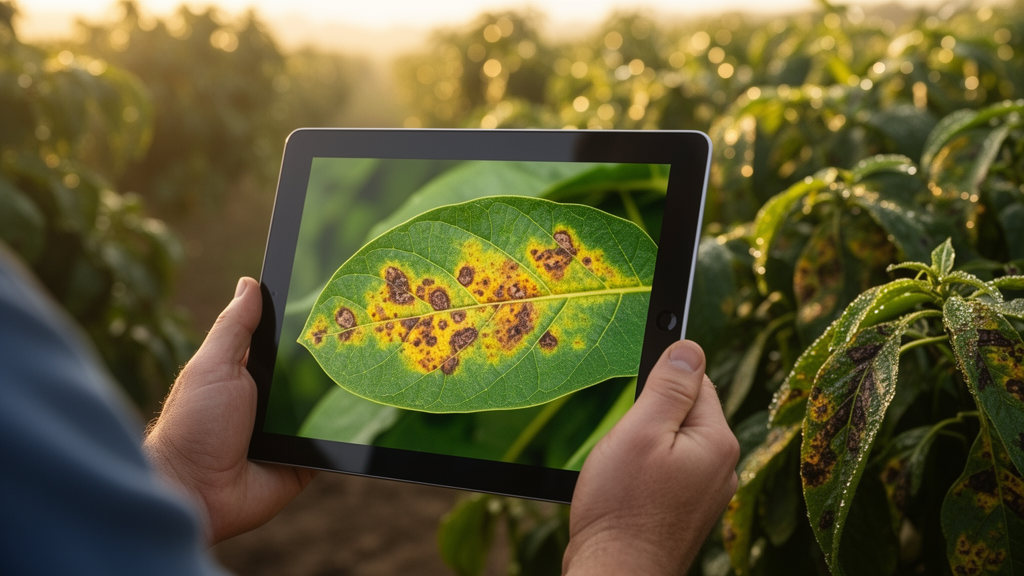
Plant pathologists have long faced a stubborn diagnostic problem: a single leaf can carry several diseases at once, each with its own symptoms, and distinguishing them reliably has been difficult for both experts and automated systems. Deep learning models have made impressive strides in plant disease recognition, but most were trained and evaluated under the assumption that one image corresponds to one disease. When several pathogens coexist on the same leaf, symptoms overlap, co-occur, and partially mask one another, and models built for single-disease recognition often falter. A research team led by authors including Cui, Zhang, and Chen has now introduced a vision-language diagnostic framework designed specifically for this symptom-mixed scenario, and it pairs the framework with a carefully constructed image resource for coexisting leaf diseases.
The new framework, called CA-CLIP, builds on vision-language models that align images and text in a shared embedding space. Category names, attribute descriptions, and symptom descriptions can all participate in recognition, allowing textual semantics to guide visual classification. Earlier plant disease studies using such models focused mainly on general image recognition, few-shot learning, or single-disease scenarios, and global image-text alignment was often sufficient for those tasks. But when several diseases coexist on one leaf, global alignment alone cannot capture the local, class-specific evidence needed to separate overlapping symptoms. CA-CLIP addresses this gap with a class-aware local alignment mechanism that matches each disease category to its own local visual evidence rather than relying on a single global image-text score.
Constructing reliable training material for coexisting diseases posed its own challenge. Annotating real images of multiple diseases on the same leaf is costly, and the resulting datasets are often small and imbalanced. The team therefore built a benchmark called CC-Leaf, a resource for coexisting leaf diseases, by combining real disease images with controlled image synthesis. The pipeline used the Segment Anything Model, a general-purpose segmentation tool, to extract leaf and lesion regions with minimal manual effort. Because lesion boundaries can be blurry and colors can shift between healthy and diseased tissue, the researchers applied manual corrections and color harmonization to keep the synthesized images visually plausible. The result is a dataset covering five crops and eleven disease categories, with images containing one, two, or three coexisting diseases per leaf.
The synthesis workflow proceeded in several stages. First, real leaf and lesion regions were segmented and cleaned. Next, lesion patches were grafted onto healthy leaf backgrounds at controlled locations and densities, with blending and color adjustments to avoid abrupt edges. Finally, the team verified that the synthesized images preserved the characteristic appearance of each disease and that co-occurring combinations remained phenotypically reasonable. This controlled construction allowed the researchers to vary disease density, lesion size, and co-occurrence patterns systematically, producing a dataset that is larger and more balanced than what real-world annotation alone could provide.
On the recognition side, CA-CLIP combines a vision encoder with a text encoder that processes category names and symptom descriptions. The key innovation is the class-aware local alignment module: for each disease category, the model identifies local image regions whose features align with that category’s textual semantics, producing a per-class matching score. These scores are then aggregated to decide which diseases are present. This design lets the model separate evidence for different categories even when their symptoms overlap spatially. The researchers also introduced a co-occurrence-aware training objective that encourages the model to recognize each disease independently rather than treating co-occurring diseases as a single combined pattern.
Evaluations on the CC-Leaf benchmark showed that CA-CLIP outperformed representative baselines across multiple metrics. In multi-label recognition scenarios with two or three coexisting diseases, the framework achieved higher accuracy and better per-class recall than models relying on global image-text alignment alone. The class-aware local alignment mechanism proved especially valuable when symptoms of different categories overlapped, a situation where global approaches tended to confuse categories or miss the less prominent disease. The co-occurrence-aware objective further improved recognition of each disease independently, reducing the tendency to treat co-occurring diseases as one combined pattern.
The study also examined how the framework behaves under different data conditions. When trained with limited annotated data, CA-CLIP retained strong performance, suggesting that the textual semantics and local alignment mechanism help compensate for scarce supervision. The researchers further tested robustness to variations in lesion density and co-occurrence patterns, finding that performance degraded gracefully as conditions became harder. These analyses indicate that the framework is not merely fitting the specific construction of the benchmark but is learning transferable diagnostic evidence.
Beyond raw accuracy, the framework offers practical advantages for agricultural deployment. Because textual descriptions participate in recognition, the model’s per-class matching scores provide a form of interpretability: the regions that drive each disease decision can be identified and inspected. This is valuable in the field, where agronomists need to understand why a model flags a particular pathogen. The framework also operates on ordinary leaf photographs, requiring no special imaging equipment, which lowers the barrier to adoption in real-world settings.
The researchers acknowledge limitations. The benchmark was constructed with controlled synthesis, and while the images are visually plausible, real-world conditions introduce additional variability such as leaf deformation, complex backgrounds, and uncontrolled lighting. The team notes that future work could extend the framework to field-collected images and to a broader range of crops and pathogens. They also point out that the current design focuses on leaf diseases and does not yet address other plant organs or disease types.
Nevertheless, the study represents a meaningful advance for automated plant pathology. By pairing a carefully constructed benchmark for coexisting leaf diseases with a vision-language framework built for symptom-mixed recognition, the researchers have addressed a scenario that earlier single-disease approaches could not handle reliably. The combination of local, class-aware alignment and co-occurrence-aware training offers a template for future diagnostic systems that must separate overlapping evidence rather than treat each image as a single pattern. As automated plant pathology moves from laboratory benchmarks to field deployment, frameworks like CA-CLIP may prove essential for the messy, multi-pathogen reality of agricultural practice.
Subject of Research: CA-CLIP for multi-label diagnosis of co-occurring plant leaf diseases: A class-aware vision-language framework
Article Title: CA-CLIP for multi-label diagnosis of co-occurring plant leaf diseases: A class-aware vision-language framework
Article References: Liu, S., Wu, J., Zhao, W., Liu, J., Chen, J., & Cui, Y. (2026). CA-CLIP for multi-label diagnosis of co-occurring plant leaf diseases: A class-aware vision-language framework. Smart Agricultural Technology, 15, Article 102617. https://doi.org/10.1016/j.atech.2026.102617
Image Credits: AI Generated
DOI: 10.1016/j.atech.2026.102617
Keywords: plant pathology, vision-language models, coexisting diseases, multi-label recognition, Segment Anything Model, image synthesis, local alignment, agricultural AI, leaf diseases, benchmark construction, interpretability, deep learning
Cite Scienmag News
Alan Morgan. (October 17, 2026). Vision-language model CA-CLIP diagnoses multiple coexisting leaf diseases from a single image. Scienmag. https://scienmag.com/vision-language-model-ca-clip-diagnoses-multiple-coexisting-leaf-diseases-from-a-single-image/
Alan Morgan. "Vision-language model CA-CLIP diagnoses multiple coexisting leaf diseases from a single image." Scienmag, 17 October 2026, https://scienmag.com/vision-language-model-ca-clip-diagnoses-multiple-coexisting-leaf-diseases-from-a-single-image/. Accessed 17 October 2026.
Alan Morgan. "Vision-language model CA-CLIP diagnoses multiple coexisting leaf diseases from a single image." Scienmag. October 17, 2026. https://scienmag.com/vision-language-model-ca-clip-diagnoses-multiple-coexisting-leaf-diseases-from-a-single-image/


