


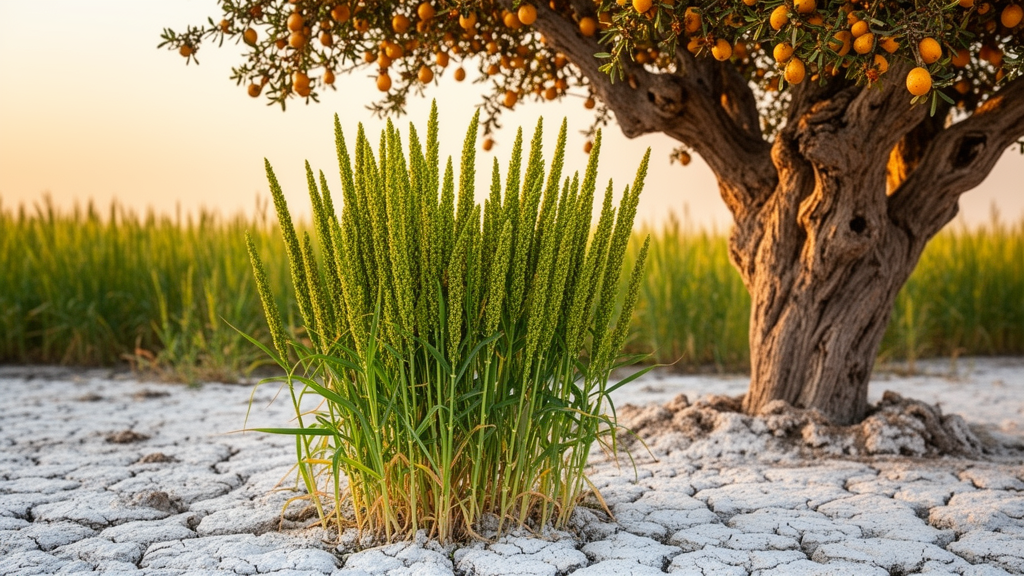
Deep inside the tissues of the jujuba tree, a hardy perennial that shrugs off drought and salt in some of the world’s harshest landscapes, scientists have found microscopic tenants that may transform how we grow one of Africa’s most important cereal crops. A team of researchers from Pakistan and Ethiopia has isolated two bacterial endophytes from Ziziphus jujuba and shown that they can dramatically boost the growth of pearl millet while helping the plant withstand salinity, one of the most damaging stresses in agriculture. Remarkably, the bacteria delivered these benefits even when farmers used only a fraction of the standard chemical fertilizer, pointing toward a biological route to more sustainable farming on salt-stressed land.
The study, published in BMC Plant Biology, focused on pearl millet (Pennisetum glaucum), a staple grain for millions of people across arid and semi-arid regions of Africa and South Asia. Pearl millet is prized for its ability to grow where other cereals fail, yet salinity still takes a heavy toll on its productivity. High concentrations of salt in the soil make it harder for roots to take up water, disrupt nutrient uptake, and trigger a cascade of damaging chemical reactions inside plant cells. At the same time, decades of reliance on chemical fertilizers have degraded soil health in many farming regions, creating an urgent need for approaches that maintain yields without further harming the ground beneath our feet.
The researchers turned to an unusual source for help: the jujuba tree, a stress-adapted perennial that thrives in marginal environments. Plants that survive under extreme conditions often harbor endophytes, microorganisms that live within their tissues without causing disease, and these internal partners frequently carry genes and biochemical capabilities that help the host cope with stress. The team isolated bacterial endophytes from jujuba tissues and screened them in the laboratory for multiple plant-growth-promoting traits, including the ability to produce indole-3-acetic acid, a key plant hormone that stimulates root growth, to solubilize phosphate so that plants can access this essential nutrient, to produce siderophores that bind iron and make it available to the plant, and to produce ammonia, another nutrient contribution.
Two strains stood out from the screening. Bacillus safensis, designated Zj-Ea, showed superior multi-trait plant-growth-promoting capabilities, while Pantoea septica, designated Zj-E2, displayed exceptional halotolerance, meaning it could survive and function under high salt concentrations. The researchers then designed a greenhouse experiment to test how these bacteria, alone and in combination, would affect pearl millet under four different soil conditions: a normal control soil, soil amended with 150 millimolar sodium chloride to simulate salinity stress, soil treated with diammonium phosphate fertilizer at a reduced dose of 12.5 milligrams per 2.5 kilograms of soil, and soil receiving both the salt and the fertilizer together.
The results were striking. Seed priming, a technique in which seeds are soaked in a bacterial suspension before planting, and soil drenching, where the bacteria are applied directly to the growing medium, both produced substantial improvements in germination rates, vegetative growth, biomass accumulation, and reproductive traits across all soil conditions. Under normal, non-stress conditions, the consortium of both bacterial strains produced the strongest overall growth responses, while individual strains each optimized specific aspects of germination. This suggests that the two bacteria complement each other, with each contributing different capabilities to the plant.
Under saline conditions, the advantages of combining the two strains became even more pronounced. Co-inoculation with both Bacillus safensis and Pantoea septica significantly outperformed treatment with either strain alone, indicating that a strategically engineered consortium pairing a highly halotolerant strain with a robust plant-growth-promoting strain produces more powerful results than either partner working independently. This finding has important implications for how scientists design microbial inoculants for stressed environments, moving beyond single-strain products toward deliberately composed bacterial teams.
The most impressive results emerged when the bacterial treatments were combined with the reduced dose of diammonium phosphate fertilizer. This synergy between the endophytes and a sub-optimal amount of chemical fertilizer yielded the greatest alleviation of salinity stress, markedly increasing photosynthetic pigments, boosting the accumulation of osmolytes, and elevating antioxidant enzyme activities while simultaneously reducing oxidative stress markers. In practical terms, the bacteria helped the plants maintain the biochemical machinery needed to photosynthesize efficiently, regulate water balance under salt stress, and neutralize the reactive oxygen species that accumulate when plants are under environmental pressure.
The mechanism behind these benefits appears to involve two complementary processes. Under normal conditions, the bacteria act as biofertilizers, enhancing pearl millet productivity through their production of indole-3-acetic acid and siderophores, their ammonia generation, and their phosphate solubilization. Under salt stress, they shift toward a protective role, improving osmoregulation, the plant’s ability to maintain internal water and solute balance, and redox homeostasis, the balance of oxidation and reduction reactions that keeps cellular damage in check. This dual functionality, providing nutrition when conditions are good and protection when conditions turn hostile, makes these endophytes particularly valuable as agricultural tools.
The implications for sustainable agriculture are significant. Chemical fertilizers, particularly phosphate-based products, are energy-intensive to manufacture and can degrade soil structure and microbial communities when overused. If bacterial endophytes can maintain or even enhance crop productivity when farmers apply only a fraction of the standard fertilizer dose, the approach could reduce both the economic and environmental costs of crop production. The finding that the endophyte-fertilizer combination outperformed either alone suggests that these bacteria are not simply replacing chemical inputs but working alongside them in a more efficient partnership.
The researchers caution that these results come from greenhouse trials and must be validated under real field conditions before farmers can adopt the approach. Field environments introduce variables that greenhouse experiments cannot fully replicate, including fluctuating temperatures, variable soil types, competing microbial communities, and unpredictable rainfall. Nevertheless, the study provides a compelling proof of concept that endophytes harvested from stress-adapted perennial plants can be repurposed to protect and nourish annual crops, offering a promising biological strategy for optimizing productivity in salinity-stressed agriculture while reducing dependence on chemical fertilizers.
Subject of Research: Endophytic bacteria from Ziziphus jujuba enhance growth and salinity resilience in pearl millet under reduced fertilizer input
Article Title: Endophytic bacteria from Ziziphus jujuba enhance growth and salinity resilience in pearl millet under reduced fertilizer input
Article References: Shafqat, S., Ullah, R., Ali, M., Ullah, Z., & Fayesa, T. Y. (2026). Endophytic bacteria from Ziziphus jujuba enhance growth and salinity resilience in pearl millet under reduced fertilizer input. BMC Plant Biology. https://doi.org/10.1186/s12870-026-10035-5
Image Credits: AI Generated
DOI: 10.1186/s12870-026-10035-5
Keywords: Endophytic, bacteria, Ziziphus, jujuba, enhance, growth, salinity, resilience, pearl, millet, under, reduced
Cite Scienmag News
Alan Morgan. (October 17, 2026). Jujuba tree bacteria help pearl millet thrive in salty soil with less fertilizer. Scienmag. https://scienmag.com/jujuba-tree-bacteria-help-pearl-millet-thrive-in-salty-soil-with-less-fertilizer/
Alan Morgan. "Jujuba tree bacteria help pearl millet thrive in salty soil with less fertilizer." Scienmag, 17 October 2026, https://scienmag.com/jujuba-tree-bacteria-help-pearl-millet-thrive-in-salty-soil-with-less-fertilizer/. Accessed 17 October 2026.
Alan Morgan. "Jujuba tree bacteria help pearl millet thrive in salty soil with less fertilizer." Scienmag. October 17, 2026. https://scienmag.com/jujuba-tree-bacteria-help-pearl-millet-thrive-in-salty-soil-with-less-fertilizer/


