


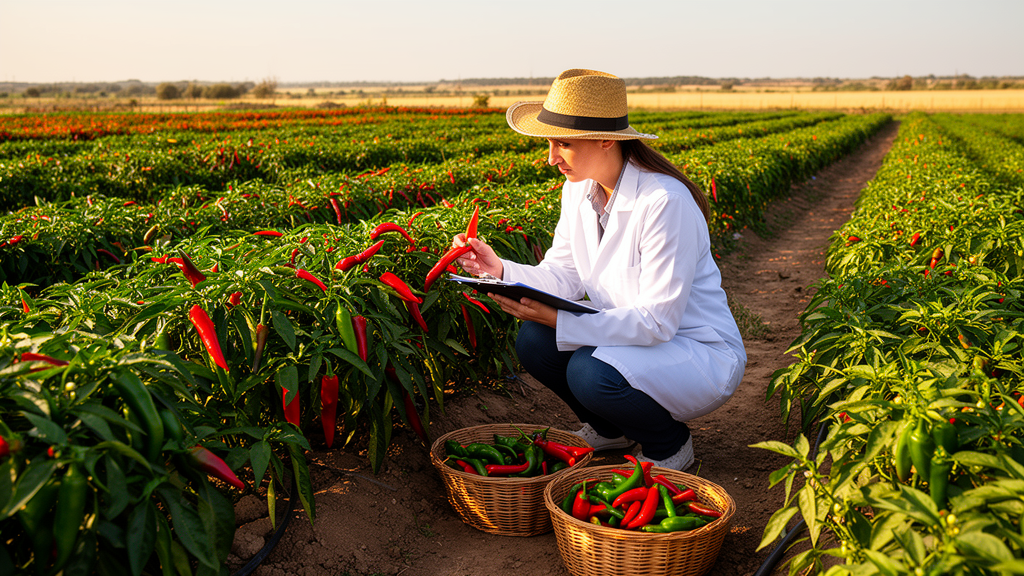
Chilli is one of those crops that hides its secrets in plain sight. The same hybrid that delivers a spectacular harvest on one mountainside can underperform badly a few valleys away, and the fruit that looks plump and glossy at one farm may carry less of the oleoresin that food processors actually pay for. That inconsistency is not bad luck; it is the fingerprint of genotype-by-environment interaction, the statistical tug-of-war between a plant’s genes and the conditions in which it grows. A new study from Himachal Pradesh, published in Discover Plants, has now tackled this problem with an unusually complete statistical toolkit, and the results point to two chilli hybrids, NHPCH16 and NHPCH20, that could reshape how breeders select for both yield and quality in one of India’s most important spice crops.
The research team, led by Ankush Chaudhary of Dr. Yashwant Singh Parmar University of Horticulture and Forestry, evaluated 28 chilli genotypes of Capsicum annuum L., comprising 21 F1 hybrids and 7 parental lines, across three agro-climatically contrasting locations during the 2022 growing season: Nauni in Solan, Dhaula Kuan in Sirmour, and Bajaura in Kullu. Each trial was laid out in a randomized complete block design with three replications, and the researchers recorded nine traits on randomly selected plants, including days to 50% flowering, plant spread, number of primary branches, fruit length and width, red ripe fruit yield per plant, thousand-seed weight, oleoresin content, and total soluble solids. What makes the study stand out is not the fieldwork alone but the analytical machinery brought to bear on it: AMMI, GGE biplots, WAASB and WAASBY stability indices, and a multi-trait stability index known as MTSI, all implemented in the R statistical environment using the metan package.
The pooled analysis of variance delivered the study’s first crucial insight. Genotypic effects were significant for all nine traits, confirming real genetic differences among the hybrids and parents, and environmental effects were also significant across the board. But the overall genotype-by-environment interaction was significant for only three traits: red ripe fruit yield per plant, oleoresin content, and total soluble solids. The remaining six traits, including flowering time, plant spread, fruit length, and thousand-seed weight, showed no significant overall interaction, meaning their expression was comparatively consistent across locations. This partitioning mattered enormously for how the rest of the analysis proceeded, because detailed stability interpretation was restricted to the three traits where the interaction was statistically confirmed, while all nine traits were retained in the multi-trait selection step.
For red ripe fruit yield, the AMMI analysis revealed something striking about where the variation actually came from. Genotype accounted for 80.00% of the total variation, followed by genotype-by-environment interaction at 6.03% and environment at 5.06%. In other words, genetic differences among the hybrids were overwhelmingly the principal source of yield variation, but the significant interaction component demonstrated that genotype responses were not completely consistent across the three locations. When the interaction was decomposed, the first interaction principal component, IPCA1, explained 91.4% of the yield interaction variation and was significant, while IPCA2 accounted for the remaining 8.6% and was non-significant. For oleoresin, IPCA1 and IPCA2 explained 85.3% and 14.7% respectively, and for total soluble solids the corresponding proportions were 72.2% and 27.8%, with both components significant for these two quality traits.
The AMMI1 biplots, which plot mean performance against IPCA1 scores, identified genotypes that combined high mean performance with low interaction. For fruit yield, G8, G27, G23, and G11 occupied the favourable quadrant, while G28 and G9 showed low interaction but below-average yield, illustrating that stability alone does not confer agronomic superiority. For oleoresin, G7, G24, and G23 combined high performance with low interaction, whereas G4 was stable but unproductive. For total soluble solids, G3, G5, and G11 were the favourable performers. The AMMI2 biplots, which use both interaction axes, showed that G7, G10, G23, G15, and G4 sat close to the origin for yield, indicating lower contributions to interaction, while G12, G8, and G22 showed stronger associations with Nauni, Dhaula Kuan, and Bajaura respectively.
The GGE biplot analysis added a different dimension to the interpretation. The which-won-where polygon view identified crossover interactions: G8 was the winning genotype in the sector containing Dhaula Kuan and Bajaura, while G11 was the winner associated with Nauni, demonstrating that no single hybrid dominated across all environments. For oleoresin, G7, G25, and G13 showed winning performance in the sectors containing Dhaula Kuan, Nauni, and Bajaura respectively. The genotype-ranking view, which integrates mean performance with stability relative to an ideal genotype, placed G11, G8, G23, G13, and G27 in favourable positions for fruit yield, with G23 and G27 also receiving support from the AMMI-derived stability criteria. The environment-evaluation view identified Nauni as the most discriminating test environment, with the longest environment vector, while Dhaula Kuan was the most representative, aligning closest with the average environment axis.
The AMMI-derived stability indices, including ASV, ASTAB, MASI, MASV, and the genotype selection index GSI, produced partly different rankings, reflecting the different interaction components each measure emphasizes. But G23 and G27 showed the strongest convergence: both shared the highest GSI ranking and occupied the first two positions for ASV and MASV while maintaining comparatively high mean fruit yield, with G27 recording 476.22 grams per plant and G23 recording 474.24 grams per plant. The WAASB and WAASBY analyses, which use REML-based mixed models to combine mean performance and stability, further differentiated the quality traits. For oleoresin, G27, G24, G23, G7, G5, and G4 combined high performance with lower interaction, while G18, G13, and G25 showed above-average content but greater environmental responsiveness. For total soluble solids, G3, G5, G11, G13, and G14 showed the more favourable performance-stability balance.
The multi-trait stability index, applied to all nine traits simultaneously at a selection intensity of approximately 15%, identified four genotypes closest to the predefined breeding ideotype: G27 (NHPCH20), G7 (DKC-8), G5 (Punjab Guchhedar), and G28 (NHPCH21). Factor analysis retained three factors with eigenvalues greater than 1, together explaining 64.10% of the total variation, with FA1 representing productivity and fruit-development traits, FA2 fruit and biochemical-quality traits, and FA3 flowering and plant-architecture traits. The selection differentials moved in the desired direction for seven of the nine traits, with the number of primary branches recording the largest proportional increase at 15.63%, while fruit length showed a negative differential of -3.03% and flowering time did not respond in its predefined direction, illustrating the trade-offs inherent in simultaneous multi-trait selection.
What emerges from this convergence of methods is a picture of complementary rather than identical information. NHPCH16 (G23) received the most consistent support across the yield-focused analyses, combining high mean fruit yield with favourable AMMI-derived stability rankings and GGE performance, but it was not among the four MTSI-selected genotypes. NHPCH20 (G27), by contrast, was identified by both the yield-focused approaches and the multi-trait assessment, providing cross-method support that makes it the strongest overall candidate. The study’s authors are careful to note that the work was conducted across three locations during a single growing season, which limits inference about temporal stability and broader adaptation. Further multi-year and multi-location testing will be required to confirm whether these promising hybrids maintain their performance across seasons and beyond the northwestern Himalayas. But for a crop grown over approximately 0.419 million hectares in India, with a production of 4.43 million metric tonnes, the identification of genotypes that combine high yield with consistent quality expression across contrasting environments represents a meaningful step forward in the science of chilli breeding.
Subject of Research: Evaluation of the yield and quality stability of chilli genotypes by employing AMMI, GGE and MTSI techniques
Article Title: Evaluation of the yield and quality stability of chilli genotypes by employing AMMI, GGE and MTSI techniques
Article References: Chaudhary, A., Sharma, H. D., Vikram, A., Gupta, M., Sharma, V., & Sohi, A. (2026). Evaluation of the yield and quality stability of chilli genotypes by employing AMMI, GGE and MTSI techniques. Discover Plants, 3(1), Article 468. https://doi.org/10.1007/s44372-026-00950-0
Image Credits: AI Generated
DOI: 10.1007/s44372-026-00950-0
Keywords: Evaluation, yield, quality, stability, chilli, genotypes, employing, AMMI, MTSI, techniques, scientific research
Cite Scienmag News
Alan Morgan. (October 17, 2026). Evaluation of the yield and quality stability of chilli genotypes by employing AMMI, GGE and MTSI techniques. Scienmag. https://scienmag.com/evaluation-of-the-yield-and-quality-stability-of-chilli-genotypes-by-employing-ammi-gge-and-mtsi-techniques/
Alan Morgan. "Evaluation of the yield and quality stability of chilli genotypes by employing AMMI, GGE and MTSI techniques." Scienmag, 17 October 2026, https://scienmag.com/evaluation-of-the-yield-and-quality-stability-of-chilli-genotypes-by-employing-ammi-gge-and-mtsi-techniques/. Accessed 17 October 2026.
Alan Morgan. "Evaluation of the yield and quality stability of chilli genotypes by employing AMMI, GGE and MTSI techniques." Scienmag. October 17, 2026. https://scienmag.com/evaluation-of-the-yield-and-quality-stability-of-chilli-genotypes-by-employing-ammi-gge-and-mtsi-techniques/


