


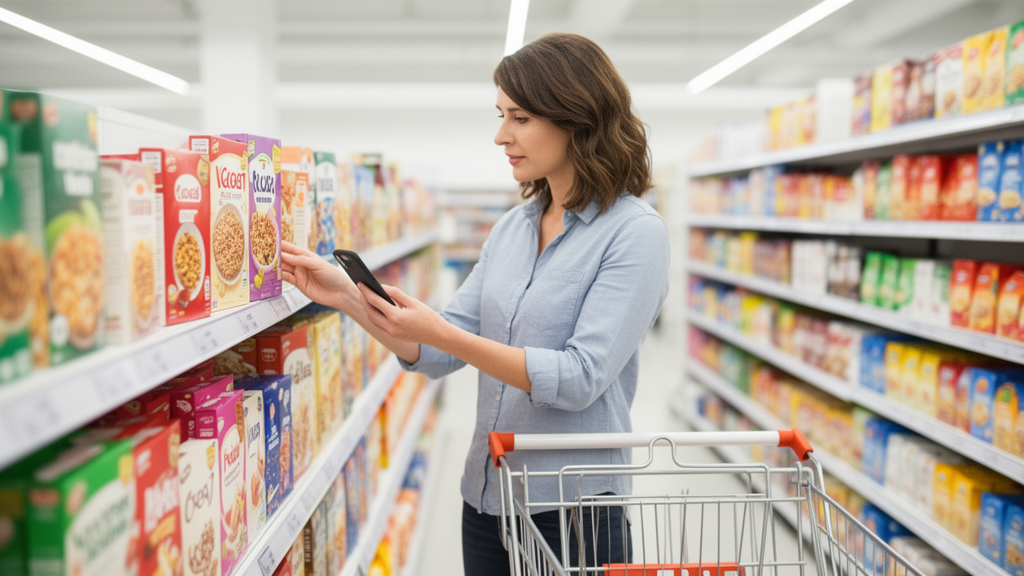
Consumers place essentially the same monetary value on packaged cereal whether they shop in a physical laboratory or inside an immersive virtual supermarket, according to a new study from Japan. Researchers at Toyo University and Mie University ran a real choice experiment with 227 university students, in which participants selected ready-to-eat cereal products under genuine economic incentives, sometimes while wearing a head-mounted display inside a 360-degree virtual store. Their statistical models found no significant differences in willingness to pay between the immersive virtual reality environment and the real-world setting for any of the three cereal products tested. To the authors’ knowledge, this is the first study to compare monetary willingness to pay between immersive virtual reality and real environments using an incentive-compatible experimental design.
The study, published in PLOS One by Toru Nakajima of Toyo University and Mizuki Mukai of Mie University, addresses a long-standing gap in consumer research. Virtual reality has become an attractive tool for food-choice studies because it lets researchers recreate retail environments cheaply and quickly, run controlled interventions without cooperating stores, and shield experiments from external disruptions. Earlier work relied mostly on desktop virtual reality, where participants viewed a monitor and navigated with a keyboard or mouse, offering only low immersion. The arrival of affordable head-mounted displays changed that, allowing entire fields of view to become virtual shopping spaces, but questions remained about whether the monetary valuations consumers reveal in such settings match those they reveal in real shops.
Previous comparisons had produced encouraging but incomplete evidence. Studies of bakery products, cereals, milk packaging, pizza sauce, pasta, and dark chocolate found no significant differences between immersive virtual and real environments in shelf-viewing time, product information acquisition, price recall, perceived appearance and quality, purchase intentions, or stated willingness to pay. Yet none of these studies derived willingness to pay as an actual monetary value from real purchasing decisions. One study measured willingness to pay on a seven-point Likert scale rather than in currency, and another compared payment amounts in a conjoint framework without estimating willingness to pay at all. The new study set out to close that gap by estimating monetary values directly from choices backed by real payments.
The experiment took place over four days in November 2024 at Toyo University’s Asaka Campus, with undergraduate and graduate students who occasionally ate ready-to-eat cereals, including granola. Crucially, participants booked their own time slots through a reservation system without being told which dates corresponded to the real-world sessions, held on the first two days, and which to the immersive virtual reality sessions, held on the last two days. Because participants chose dates purely on convenience, the assignment to environments can be considered random. The final sample split nearly evenly, with 49 percent assigned to the virtual environment, and statistical tests showed the two groups were well balanced in age, gender, income, and food preferences.
The economic incentives were designed to elicit genuine decisions. Each participant received a voucher worth 1,100 yen for taking part, and after the choice experiment one question was randomly selected; the cereal the participant had chosen in that question was actually purchased, with the price deducted from the compensation and the remainder paid in cash. Participants could also select a buy-nothing option, in which case they kept the full 1,100 yen. This structure, known as a real choice experiment, is incentive-compatible: because one choice is actually implemented, participants have reason to reveal their true valuations, and prior research shows it reduces the hypothetical bias that inflates willingness to pay in purely hypothetical surveys.
The products were three granola cereals from Calbee: Mygra, which contains no dried fruit; Frugra, which includes raisins, strawberries, and apples; and Frugra LC, a low-carbohydrate version with 30 percent less sugar achieved using soy protein. In nine trials with different price combinations generated by an orthogonal design, participants chose one product or nothing. In the real-world condition, the products and price tags sat on actual laboratory shelves, and participants marked their choices on checklists. In the virtual condition, participants wore Meta Quest Pro headsets and stood inside a 3D supermarket built in Unity, grabbing products with controllers and placing them in a virtual shopping cart. Scanned images of the real packaging were used, nutrition labels were positioned for visibility, and participants could inspect products freely in both settings. Three practice rounds preceded the main trials, and no participant in the virtual group reported discomfort or operational errors.
To analyze the choices, the researchers estimated random parameter logit models, primarily in willingness-to-pay space, a specification that models monetary valuations directly and avoids instability that can arise when willingness to pay is computed as a ratio of random coefficients in preference space. Preference-space models served as a robustness check, and maximum simulated likelihood with Halton and Sobol sequences handled the simulations. The baseline model estimated average willingness to pay per bag at roughly 633 yen for Mygra, 736 yen for Frugra, and 707 yen for Frugra LC, equivalent to about 90, 98, and 118 yen per 100 grams respectively, values that fell within, though somewhat above the middle of, local retail price ranges.
The central result was environmental equivalence. When interaction terms between the product constants and a virtual-reality dummy were added, willingness to pay for all three cereals trended slightly lower in the immersive virtual environment, but the differences were not statistically significant. Adding consumer characteristics as controls did not change this, and the findings held when the price coefficient was fixed rather than random. The authors suggest a plausible mechanism: participants likely processed product and price information similarly in both settings, consistent with earlier findings of no environmental differences in information viewing, price recall, or quality perception. Because packaged cereal can be evaluated mainly from visually available information such as packaging, price, ingredients, and nutrition labels, the two environments presented comparable decision inputs.
The models also revealed preference patterns that make economic sense. Willingness to pay for Mygra fell by about 10.6 yen per bag with each additional year of age and rose with income, suggesting the relatively inexpensive product appealed to younger, budget-conscious students. Women valued Frugra and especially the low-carbohydrate Frugra LC more highly than men, consistent with prior research linking fruit consumption and carbohydrate consciousness to female consumers. Participants who prioritized low prices valued Mygra more, those who prioritized low calories or sugar valued Frugra LC more, and those who valued dried fruit valued both fruit-containing products more. First-hand tasting experience raised willingness to pay for Mygra and Frugra LC, although the widely recognized Frugra, which over 60 percent of participants had already tried, showed no such experience effect.
The implications extend beyond cereal. Because immersive virtual stores can be modified without touching a real retail environment, immersive virtual reality combined with real economic incentives could serve as a controlled preliminary testing ground for food and retail policies, including taxes, subsidies, nutrition labels, health messages, and changes in product placement, before expensive field experiments are launched. The authors are careful about limitations, however. The virtual and physical setups were not identical in every procedural detail, the sample consisted entirely of students around 21 years old, limiting external validity, and the timing of participation was not analyzed, so hunger effects could not be examined. Whether the willingness-to-pay equivalence extends to older and more diverse consumers, to other product categories, and to setups that minimize environmental differences remains an open empirical question. Still, the core message stands: when comparable product information and real money are on the table, an immersive virtual supermarket appears to elicit the same monetary valuations consumers hold in the real one.
Subject of Research: Comparing consumer willingness to pay for ready-to-eat cereals between immersive virtual reality and real-world choice experiments
Article Title: Can immersive virtual reality be an alternative world for eliciting consumer willingness to pay for food?
Article References: Nakajima, T., & Mukai, M. (2026). Can immersive virtual reality be an alternative world for eliciting consumer willingness to pay for food?. PLOS One, 21(10), e0361063. https://doi.org/10.1371/journal.pone.0361063
Image Credits: AI Generated
DOI: 10.1371/journal.pone.0361063
Keywords: immersive virtual reality, willingness to pay, choice experiment, consumer behavior, ready-to-eat cereal, food economics, hypothetical bias, head-mounted display, virtual supermarket, random parameter logit, incentive compatibility, food policy
Cite Scienmag News
Daisy Hatcher. (October 26, 2026). Virtual Supermarkets Match Real Ones When Shoppers Put Real Money on the Line. Scienmag. https://scienmag.com/virtual-supermarkets-match-real-ones-when-shoppers-put-real-money-on-the-line/
Daisy Hatcher. "Virtual Supermarkets Match Real Ones When Shoppers Put Real Money on the Line." Scienmag, 26 October 2026, https://scienmag.com/virtual-supermarkets-match-real-ones-when-shoppers-put-real-money-on-the-line/. Accessed 26 October 2026.
Daisy Hatcher. "Virtual Supermarkets Match Real Ones When Shoppers Put Real Money on the Line." Scienmag. October 26, 2026. https://scienmag.com/virtual-supermarkets-match-real-ones-when-shoppers-put-real-money-on-the-line/


