


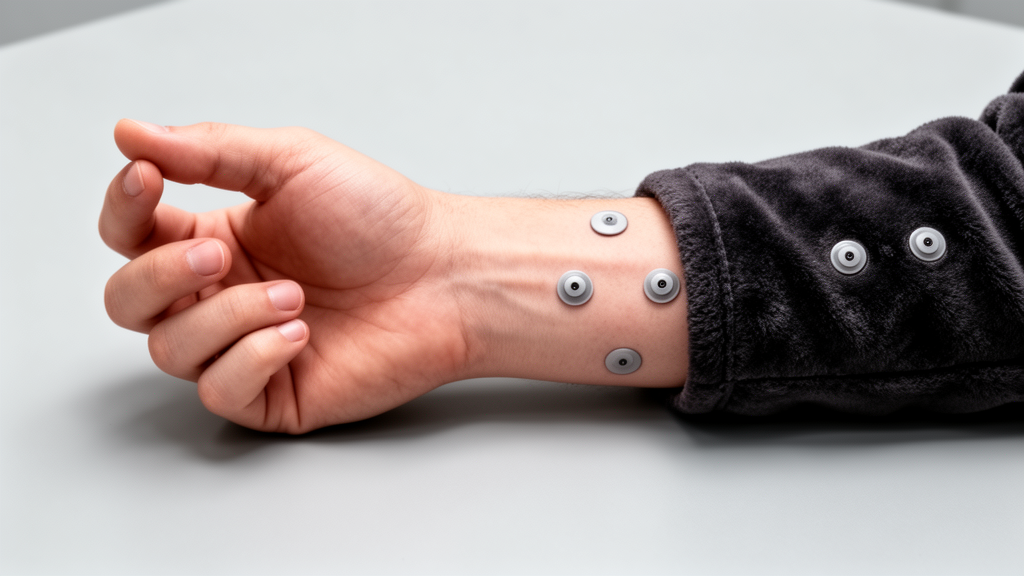
A compact deep learning model can identify which fingers a person is moving simply by reading the electrical chatter of their forearm muscles, correctly classifying nine distinct finger movements with an overall accuracy of 90.1 percent. The study, published in PLOS One, tackles a problem that has long been treated as a footnote in prosthetics research: while whole-hand gestures such as power grasps and wrist rotations have dominated the field, the fine, individual motions of single fingers have received far less attention, even though they are precisely what a person needs for typing, holding a pen, or picking up a coin.
The research team, led by Hiam Alquran of Yarmouk University in Jordan together with collaborators in Australia, Jordan, and Malaysia, built a one-dimensional convolutional neural network, or 1D-CNN, designed to decode surface electromyography signals, the tiny electrical voltages that muscles emit when they contract. Electrodes placed on the skin pick up these signals without any surgery, making sEMG the standard sensing method for myoelectric prosthetic hands. The challenge has always been that the signals are non-stationary, noisy, and highly variable between people, contaminated by muscle fatigue, electrode displacement, and interference from nearby electrical equipment.
To train and test the model, the researchers turned to the NinaPro DB2 database, a widely used benchmark containing recordings from 40 intact-limbed participants who performed dozens of hand movements while wearing 12 surface electrodes. From the dataset’s movement catalog, the team selected nine finger movements, including flexion of the little, ring, middle, and index fingers, thumb abduction, thumb flexion, and three combined movements: index and little finger flexion together, ring and middle finger flexion together, and index finger and thumb flexion together. The authors describe these combined movements as similar movements that the model must capture, and note that small analysis windows tend to have difficulty distinguishing such similar patterns from one another.
Before any classification took place, the raw signals passed through a carefully staged preprocessing pipeline. A band-pass filter from 20 to 500 hertz preserved the useful EMG energy while discarding unwanted frequencies, and a notch filter at 50 to 60 hertz suppressed power-line interference. The team then applied wavelet-based denoising, decomposing each signal into multiple frequency components using the Daubechies 4 mother wavelet across five decomposition levels, with empirical Bayesian thresholding shrinking the small coefficients that mostly represent noise while preserving the large coefficients that carry genuine muscle activity. The cleaned signal was reconstructed through an inverse wavelet transform.
Two further steps prepared the data for the network. Full-wave rectification converted the bipolar waveforms into unipolar signals by taking absolute values, so that all muscle activation energy appeared as positive magnitudes. Then Z-score standardization, calculated independently for each of the 12 channels, scaled every signal to zero mean and unit variance, preventing high-amplitude channels from dominating the feature space during training and allowing consistent interpretation of signal strength across subjects and recording sessions. The continuous signals were then chopped into overlapping 400-millisecond windows with 50 percent overlap, each window serving as one classification sample.
The choice of window length was a deliberate trade-off. Most real-time myoelectric control systems use windows of 150 to 250 milliseconds to keep response latency low, but the authors chose the longer 400-millisecond window for this offline study because refined, coordinated finger movements produce distributed EMG patterns that short windows struggle to capture. They acknowledged that the decision came from qualitative rather than systematic evaluation, and that no accuracy-versus-latency analysis was performed, leaving a systematic sweep across window lengths as a priority for future real-time work.
The network itself follows a streamlined architecture: an input layer accepting 12 channels over 800 time steps, convolutional layers that automatically learn discriminative filters, a global pooling layer, a fully connected layer, and a Softmax output for the nine classes. Training ran for 500 epochs with the Adam optimizer, and the team guarded against overfitting with L2 regularization at a coefficient of 0.001, data shuffling every epoch, and continuous monitoring of validation loss. Evaluation used a within-subject strategy, training and testing on the same individuals across different repetitions of the movements, specifically repetitions 2 and 5 of the NinaPro protocol to avoid the model memorizing temporal patterns.
The results were strong and, unusually for this field, reported in fine detail for every movement class. Thumb flexion achieved the highest precision at 91.9 percent and the highest F1-score at 0.916, while little finger flexion recorded the highest recall at 93.1 percent. Index finger flexion had the lowest precision at 88.5 percent, and the combined index-plus-little-finger movement scored the lowest recall at 90.3 percent and the lowest F1-score at 0.888. Specificity ranged from 0.983 for little finger flexion to 0.989 for index and thumb flexion. A 95 percent confidence interval for the overall accuracy, calculated with the normal approximation for binomial proportions, spanned 89.63 to 90.57 percent, a margin of error of just plus or minus 0.47 percentage points that the authors cite as evidence of statistical reliability.
How does this compare with earlier work? Previous finger-decoding studies reported higher raw accuracies, with Tenore and colleagues exceeding 98 percent for twelve finger motions and Kanitz and colleagues reaching 97.7 percent, but those studies involved only five and one participants respectively and used classical time-domain features, designs the authors argue are more susceptible to overfitting. On the same NinaPro DB2 dataset, other deep learning approaches achieved 76.1 to 88.25 percent accuracy for whole-hand gesture sets, and a hybrid CNN-LSTM model with attention modules reached 92.15 percent with considerably greater computational cost. The authors note that their simpler architecture delivers competitive performance with reduced computational demands, making it a plausible candidate for embedded, low-power prosthetic hardware, though they did not directly re-implement a conventional time-domain-plus-LDA baseline on the same data subset, a limitation they flag as addressable in follow-up work.
The authors are careful about what the results do and do not demonstrate. All evaluation was offline, within a single dataset of intact-limbed participants, with no amputee data, no real-time or embedded-hardware testing, no between-subject variability analysis, and no ablation study isolating the contribution of the normalization step. Because EMG characteristics differ significantly in residual limbs compared with intact limbs, the team regards amputee validation as a prerequisite before any claim of clinical translation. Within those boundaries, the study stands as evidence of technical feasibility: fine-resolution, finger-level decoding from non-invasive surface electrodes is achievable with a model compact enough to imagine running on a prosthetic hand, and the per-movement diagnostic detail, rather than a single headline accuracy figure, gives future prosthetic designers a clearer map of which motions current recognition systems handle well and which still need work.
Subject of Research: Deep learning classification of individual finger movements from surface electromyography signals for prosthetic control
Article Title: Deep learning–driven fine-resolution finger movement recognition from surface EMG signals
Article References: Alquran, H., Alawneh, H., Alsalatie, M., Khader, A., Mustafa, W. A., & Alawneh, K. Z. (2026). Deep learning–driven fine-resolution finger movement recognition from surface EMG signals. PLOS One, 21(10), e0361050. https://doi.org/10.1371/journal.pone.0361050
Image Credits: AI Generated
DOI: 10.1371/journal.pone.0361050
Keywords: surface EMG, deep learning, 1D-CNN, prosthetic control, finger movement recognition, NinaPro DB2, myoelectric signals, wavelet denoising, signal processing, machine learning, assistive technology, convolutional neural network
Cite Scienmag News
Blake Davidson. (October 26, 2026). Deep learning model reads individual finger movements from muscle signals with 90% accuracy. Scienmag. https://scienmag.com/deep-learning-model-reads-individual-finger-movements-from-muscle-signals-with-90-accuracy/
Blake Davidson. "Deep learning model reads individual finger movements from muscle signals with 90% accuracy." Scienmag, 26 October 2026, https://scienmag.com/deep-learning-model-reads-individual-finger-movements-from-muscle-signals-with-90-accuracy/. Accessed 26 October 2026.
Blake Davidson. "Deep learning model reads individual finger movements from muscle signals with 90% accuracy." Scienmag. October 26, 2026. https://scienmag.com/deep-learning-model-reads-individual-finger-movements-from-muscle-signals-with-90-accuracy/


