


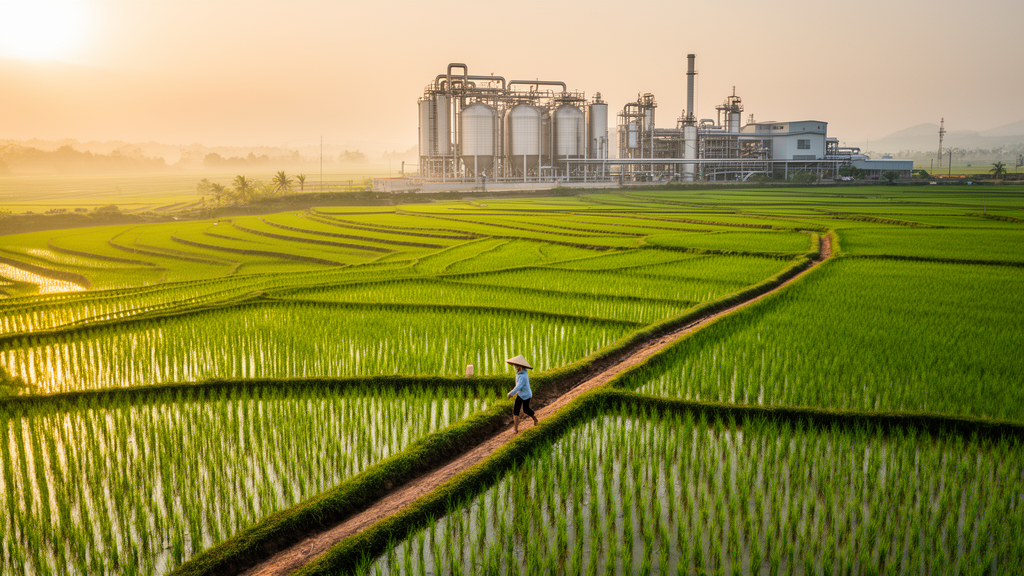
Vietnam burns a fortune every year. Across the rice paddies of the Mekong Delta and the coffee highlands of the Central Plateau, tens of millions of tonnes of agricultural residue are left to rot or set alight in open fields, releasing particulate pollution and greenhouse gases into the atmosphere. Yet a new review published in Case Studies in Chemical and Environmental Engineering argues that this seemingly worthless waste could become the raw material for a thriving biochemical industry, transforming rice husks, sugarcane bagasse, bamboo offcuts and spent coffee grounds into ethanol, rare sugars, bioplastics precursors and prebiotic food ingredients. The study, led by Nguyen Thanh Dien, Nguyen Ngoc Mai Phuong and Thach Nguyen, is one of the first to connect Vietnam’s specific residue streams to quantified, experimentally validated conversion processes, offering what amounts to a feedstock-by-feedstock roadmap for a circular bioeconomy in Southeast Asia.
The scale of the resource is staggering. National estimates place annual crop and processing residues at more than 60 million tonnes, with rice straw alone contributing roughly 40 to 50 million tonnes each year, followed by rice husk at 8 to 10 million tonnes and sugarcane bagasse at 6 to 10 million tonnes. Bamboo processing generates a further 0.75 to 1.25 million tonnes of waste, a consequence of the fact that only 50 to 70 percent of each culm finds a use, while the country’s position as the world’s second-largest coffee producer yields 0.5 to 1 million tonnes of coffee husk and pulp annually. Crucially, these volumes are not a fleeting surplus. Successive national surveys indicate that residue generation is stable or rising in step with agricultural output, meaning the feedstock base is durable rather than transient.
What makes these residues chemically attractive is their composition. Structural carbohydrates, the cellulose and hemicellulose that form the scaffolding of plant cell walls, typically account for 50 to 80 percent of the dry mass in rice straw, husk, bagasse and bamboo, and even coffee by-products contain around 45 percent. In principle, this represents a dense reservoir of fermentable sugars locked inside a recalcitrant lignocellulosic matrix. In practice, exploitation remains rudimentary: only about half of the rice husk is valorized, largely as cooking fuel or kiln feedstock, most rice straw is still burned in the fields, and modern biomass power capacity remains limited to a few sugar-mill cogeneration units and pilot husk-fired plants totalling well under 200 megawatts.
Converting those carbohydrates into useful molecules rests on two biotechnological pillars: enzymatic hydrolysis and microbial fermentation. Hydrolysis uses cellulolytic and hemicellulolytic enzymes to cleave structural polysaccharides into glucose and xylose under mild conditions, typically 45 to 50 degrees Celsius at a pH between 4.8 and 5.2. This selectivity is precisely why enzymatic routes are preferred over harsh acid hydrolysis: they consume less energy, produce fewer inhibitory by-products and preserve the sugar stream for fermentation. Performance, however, hinges on pretreatment, because lignin shields cellulose and adsorbs enzymes unproductively, while rice husk adds the complication of a silica layer. Combined alkali and hydrogen-peroxide-acetic-acid pretreatment of rice husk enabled hydrolysis yields of up to 86.3 percent at optimized enzyme loading, and for bamboo the same strategy delivered 84.3 percent of theoretical sugar yield. Remarkably, low-lignin fruit and vegetable waste needed no pretreatment at all, reaching 91 percent sugar conversion within 24 hours.
Once the sugars are liberated, microbes take over. The review catalogues an impressive array of conversions: co-fermentation of glucose and xylose with engineered Saccharomyces cerevisiae and Scheffersomyces stipitis has reached ethanol yields up to 88 percent from rice husk, bamboo and fruit waste. Succinic acid, a platform chemical for bioplastics, has been produced from rice straw and bagasse at yields of 0.18 and 0.25 grams per gram of substrate respectively, while an engineered Corynebacterium glutamicum strain converted bamboo hydrolysate to succinic acid at 63.2 percent of theoretical yield. Lactic acid, the precursor to polylactic acid bioplastic, has been obtained from mixed agricultural waste at over 80 percent conversion, and engineered Candida tropicalis has pushed xylitol production above 97 grams per litre from xylose-rich hydrolysate. Even rare sugars are on the menu: d-psicose, a low-calorie sweetener also known as d-allulose, was synthesized from rice-husk hydrolysate using xylose isomerase and d-psicose 3-epimerase at conversions of 30 to 59 percent.
The decisive insight, the authors argue, is that no single product pays the bills. First- and second-generation ethanol differ sharply in cost: the biomass-conversion step alone for lignocellulosic ethanol runs at roughly US$0.9 per gallon, more than double the US$0.3 to 0.4 per gallon for first-generation feedstocks, thanks to extra pretreatment, high enzyme loadings and lower conversion efficiencies. Two levers close this gap. The first is process integration: switching from separate hydrolysis and fermentation to simultaneous saccharification and fermentation cuts the estimated production cost from about US$2.28 to roughly US$1.48 per gallon, an approximately 35 percent reduction, by reducing reactor count, residence time and end-product inhibition. The second is co-production of higher-value chemicals that spread capital and feedstock costs across several revenue streams. Xylitol, for instance, occupies about 12 percent of the global polyol market at roughly US$4.5 to 5.5 per kilogram in bulk, an order of magnitude above ethanol, and rare sugars and prebiotic oligosaccharides command still higher food- and pharma-grade prices.
Worked examples show what such integration looks like in practice. A single rice-husk hydrolysate yielded bioethanol at 85.4 percent of theoretical yield, lactic acid at 92.5 percent and d-psicose at 40.6 percent simultaneously. Spent coffee grounds, rich in mannan, were converted by sequential alkali-bleaching pretreatment and mannanase-assisted hydrolysis into d-mannose and manno-oligosaccharides; a mass balance indicated that one kilogram of grounds yields about 40 grams of ethanol while retaining roughly 76 grams of mannose, achieved through a selective fermentation trick in which an evolved yeast mutant consumed glucose while leaving 79.9 percent of the mannose intact for recovery. Bamboo biorefining co-produced xylo-oligosaccharides at 83.9 percent xylan conversion alongside succinic and lactic acids, and in some configurations even lignin-containing cellulose nanofiber films. Across the studies, integrated cascades consistently deliver hydrolysis yields of 84 to 91 percent, ethanol yields of 85 to 88 percent, organic-acid yields of 63 to 92 percent and oligosaccharide conversions of 50 to 84 percent.
Neither technology is without its bottlenecks. Commercial cellulolytic enzymes remain expensive, a constraint that bites particularly hard in Vietnam, where enzymes are largely imported. Hydrolysis is slow relative to chemical routes, lignin adsorbs enzymes non-productively, and pretreatment can generate furan and phenolic inhibitors that poison fermentations. Fermentation itself faces incomplete pentose utilization, sensitivity to inhibitors and contamination risk in large non-sterile vessels. On the standard technology-readiness scale, the review assigns enzymatic hydrolysis and microbial fermentation levels of 5 to 7, spanning laboratory validation to pilot demonstration, while integrated biorefineries sit lower at 4 to 6, the most promising route for Vietnam yet the least demonstrated commercially. Mitigation strategies are emerging: on-site enzyme production on low-cost biomass, enzyme recycling by ultra- and nanofiltration, engineered cocktails balancing cellulase and xylanase, and robust C5-fermenting strains, which are especially relevant given that Vietnam’s dominant residues are pentose-rich.
The environmental case is equally nuanced. Diverting residues from open burning avoids particulate and greenhouse-gas emissions in a sector responsible for roughly 7 percent of global anthropogenic greenhouse-gas emissions, and the mild conditions of enzymatic and microbial processing consume less energy than thermochemical alternatives. But the authors caution that net performance is pathway-specific, depending on pretreatment chemicals, enzyme manufacture, water demand and wastewater treatment, so that energy- or solvent-intensive pretreatment can erode the savings from avoided burning. Rigorous life-cycle assessment following ISO 14040/14044, benchmarked against both open burning and the displaced fossil product, remains a critical data gap.
Perhaps the most sobering comparison is regional. Thailand has scaled bioethanol and biogas from cassava and palm residues under blending mandates and feed-in support, while Malaysia has leveraged its concentrated palm-oil waste stream toward integrated biorefineries under national biomass strategies. Vietnam, by contrast, has feed-in tariffs of about 7.03 US cents per kilowatt-hour for cogeneration and 8.47 US cents for other biomass projects, figures that lag behind solar and wind, and no dedicated instruments promoting biochemicals and biomaterials. The review concludes that the gap is institutional and structural rather than geographic, and that closing it requires organized year-round supply chains, investment in industrial-scale pretreatment and domestic enzyme production, an innovation ecosystem linking universities with industry, and policies such as tax credits and offtake guarantees that reward multi-product biorefineries rather than combustion alone. If those levers are pulled, the smoke over Vietnam’s rice fields could give way to something far more valuable.
Subject of Research: Bioconversion of Vietnam's agricultural biomass waste into high-value chemicals
Article Title: Abundant biomass waste and its potential bioconversion into high-value chemicals in Vietnam
Article References: Dien, N. T., Phuong, N. N. M., & Nguyen, T. (2026). Abundant biomass waste and its potential bioconversion into high-value chemicals in Vietnam. Case Studies in Chemical and Environmental Engineering, 14, Article 101503. https://doi.org/10.1016/j.cscee.2026.101503
Image Credits: AI Generated
DOI: 10.1016/j.cscee.2026.101503
Keywords: biomass waste, Vietnam, bioconversion, biorefinery, enzymatic hydrolysis, microbial fermentation, bioethanol, lactic acid, xylitol, rare sugars, rice straw, circular bioeconomy
Cite Scienmag News
Alan Morgan. (October 18, 2026). Vietnam’s Rice Fields Could Feed a New Generation of Biorefineries. Scienmag. https://scienmag.com/vietnams-rice-fields-could-feed-a-new-generation-of-biorefineries/
Alan Morgan. "Vietnam’s Rice Fields Could Feed a New Generation of Biorefineries." Scienmag, 18 October 2026, https://scienmag.com/vietnams-rice-fields-could-feed-a-new-generation-of-biorefineries/. Accessed 18 October 2026.
Alan Morgan. "Vietnam’s Rice Fields Could Feed a New Generation of Biorefineries." Scienmag. October 18, 2026. https://scienmag.com/vietnams-rice-fields-could-feed-a-new-generation-of-biorefineries/


