


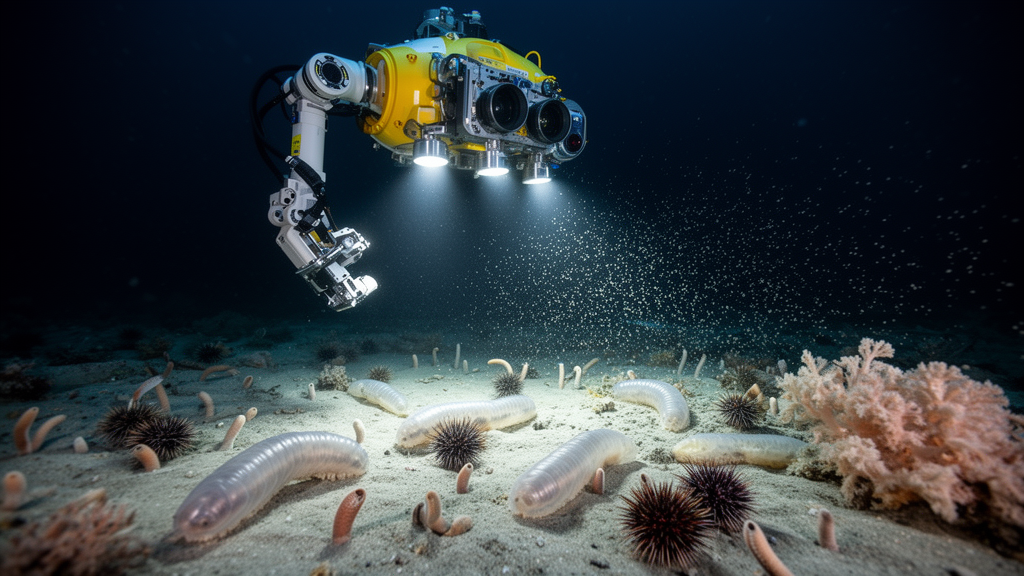
A visual biodiversity survey of the Nova Canton Trough in the Central Pacific Ocean recorded 325 organismal morphotaxa across 16 phyla, 24 classes, 52 orders and 70 families at depths from 2,751 to 7,989 metres. The primary observational study combined baited lander deployments and submersible transects to document fauna and habitat across the full abyssal-hadal depth gradient.
The survey was conducted during the four-leg Nova Canton Trough Expedition aboard RV Dagon between 21 February and 25 May 2024. The feature is an approximately 800-kilometre-long fracture zone west of the East Pacific Rise, between the Line and Phoenix Islands, with broad areas of seafloor deeper than 8,000 metres. Unlike most hadal systems studied previously, it is a fracture zone rather than a seismically active subduction trench. The study therefore offers a comparison for determining whether depth-related faunal patterns also occur in a different geological setting.
Researchers used four full-ocean-depth-rated autonomous free-fall landers and the human-occupied submersible Bakunawa. Of 110 lander deployments, 99 produced usable camera footage; 11 were excluded because cameras failed or recorded for only part of the landers’ bottom time. The analysed lander record included more than 1,500 hours of seafloor video, with mean bottom time of 7.88 ± 1.8 hours and deployment depths from 2,751 to 7,983 metres.
The Bakunawa completed 16 transects, each lasting about 3.4 ± 0.66 hours on the seafloor. The dives covered 3,273 to 8,000 metres and generated 152.9 hours of high-definition video from three exterior cameras. Because the submersible lacked a tracking system, the horizontal distance covered by individual dives could not be established. Observation depths were instead matched to time-stamped conductivity, temperature and depth measurements, with remaining uncertainty associated with timestamp resolution, possible clock offsets and short-term vertical movement.
Video was reviewed to classify visible organisms at the lowest supported taxonomic rank or, where diagnostic features could not be resolved, as distinct morphotaxa. Identifications were aligned with the World Register of Marine Species and processed in EventMeasure and BIIGLE 2.0 using a shared vocabulary. The researchers used presence-absence data to combine platforms despite differences in detection probability. The full lander and submersible datasets were made available through OBIS and GBIF.
The two platforms recorded substantially different subsets of the fauna. Of the 325 morphotaxa, 62.2% were observed only in submersible footage, 12.3% only in lander footage and about 25.5% in both. Annotators recorded approximately 24,500 individual organisms in the submersible data and 4,500 in the lander data. The contrast is consistent with the platforms sampling different ecological components: landers attract mobile animals, while submersible transects provide broader observations of sessile and weakly mobile benthic fauna and can cross multiple substrate types.
Depth was associated with marked changes in the observed assemblages. Apparent morphotaxa richness was highest in the lower abyssal zone, approximately 4,500–6,000 metres, where submersible footage recorded diverse sponges, octocorals, antipatharians, brisingid sea stars, crinoids and holothuroids. The lower-abyssal fish fauna included conspicuous diversity among ophidiiforms, or cusk eels, alongside the frequently recorded macrourid Coryphaenoides yaquinae. Across the abyssal-hadal transition, roughly 5,500–6,500 metres, many bait-attending fishes and decapods declined or disappeared, while distinct actiniarians, hyocrinids, brisingids and holothuroids were observed on gravel, nodules, mixed hard substrate and sediment.
Below approximately 6,000–6,500 metres, the fauna was associated mainly with fine sediment in the deepest part of the trough. The submersible recorded a snailfish morphotype between 6,090 and 7,985 metres, while lander deployments detected it across 29 deployments. Elpidiid holothuroids were conspicuous, including more than 1,500 individuals of Peniagone sp. indet. 1 between 6,592 and 7,987 metres. Xenophyophores were particularly abundant and diverse in the deepest flat plain, where their density reached approximately 20 individuals per square metre. The survey also extended the reported depth range of narcomedusae to 7,989 metres and recorded the first hadal occurrence of the corallimorpharian order.
The results establish a broad visual baseline but do not constitute a complete taxonomic census. Image quality, limited visibility of diagnostic features, burrowing and the grouping of morphologically similar or cryptic organisms can conceal species-level diversity, while multiple life stages or morphotypes may cause a single species to be counted more than once. Broad depth ranges assigned to coarse categories may also pool taxa with different distributions. The absence of the supergiant amphipod Alicella gigantea from both imagery and traps remains unexplained. Physical specimens and molecular work are needed to resolve uncertain identifications, confirm proposed range extensions and determine whether apparent zonation reflects taxonomic pooling as well as ecological change.
Subject of Research: Visual inventory of abyssal and hadal biodiversity in the Nova Canton Trough
Article Title: Biodiversity of the abyssal and hadal zone in the Nova Canton Trough (Central Pacific Ocean; 2751–7989 m): a visual inventory
Article References: Swanborn, D., Marchiò, A., La Bianca, G., Cundy, M., Reynolds Jr, T., Stott, M., Gonzalez, B., Stewart, H., & Jamieson, A. (2026). Biodiversity of the abyssal and hadal zone in the Nova Canton Trough (Central Pacific Ocean; 2751–7989 m): a visual inventory. Biodiversity Data Journal, 14, Article e204436. https://doi.org/10.3897/bdj.14.e204436
Image Credits: AI Generated
Keywords: deep-sea biodiversity, Nova Canton Trough, abyssal zone, hadal zone, video survey, morphotaxa, submersible observations, baited landers, depth zonation, Central Pacific, Biodiversity, abyssal
Cite Scienmag News
Drew Townsend. (October 20, 2026). Video survey documents 325 morphotaxa across the Nova Canton Trough. Scienmag. https://scienmag.com/video-survey-documents-325-morphotaxa-across-the-nova-canton-trough/
Drew Townsend. "Video survey documents 325 morphotaxa across the Nova Canton Trough." Scienmag, 20 October 2026, https://scienmag.com/video-survey-documents-325-morphotaxa-across-the-nova-canton-trough/. Accessed 20 October 2026.
Drew Townsend. "Video survey documents 325 morphotaxa across the Nova Canton Trough." Scienmag. October 20, 2026. https://scienmag.com/video-survey-documents-325-morphotaxa-across-the-nova-canton-trough/


