

Tuesday, October 20, 2026
Science
No Result
View All Result
  • Login
  • HOME
  • SCIENCE NEWS
  • CONTACT US
  • HOME
  • SCIENCE NEWS
  • CONTACT US
No Result
View All Result
Scienmag
No Result
View All Result
Home Science News Technology and Engineering

Laboratory study finds trade-offs in reinforced PLA biocomposites

October 20, 2026
in Technology and Engineering
Denise Maddox
By Denise Maddox Scienmag Editorial Profile - Mechanical Engineering
Reading Time: 2 mins read
0
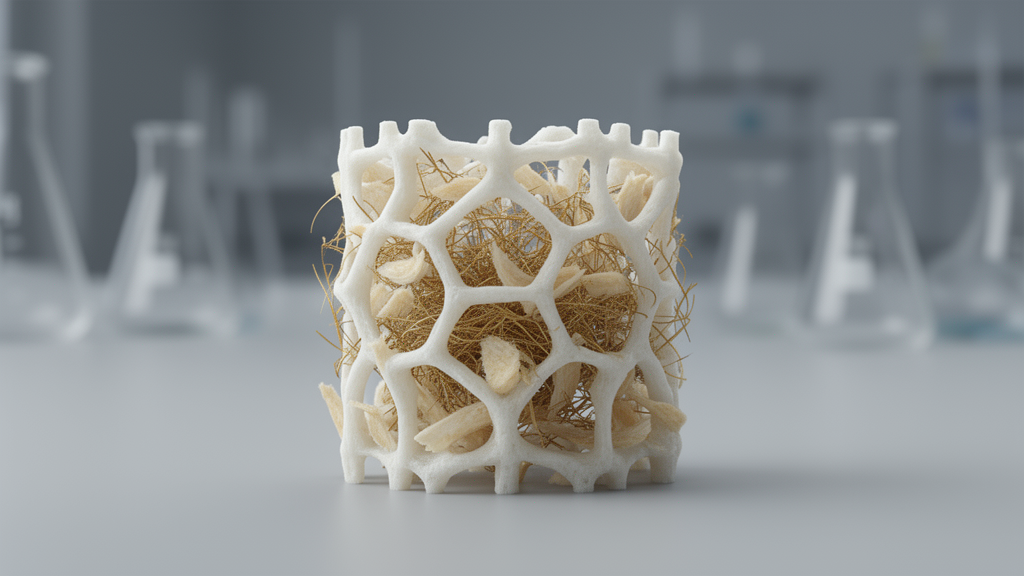
Sugar beet waste and Amazonian fibers turn 3D-printed PLA into stronger biodegradable implants

Sugar beet waste and Amazonian fibers turn 3D-printed PLA into stronger biodegradable implants

65
SHARES
587
VIEWS
Share on FacebookShare on Twitter
ADVERTISEMENT

A laboratory study of polylactic acid (PLA) biocomposites fabricated by fused deposition modeling found that reinforcement with Montrichardia linifera microfibers and sugar-beet-derived hydroxyapatite nanoparticles produced the strongest overall mechanical performance at a microfiber content of 40 vol.% and hydroxyapatite content of 3 vol.%. The article’s abstract reports that this formulation, designated PMH2, achieved a tensile strength of 125 MPa, flexural strength of 138 MPa, impact energy of 3.3 J and hardness of 83 Shore D. These values represented reported improvements over neat PLA of 123.2%, 102.9%, 400% and 6.41%, respectively.

The researchers systematically investigated the mechanical, tribological, swelling and in vitro degradation behavior of the reinforced materials as hydroxyapatite content varied. A different formulation, PMH3 containing 5 vol.% hydroxyapatite, gave the most favorable measured tribological and degradation results in the abstract. It recorded the lowest specific wear rate, 0.02 mm3/Nm, and coefficient of friction of 0.30, together with the highest swelling and degradation values at week 4: 21.73% and 11.37%, respectively. The abstract associates these observations with increased ceramic content, improved surface hardness and enhanced bioactivity, but the available evidence does not establish the mechanisms responsible for the measured differences.

The reported results show a trade-off between mechanical performance and the tribological and in vitro degradation measurements rather than a single formulation that was best across every tested property. The authors attribute PMH2’s mechanical results to a synergistic interaction between well-dispersed hydroxyapatite nanoparticles and microfibers, which they associate with interfacial bonding, stress transfer and crack-pinning mechanisms while preserving matrix continuity. They describe the hybrid reinforcement as effectively tailoring the composites’ strength, surface durability and biodegradation characteristics and as making the materials promising candidates for load-bearing and bioresorbable biomedical uses.

This evidence comes from a materials-testing study rather than a review, protocol, simulation, animal experiment or human clinical study. The supplied source provides only the article abstract and does not report the full methods, statistical uncertainty, biological assays or thermal-performance results, despite thermal performance appearing in the original title. The findings therefore apply to the tested laboratory formulations and their measured mechanical, wear, friction, swelling and four-week in vitro degradation outcomes; they do not establish performance in patients or in vivo safety and effectiveness.

Subject of Research: Laboratory evaluation of mechanical, tribological, swelling and in vitro degradation properties of reinforced PLA biocomposites

Article Title: Mechanical, biological, and thermal performance of fused deposition modeled PLA biocomposites reinforced with sugar-beet-derived hydroxyapatite nanofillers and Montrichardia linifera microfibers

Article References: Jayabalakrishnan, D., Gobu, N., Manoj Kumar, S., & Uvaraja, V. C. (2026). Mechanical, biological, and thermal performance of fused deposition modeled PLA biocomposites reinforced with sugar-beet-derived hydroxyapatite nanofillers and Montrichardia linifera microfibers. Journal of Materials Science. https://doi.org/10.1007/s10853-026-13904-4

Image Credits: AI Generated

DOI: 10.1007/s10853-026-13904-4

Keywords: polylactic acid, fused deposition modeling, hydroxyapatite nanoparticles, Montrichardia linifera, biocomposites, mechanical properties, tribology, in vitro degradation, swelling, materials science, Mechanical, biological

Cite Scienmag News

Denise Maddox. (October 20, 2026). Laboratory study finds trade-offs in reinforced PLA biocomposites. Scienmag. https://scienmag.com/laboratory-study-finds-trade-offs-in-reinforced-pla-biocomposites/

Denise Maddox. "Laboratory study finds trade-offs in reinforced PLA biocomposites." Scienmag, 20 October 2026, https://scienmag.com/laboratory-study-finds-trade-offs-in-reinforced-pla-biocomposites/. Accessed 20 October 2026.

Denise Maddox. "Laboratory study finds trade-offs in reinforced PLA biocomposites." Scienmag. October 20, 2026. https://scienmag.com/laboratory-study-finds-trade-offs-in-reinforced-pla-biocomposites/


Tags: bio-based nanomaterials for sustainable compositesbioactivity and degradation behaviorbiocomposite formulation trade-offsbiocompositesbiodegradable materials in 3D printingBiologicalFused deposition modelinghydroxyapatite nanoparticlesimpact energy and hardnessin vitro degradationmaterials scienceMechanicalmechanical performance improvementsmechanical propertiesmicrofibers and hydroxyapatite nanoparticlesMontrichardia liniferapolylactic acidReinforced PLA biocompositessurface hardness and swellingswellingtensile and flexural strengthtribological properties and wear ratetribology
Share26Tweet16
Previous Post

Cryptococcal antigenemia detected in 11.1% of hospitalized advanced-HIV patients in Ceará study

Next Post

Cultivation and gene-expression study links low temperature to Armillaria ostoyae fruiting-body development

Related Posts

Deepest visual census ever reveals 325 morphotaxa in Pacific fracture zone
Biology

Video survey documents 325 morphotaxa across the Nova Canton Trough

October 20, 2026
Controlled robot experiment shows trigger attack and defense for LLM planners
Technology and Engineering

Controlled robot experiment shows trigger attack and defense for LLM planners

October 20, 2026
Hidden Nightlife of Madeira: Thousands of Moths and Rare Endemics Recorded Across Protected Areas
Biology

Nocturnal arthropod occurrences across Natura 2000 protected areas of Madeira Island (Portugal)

October 20, 2026
Machine Learning Turns Tea Waste Into Glowing Carbon Quantum Dots With Near-Perfect Yield Prediction
Technology and Engineering

Machine learning-assisted hydrothermal process optimization yields carbon quantum dots from tea waste

October 20, 2026
AI in construction cost management lags behind policy support in China’s Yangtze River Delta, study finds
Technology and Engineering

Expert-based AHP-cloud assessment finds average AI development in Yangtze River Delta construction cost management

October 20, 2026
AI Model Reads Children’s Drawings and Scores Creativity by Fusing DETR Detection With CLIP Semantics
Technology and Engineering

DETR-CLIP study evaluates detection, semantics and creativity scoring in 5,000 children’s drawings

October 20, 2026
Next Post
Cold-Triggered Molecular Switch Behind Mushroom Fruiting Identified in Armillaria ostillata

Cultivation and gene-expression study links low temperature to Armillaria ostoyae fruiting-body development

  • Mothers who receive childcare support from maternal grandparents show more optimized

    Mothers who receive childcare support from maternal grandparents show more parental warmth, finds NTU Singapore study

    27656 shares
    Share 11059 Tweet 6912
  • University of Seville Breaks 120-Year-Old Mystery, Revises a Key Einstein Concept

    1061 shares
    Share 424 Tweet 265
  • Bee body mass, pathogens and local climate influence heat tolerance

    682 shares
    Share 273 Tweet 171
  • Researchers record first-ever images and data of a shark experiencing a boat strike

    546 shares
    Share 218 Tweet 137
  • Groundbreaking Clinical Trial Reveals Lubiprostone Enhances Kidney Function

    531 shares
    Share 212 Tweet 133
Science

Embark on a thrilling journey of discovery with Scienmag.com—your ultimate source for cutting-edge breakthroughs. Immerse yourself in a world where curiosity knows no limits and tomorrow’s possibilities become today’s reality!

RECENT NEWS

  • Video survey documents 325 morphotaxa across the Nova Canton Trough
  • Cultivation and gene-expression study links low temperature to Armillaria ostoyae fruiting-body development
  • Laboratory study finds trade-offs in reinforced PLA biocomposites
  • Cryptococcal antigenemia detected in 11.1% of hospitalized advanced-HIV patients in Ceará study

Categories

  • Agriculture
  • Anthropology
  • Archaeology
  • Athmospheric
  • Biology
  • Biotechnology
  • Blog
  • Bussines
  • Cancer
  • Chemistry
  • Climate
  • Earth Science
  • Editorial Policy
  • Marine
  • Mathematics
  • Medicine
  • Pediatry
  • Policy
  • Psychology & Psychiatry
  • Science Education
  • Science News
  • Social Science
  • Space
  • Technology and Engineering

Subscribe to Blog via Email

Enter your email address to subscribe to this blog and receive notifications of new posts by email.

Join 5,150 other subscribers

© 2025 Scienmag - Science Magazine

Welcome Back!

Login to your account below

Forgotten Password?

Retrieve your password

Please enter your username or email address to reset your password.

Log In
No Result
View All Result
  • HOME
  • SCIENCE NEWS
  • CONTACT US

© 2025 Scienmag - Science Magazine

Discover more from Science

Subscribe now to keep reading and get access to the full archive.

Continue reading