


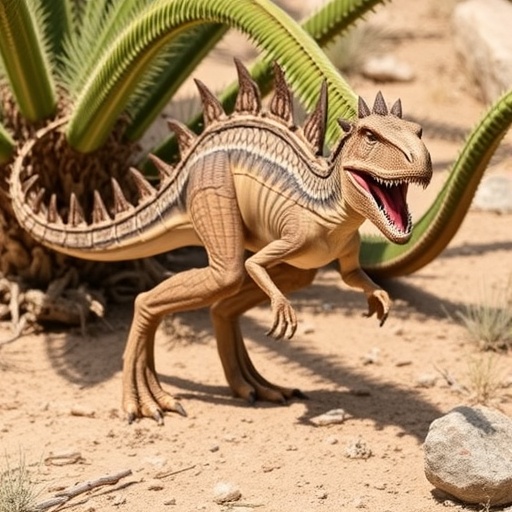
In an unexpected breakthrough in paleontology, Dr. Jason W. Ricketts, an associate professor in the Department of Earth, Environmental and Resource Sciences at The University of Texas at El Paso (UTEP), has unearthed fossil fragments from a dinosaur species previously unknown to inhabit West Texas. This remarkable discovery significantly broadens the paleogeographic range of the genus Tenontosaurus, a widespread ornithopod dinosaur, extending its known distribution to the southwestern reaches of North America. The fossils were discovered serendipitously during geological fieldwork at the Indio Mountains Research Station (IMRS), an expansive natural laboratory owned by UTEP, located in the relatively underexplored southeastern part of Hudspeth County.
The fossil assemblage, consisting predominantly of disarticulated bone fragments weathering from soft shale deposits, includes a partial femur—an invaluable specimen for taxonomic and anatomical study. The preservation of these remains in fluvial-lacustrine sedimentary contexts invites detailed stratigraphic and taphonomic analysis, potentially offering insight into the depositional environment and paleoecological conditions of this portion of the Early Cretaceous period, approximately 115 million years ago. Prior to this finding, Tenontosaurus fossils were commonly recovered from the northern and eastern territories of the western United States, including localities in Montana, Idaho, Arizona, Utah, and Wyoming.
This novel finding challenges established biogeographic models by narrowing the apparent dispersal gap of ornithopods, suggesting a broader ecological plasticity and habitat tolerance than previously documented. Tenontosaurus, a medium-sized herbivore characterized by its robust limb elements and specialized dentition adapted for processing vegetation, plays a critical role in reconstructing Early Cretaceous terrestrial ecosystems. The data gathered from these West Texas fossils will aid in clarifying the phylogenetic relationships within Ornithopoda, as well as the mechanisms driving faunal interchange across varied paleoenvironmental gradients.
Dr. Ricketts’ contribution to paleontological science underlines the latent potential within underexplored basins in the southwest, regions historically overlooked due to sedimentary cover and limited accessibility. The discovery not only enriches the body of fossil evidence available for Tenontosaurus but also accentuates the significance of multipurpose field investigations, where geological scrutiny can serendipitously yield paleobiological treasures. This event exemplifies the interdisciplinary nature of earth sciences, where lithostratigraphic inquiry can converge with paleobiology to unlock evolutionary histories.
The ensuing publication, entitled “An Ornithopod Dinosaur from the Lower Cretaceous of West Texas,” coauthored with Dr. Spencer G. Lucas, curator of paleontology at the New Mexico Museum of Natural History and Science, and doctoral candidate Sebastian G. Dalman from Montana State University, has set a precedent for regional collaboration in paleontological research. While the manuscript awaits peer-reviewed validation, preliminary analyses highlight adaptive morphological traits consistent with known Tenontosaurus specimens, affirming taxonomic identification despite the fragmentary nature of the fossils.
This discovery is especially momentous considering the rarity of dinosaur osteological material in West Texas compared to trace fossils such as footprints. The recovery of bone material opens unprecedented opportunities for histological studies, isotopic analyses, and comparative morphology to elucidate growth patterns, diet, and climatic adaptations. Furthermore, the identification of Tenontosaurus in this geological context may prompt a reassessment of Early Cretaceous faunal provincialism and niche occupation, illuminating complex evolutionary dynamics in North America.
The broader implications extend to paleoenvironmental reconstruction, as the depositional milieu of the shale units at IMRS may signal the presence of wetlands or floodplains that supported diverse flora and fauna. The interplay between these ancient landscapes and dinosaur population distributions offers a fertile area for ongoing research, potentially integrating sedimentology with paleobotany to reconstruct the ecosystems that sustained herbivorous dinosaurs like Tenontosaurus.
This discovery has garnered acclaim from the academic leadership at UTEP, where interim dean Dr. Liz Walsh emphasized the profound impact of exploratory fieldwork and the fundamental role of curiosity-driven research in driving paradigm shifts within the earth sciences. Dr. Walsh asserted that such findings demonstrate the inherent value of investing in research infrastructure and fostering local expertise in regions that have historically been scientific frontiers.
Continuing investigations are planned to perform detailed morphological characterization, including 3D digital modeling and comparative biomechanical assessments to better understand locomotor capabilities and ecological behaviors. With advances in geochronological techniques and non-invasive imaging, these fossil fragments hold promise for reconstructing life appearance, ontogeny, and paleoecology of Tenontosaurus populations in West Texas during the Early Cretaceous.
In conclusion, the serendipitous discovery of Tenontosaurus fossils at UTEP’s Indio Mountains Research Station represents a landmark development in North American paleontology. It challenges long-held assumptions regarding dinosaur biogeography, opens new investigative pathways into Early Cretaceous ecosystems, and underscores the ongoing value of field-based geology coupled with interdisciplinary sciences. This finding emboldens optimism toward uncovering additional paleobiological records in underexplored territories, contributing vital pieces to the complex evolutionary mosaic of dinosaurs in the ancient Americas.
News Publication Date: November 4, 2025
Web References:
https://www.utep.edu/science/indio/
https://mediasvc.eurekalert.org/Api/v1/Multimedia/cb61ec4a-a3ec-43f9-8f16-698120dffbd6/Rendition/low-res/Content/Public
References: New Mexico Museum of Natural History and Science publication (non-peer reviewed paper).
Cite Scienmag News
Violet Maxwell. (November 4, 2025). UTEP Dinosaur Discovery Expands Ancient Species’ Known Habitat Range. Scienmag. https://scienmag.com/utep-dinosaur-discovery-expands-ancient-species-known-habitat-range/
Violet Maxwell. "UTEP Dinosaur Discovery Expands Ancient Species’ Known Habitat Range." Scienmag, 4 November 2025, https://scienmag.com/utep-dinosaur-discovery-expands-ancient-species-known-habitat-range/. Accessed 3 September 2026.
Violet Maxwell. "UTEP Dinosaur Discovery Expands Ancient Species’ Known Habitat Range." Scienmag. November 4, 2025. https://scienmag.com/utep-dinosaur-discovery-expands-ancient-species-known-habitat-range/


