


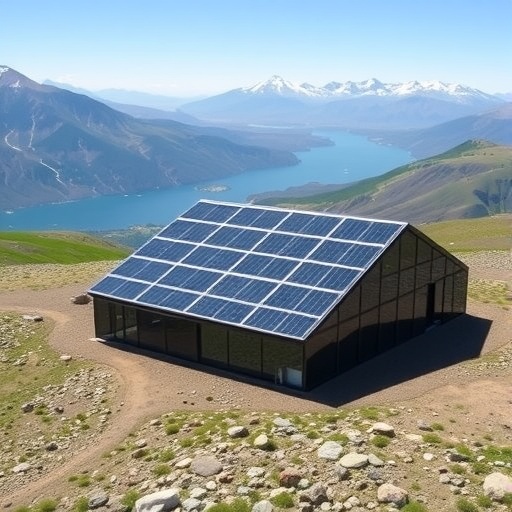
A new study in Communications Earth & Environment reports a user-centric renewable energy framework designed to power self-sufficient, zero-carbon infrastructure in high-altitude regions. The work, led by Guan, Fu, Liu and colleagues, tackles a persistent problem: remote communities often face unreliable grids, harsh weather, and complex logistics that make conventional infrastructure both costly and carbon intensive.
The proposed approach shifts planning from technology-first deployments to human-and-site requirements. Instead of treating solar, wind, storage, and power management as separate components, the framework coordinates them around daily usage patterns, service reliability targets, and site-specific constraints typical of high elevations.
At its core, the model integrates high-resolution energy-demand profiling with renewable resource estimates. By coupling local climate variability—such as seasonal solar attenuation and wind fluctuations—with adaptive generation scheduling, the system aims to maintain stable power supply even when conditions deteriorate.
A key element is an energy-management layer that uses real-time or near-real-time signals to balance supply and demand. This includes directing power flows between generation sources and storage, optimizing charging cycles, and prioritizing critical loads during periods of low renewable output.
The framework also emphasizes “self-sufficiency,” meaning the infrastructure is engineered to operate with minimal external fuel dependence. That concept is operationalized through a resilience logic: the design considers not only average energy production but also worst-case scenarios, reducing the risk of outages during extended cloudy or calm spells.
For high-altitude environments, the study highlights additional engineering pressures—maintenance accessibility, material durability under rapid temperature swings, and constraints on transporting spare parts. The proposed system architecture therefore supports modular expansion and straightforward operational tuning, which can lower lifecycle costs and improve long-term feasibility.
The authors frame their contribution as both technical and practical: the framework can guide decision-makers in selecting component sizes, control strategies, and service-level targets. By embedding user-centric assumptions into system design, the work claims improved alignment with real operational needs rather than generic energy benchmarks.
With the DOI ending in 03867-4, the research positions zero-carbon infrastructure not as an aspirational goal but as a design problem solvable through integrated modeling and adaptive control. If validated across diverse high-altitude contexts, the framework could accelerate viral-scale attention for renewable reliability where it has historically been hardest to achieve.
Cite Scienmag News
Faith Mcneil. (July 28, 2026). User-Centered Framework Enables Self-Sufficient Zero-Carbon Energy in High Altitudes. Scienmag. https://scienmag.com/user-centered-framework-enables-self-sufficient-zero-carbon-energy-in-high-altitudes/
Faith Mcneil. "User-Centered Framework Enables Self-Sufficient Zero-Carbon Energy in High Altitudes." Scienmag, 28 July 2026, https://scienmag.com/user-centered-framework-enables-self-sufficient-zero-carbon-energy-in-high-altitudes/. Accessed 4 September 2026.
Faith Mcneil. "User-Centered Framework Enables Self-Sufficient Zero-Carbon Energy in High Altitudes." Scienmag. July 28, 2026. https://scienmag.com/user-centered-framework-enables-self-sufficient-zero-carbon-energy-in-high-altitudes/


