


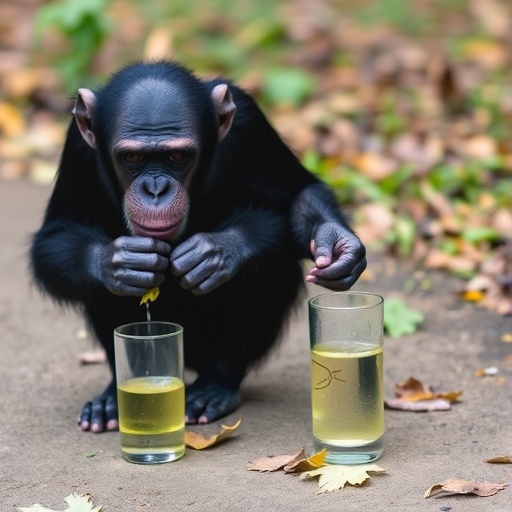
In the dense rainforests of Uganda’s Kibale National Park, a groundbreaking study has brought new evidence to light supporting the controversial “drunken monkey” hypothesis. Aleksey Maro, a graduate student at UC Berkeley, along with his adviser, Robert Dudley, has revealed that wild chimpanzees (Pan troglodytes) regularly ingest naturally fermented fruit containing ethanol, as confirmed by direct biochemical analysis of their urine. This novel approach resolves a longstanding challenge in field biology: how to accurately quantify alcohol consumption in wild animals where breathalyzers and other direct measurement tools are impossible to use.
Maro’s research hinged on a clever workaround—stealth collection of chimpanzee urine samples beneath fruiting trees at Ngogo, one of the park’s richest chimpanzee habitats. Using improvised tools such as forked branches outfitted with plastic sleeves, Maro could capture freshly voided urine without disturbing the animals. Additionally, urine collected from leaves and puddles on the forest floor complemented his sampling, resulting in 20 samples from 19 individual chimps. This meticulous work, conducted over an 11-day period in August 2025, provided enough material for metabolic analysis of ethyl glucuronide, a robust and direct ethanol metabolite indicative of recent alcohol ingestion.
This metabolic byproduct’s presence is an unequivocal marker that the chimpanzees are not merely incidentally exposed but actively consuming ethanol through fermented fruit. Commercially available ethanol-sensitive strips revealed that 85% of the individuals tested positive at thresholds comparable to human light drinking—equivalent to one to two standard drinks within 24 hours. These biochemical findings corroborate earlier quantitative estimates Maro derived from measuring ethanol concentrations within fruit pulp combined with observed feeding rates. The chimps’ diet delivers roughly 14 grams of ethanol daily, demonstrating a significant intake that rivals moderate human consumption.
Interestingly, the research indicates intra-population variation in ethanol ingestion. Male chimps showed higher positivity for ethanol metabolites compared to females, particularly females in estrus, and juveniles. This pattern hints at behavioral or ecological factors influencing access to fermented fruits, possibly including resource hoarding or selective feeding strategies among males. The fruits primarily consumed during this study were African star apples (Gambeya albida), which during a bumper crop year contained lower ethanol concentrations than other fruits previously studied at Ngogo. The chimpanzees likely consumed riper, more fermented fruit higher in ethanol than that measurable from undamaged fallen fruit.
Beyond advancing understanding of chimpanzee foraging ecology and dietary preferences, these findings have profound evolutionary implications. As our closest living relatives share this natural interaction with dietary ethanol, it suggests that a propensity for alcohol consumption may be deeply rooted in hominid lineage. Dudley and Maro highlight that the evolutionary relationship between fruit consumption and alcohol exposure sheds light on human predisposition towards ethanol intake. This ancestral exposure may have primed humans to domesticate alcoholic beverages thousands of years ago via fermentation technologies involving brewer’s yeast.
The methodology employed here, particularly the use of ethanol-sensitive immunoassay strips adapted from human clinical and forensic contexts, sets a new standard for field research into animal intoxication. Dudley envisions expanding this approach to other frugivorous species that likely encounter fermented fruit regularly. Fruit bats, for example, represent an enticing future target. This could enable assessments of how dietary ethanol affects animal physiology, behavior, and even reproductive timing over seasonal and climatic cycles.
The study also raises provocative questions about the broader ecological role of ethanol in food webs. Animal intoxication has been observed anecdotally across many taxa, yet few field studies have quantified actual ethanol intake or its metabolic signatures until now. These new data suggest that natural ethanol ingestion might be a widespread and evolutionarily significant aspect of wild animal life, influencing social dynamics, foraging patterns, and perhaps stress physiology or aggression.
Despite this advance, Dudley acknowledges remaining gaps to fully validate the “drunken monkey” hypothesis. Most notably, direct evidence that chimps actively seek out fruits with higher ethanol concentrations remains elusive. Demonstrating purposeful selection for more alcoholic foods would cement the link between attraction and evolutionary exposure. Future research involving controlled feeding experiments or detailed fruit ethanol mapping paired with behavioral observations could fill this important gap.
The results have sparked interest beyond academia, as Maro’s work was featured in a German documentary, “Tiere im Rausch” (“Wild on a High”), which explores animal intoxication in natural settings. This interdisciplinary engagement highlights the public fascination with alcohol’s role beyond human culture and serves as a catalyst for wider scientific inquiry into the ecological and evolutionary ramifications of natural ethanol consumption.
In sum, this pioneering field study not only confirms that wild chimpanzees ingest biologically significant amounts of ethanol through their naturally fermented fruit diet but also underscores the deep evolutionary roots of alcohol consumption. By blending innovative field techniques with biochemical assays, Maro and Dudley’s work opens exciting new frontiers in our understanding of primate ecology, evolutionary biology, and the multifaceted relationships between animals and the chemical world of fermented foods.
News Publication Date: 24-Feb-2026
Web References:
http://dx.doi.org/10.1098/rsbl.2025.0740
Cite Scienmag News
Daisy Hatcher. (February 25, 2026). Urine Tests Reveal Alcohol Consumption in Wild African Chimpanzees. Scienmag. https://scienmag.com/urine-tests-reveal-alcohol-consumption-in-wild-african-chimpanzees/
Daisy Hatcher. "Urine Tests Reveal Alcohol Consumption in Wild African Chimpanzees." Scienmag, 25 February 2026, https://scienmag.com/urine-tests-reveal-alcohol-consumption-in-wild-african-chimpanzees/. Accessed 5 September 2026.
Daisy Hatcher. "Urine Tests Reveal Alcohol Consumption in Wild African Chimpanzees." Scienmag. February 25, 2026. https://scienmag.com/urine-tests-reveal-alcohol-consumption-in-wild-african-chimpanzees/


