


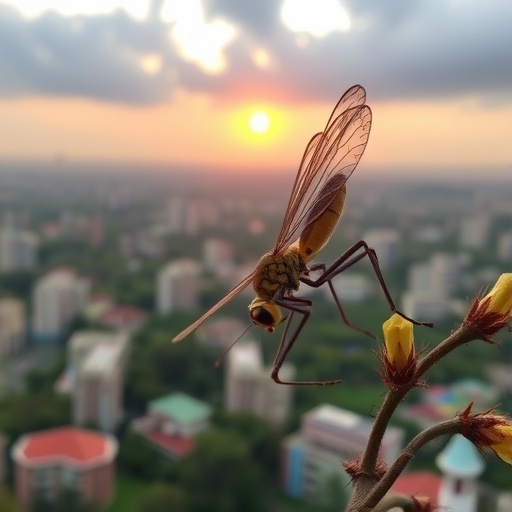
Urbanization is reshaping disease risk in subtle ways, and a new study points to a worrying match between city growth and the environmental preferences of Anopheles stephensi, a major malaria vector. Writing in Communications Earth & Environment, researchers report that development patterns can create habitat conditions that make the mosquito more likely to thrive, even before traditional “outbreak” signals appear.
The team analyzed how different aspects of urbanization—such as land-cover change, infrastructure expansion, and associated water-and-land management—translate into ecological conditions in space and time. Their central finding is that particular urban development characteristics systematically align with higher habitat suitability for An. stephensi, suggesting that city planning decisions may indirectly steer vector populations.
Using data-driven modeling, the study links environmental variables that proxy for breeding potential—like local moisture conditions, vegetation structure, and surface-water availability—to suitability for the species. Rather than treating urban areas as uniform, the authors examine fine-grained differences across neighborhoods and development stages.
A key technical emphasis is that habitat suitability does not rise randomly. The researchers show that certain urban transitions can increase the persistence of microhabitats suitable for larvae, for example by sustaining humid conditions or creating small water-retention zones around built environments. These effects can be amplified where urban growth alters drainage and the distribution of shallow, slow-moving water.
The results help explain why malaria transmission risk can increase in fast-growing cities even when overall climate trends appear stable. By identifying which development signatures correlate with enhanced mosquito habitat, the work offers a route to earlier risk forecasting.
Importantly, the study frames urbanization as a driver of ecological opportunity. When the built environment reduces natural barriers or changes how water is stored and evaporates, it can favor mosquitoes that exploit urban niches. An. stephensi is particularly capable of persisting in such settings, making the urban match clinically significant.
The authors argue that public health interventions need to keep pace with urban transformation. Targeting larval habitats in the specific microenvironments suggested by the model could be more effective than broad, area-wide measures, especially in rapidly changing urban landscapes.
Overall, the research delivers a viral-science message with direct implications: city growth is not just a backdrop for disease—it can be an amplifier of mosquito ecology, reshaping malaria risk from the ground up.
Cite Scienmag News
Violet Maxwell. (July 28, 2026). Urbanization Alters Development Patterns, Boosting Anopheles stephensi Habitat Suitability. Scienmag. https://scienmag.com/urbanization-alters-development-patterns-boosting-anopheles-stephensi-habitat-suitability/
Violet Maxwell. "Urbanization Alters Development Patterns, Boosting Anopheles stephensi Habitat Suitability." Scienmag, 28 July 2026, https://scienmag.com/urbanization-alters-development-patterns-boosting-anopheles-stephensi-habitat-suitability/. Accessed 4 September 2026.
Violet Maxwell. "Urbanization Alters Development Patterns, Boosting Anopheles stephensi Habitat Suitability." Scienmag. July 28, 2026. https://scienmag.com/urbanization-alters-development-patterns-boosting-anopheles-stephensi-habitat-suitability/


