


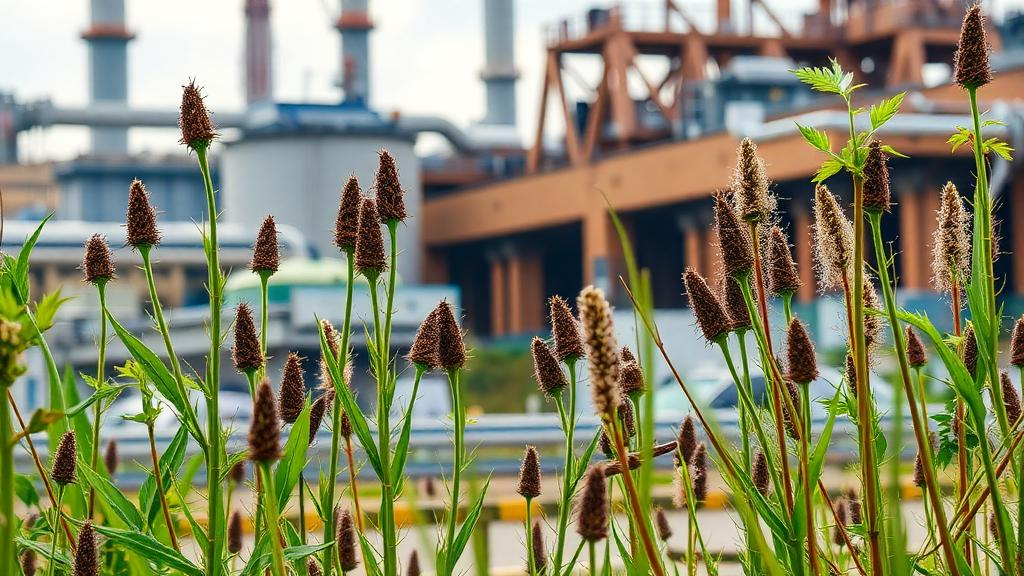
Wild plants growing in the shadow of factories may be quietly recording the environmental cost of industrialization in their leaves, stems, and pigments. A new study published in Plant Biosystems suggests that common herbaceous species in a rapidly industrializing part of subtropical South Asia show measurable shifts in their functional traits along a gradient of industrial exposure, offering a potentially cheap and accessible way to track ecological change where conventional pollution monitoring is sparse. The research, led by Sehrish Sadia and Muhammad Waheed with colleagues at institutions in Pakistan and Uzbekistan, examined how plant communities and their physical and biochemical characteristics change as one moves from agricultural land toward the perimeter of industrial operations.
The team organized their sampling around three site categories: an Agricultural Reference category serving as the baseline, an Industrial-Periphery category adjacent to industrial activity, and an Industrial-Edge category closest to the industrial footprint. These categories were distributed across 24 sampling units, allowing the researchers to compare vegetation at different distances from presumed sources of industrial stress. In total, the survey recorded 23 herbaceous species, and for each plant the team measured a suite of traits that ecologists consider sensitive indicators of environmental conditions: plant height, stem diameter, leaf area, leaf fresh weight, leaf dry weight, a derived proxy for leaf thickness, and the concentrations of three key photosynthetic pigments, namely chlorophyll a, chlorophyll b, and carotenoids.
Functional traits are, in essence, the working parts of a plant. Leaf area governs how much light a plant can capture; stem diameter reflects structural investment and water transport capacity; and the balance of chlorophyll and carotenoids reveals how the photosynthetic apparatus is coping with its surroundings. Because these traits respond to stress in predictable ways, ecologists increasingly use them to read the health of ecosystems without expensive instrumentation. The approach is particularly attractive in regions of South Asia, where industrial expansion often outpaces the installation of air and soil quality monitoring networks, and where the study’s authors note that trait-based research on urban herbaceous vegetation has remained scarce.
One of the study’s most striking findings concerned community composition. Species richness and diversity turned out to be broadly comparable across the three site categories, meaning the sheer number and variety of species did not collapse near industry. Yet the composition of those communities shifted substantially. The greatest compositional dissimilarity was recorded between the Agricultural Reference sites and the Industrial-Edge sites, and this difference was driven mainly by species turnover, the replacement of some species by others, rather than by a simple loss of species. In other words, industrial proximity appears to reshuffle which herbs can persist locally, even when overall diversity remains intact. Indicator-species analyses helped identify which taxa were associated with particular site categories, adding another layer to the community-level picture.
The trait measurements told a more nuanced story. Stem diameter was significantly lower at Industrial-Edge sites than at the agricultural reference, and leaf fresh weight also reached its lowest values at the industrial edge. Leaf dry weight showed a consistent decline across all three categories, suggesting a graded response to increasing industrial influence. Leaf area was reduced at both the Industrial-Periphery and Industrial-Edge sites compared with the reference, while the leaf-thickness proxy actually increased across the gradient. Thicker leaves with reduced area are a classic stress-response signature in plant ecology, often interpreted as a shift toward more conservative resource use, though the authors are careful to frame these patterns as associations rather than proven causal effects.
The pigment data added a biochemical dimension to the morphological signals. Chlorophyll a and chlorophyll b, the pigments responsible for harvesting light in photosynthesis, were both higher at the Agricultural Reference sites than in the industrially influenced categories. Reduced chlorophyll content under stress is a well-documented phenomenon, and it matters because chlorophyll levels are widely used as a proxy for photosynthetic capacity. Carotenoids, by contrast, increased from the agricultural reference toward the Industrial-Periphery and Industrial-Edge sites. That pattern is intriguing because carotenoids play a protective role, quenching reactive oxygen species and shielding the photosynthetic machinery from damage. Elevated carotenoid levels under stress can indicate that plants are mounting an antioxidant defense, a physiological response consistent with exposure to environmental pressure.
Statistically, the study employed a mixed-model framework that allowed the researchers to separate two distinct phenomena: differences in which species occur where, and differences in how the same species perform across sites. Site category explained a significant but modest proportion of the multivariate variation in traits, with a p-value below 0.001. More revealing were the significant exposure-by-species interactions detected for most traits. This means that common species did not respond uniformly to industrial proximity; instead, they differed markedly in both the direction and the magnitude of their responses. One species might invest in thicker leaves under stress while a neighbor at the same site shows little morphological change but shifts its pigment profile. Such idiosyncrasy complicates any attempt to read a single trait as a universal alarm bell, but it also opens the door to selecting species whose responses are consistent and therefore informative.
The authors are explicit about the limits of their inference. Because pollutants were not directly measured in the study, the observed patterns represent associations with industrial proximity and surrounding land use rather than confirmed pollution effects. Soil chemistry, dust deposition, microclimate, and management history could all contribute to the trait shifts, and disentangling these factors requires follow-up work. The researchers recommend that any candidate bioindicator species emerging from this kind of survey be validated through direct pollutant measurements, sampling across multiple seasons, and testing at independent sites. Without that validation, trait shifts remain suggestive correlations rather than calibrated signals.
Even so, the practical implications are considerable. Common species with consistent responses in biomass, chlorophyll, or carotenoid content could support biomonitoring programs that cost a fraction of instrumental networks, particularly valuable in industrializing regions where regulatory oversight lags behind development. The study also speaks to green-belt planning, the practice of planting vegetated buffers around industrial zones. If certain herbs reliably register stress near industry, planners could use them as sentinels within green belts, while the trait data help identify which species are likely to survive and function under local conditions. The authors caution, however, that biomonitoring value should be distinguished from suitability for urban greening. Some responsive species may be invasive or allergenic, and planting them near communities would trade one problem for another.
The research arrives amid growing global interest in urban plant physiology as cities expand into formerly agricultural and natural landscapes. Previous work has shown that urbanization alters plant traits across many taxa and that roadside vegetation can accumulate particulate matter that impairs photosynthesis. What this study adds is a gradient-based, trait-centered dataset from a subtropical South Asian landscape, a context where such data have been rare. By combining community ecology with functional trait analysis and pigment biochemistry, the work sketches a template for low-cost ecological surveillance: identify common, widespread herbs, measure a standardized set of traits, and track how those traits shift across land-use gradients over time. If subsequent studies confirm the link between these trait responses and specific pollutants, the humble weeds at the factory fence could become some of the most informative and affordable environmental sensors available to planners in the developing world.
Subject of Research: Functional trait responses of urban herbaceous plants along an industrial exposure gradient and their potential use in bioindication and green-belt planning
Article Title: Functional trait responses of urban herbs along an industrial exposure gradient: implications for bioindication and green-belt planning
Article References: Sadia, S., Shahzad, F., Fatima, N., Arshad, F., Sherzodbek, T., Tukhtarovich, M. N., Mirzakamol o’g’li, M. H., & Waheed, M. (2026). Functional trait responses of urban herbs along an industrial exposure gradient: implications for bioindication and green-belt planning. Plant Biosystems, 160(5), Article 273. https://doi.org/10.1007/s44473-026-00290-7
Image Credits: AI Generated
DOI: 10.1007/s44473-026-00290-7
Keywords: plant functional traits, urban ecology, industrial pollution, bioindicators, chlorophyll, carotenoids, species turnover, green-belt planning, biomonitoring, urban herbs, South Asia, abiotic stress
Cite Scienmag News
Alan Morgan. (October 2, 2026). Urban Herbs Reveal Stress Fingerprints Near Industrial Zones, Study Finds. Scienmag. https://scienmag.com/urban-herbs-reveal-stress-fingerprints-near-industrial-zones-study-finds/
Alan Morgan. "Urban Herbs Reveal Stress Fingerprints Near Industrial Zones, Study Finds." Scienmag, 2 October 2026, https://scienmag.com/urban-herbs-reveal-stress-fingerprints-near-industrial-zones-study-finds/. Accessed 5 October 2026.
Alan Morgan. "Urban Herbs Reveal Stress Fingerprints Near Industrial Zones, Study Finds." Scienmag. October 2, 2026. https://scienmag.com/urban-herbs-reveal-stress-fingerprints-near-industrial-zones-study-finds/


