


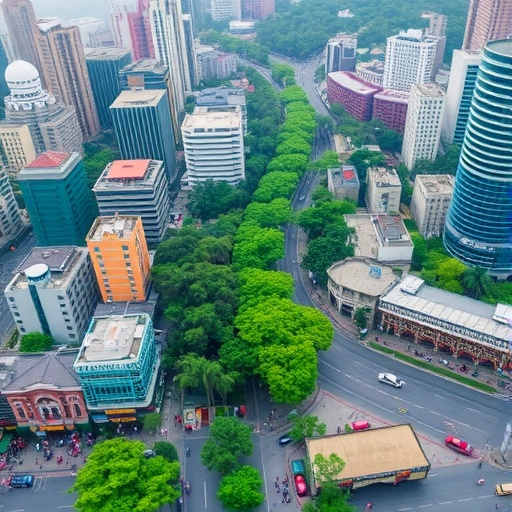
In recent years, urban ecological environment quality has become a focal point for researchers and policymakers alike, particularly in rapidly developing cities across the globe. A pioneering study conducted in Chengdu, China provides crucial insights into this pressing issue by assessing the urban ecological environment through a newly modified remote sensing ecological index. This innovative approach has significant implications for environmental management, particularly as cities face increasing challenges from urbanization.
The study, conducted by renowned researchers including Sun, F., Zhao, S., and He, X., leverages advanced methodologies to verify the ecological health of urban landscapes. With urban areas expanding at an unprecedented pace, understanding how ecological functions are affected is vital for sustainable development. The researchers employed a modified remote sensing ecological index that offers a comprehensive assessment of urban environments. This method incorporates multiple dimensions of ecological health, including biodiversity, land use, and pollution levels, making it far more effective than traditional assessments.
Chengdu, the capital of Sichuan Province, serves as an exemplary case study due to its rapid urbanization coupled with rich biodiversity. The researchers focused on various ecological indicators to gauge the overall health of the environment within the city. By utilizing satellite imagery and advanced remote sensing techniques, they cataloged significant changes in land use patterns over the years, tracking the impact of urban sprawl on natural habitats. Such data is invaluable for urban planners and policymakers aiming to mitigate adverse effects while fostering urban growth.
The modified remote sensing ecological index offers several advantages over conventional indices. Traditional methods often rely on limited data points or ground-based measurements, which can be both labor-intensive and prone to human error. By contrast, remote sensing techniques allow for continuous monitoring and data collection on a larger scale. This means that urban planners can access real-time information, ensuring more informed decision-making processes regarding urban development and environmental conservation.
Findings from this study indicate a clear correlation between urban expansion and diminished ecological quality. As Chengdu continues to grow, the research highlights significant areas of biodiversity loss and increased pollution levels accompanying this development. The implications are twofold: not only does urban growth threaten existing ecosystems, but it also endangers the crucial services they provide, such as air and water purification, carbon sequestration, and recreational spaces for urban dwellers. This will likely set off a chain reaction, as diminished ecological quality can exacerbate urban heat islands, further affecting the livability of cities.
Moving forward, the researchers advocate for integrating ecological assessments into city planning and policy-making. By doing so, the study posits that cities can transition towards more sustainable growth models that prioritize ecological integrity. Such an approach will not only benefit current residents but also future generations who will inhabit these urban spaces. Environmental management is not merely a reactive process; proactive measures can promote resilience against climate change and urban stressors.
Importantly, the research does not just spotlight challenges but also provides a roadmap for potential solutions. Incorporating green infrastructure—such as parks, green roofs, and urban forests—can significantly enhance ecological quality. Such interventions not only contribute to biodiversity preservation but also improve the urban microclimate, making cities more resilient to ecological disturbances. With urbanization set to continue at a swift pace, the urgency for implementing these strategies cannot be overstated.
Engaging local communities in environmental management is another key recommendation from the study. Localized efforts can yield significant dividends in ecological restoration and awareness. When communities are actively involved in the stewardship of their environment, they become more invested in preserving their local ecosystems. This grassroots approach to environmental management can foster a culture of sustainability among urban residents, ultimately leading to more robust ecological health.
In summary, the study by Sun, F., Zhao, S., and He, X. provides essential insights into the implications of urban ecological environment quality in Chengdu. The modified remote sensing ecological index demonstrates a novel approach that blends technology with environmental science, offering a pragmatic solution to some of the challenges posed by urbanization. As cities across the globe grapple with similar issues, the methodology and findings presented in this research can serve as a guiding framework for sustainable urban development and environmental management.
In an era where the stakes for ecological health have never been higher, falling behind in ecological assessments is to risk the very livability of our cities. The research serves as a clarion call for integrating advanced ecological evaluation methods into traditional urban planning paradigms. In doing so, it proposes a model of growth that does not just prioritize economic gains, but actively works to protect the ecosystems on which urban populations depend.
The urgency and relevance of this study resonate not just in Chengdu but across rapidly urbanizing regions worldwide. As cities expand to accommodate growing populations, the trade-offs between development and ecological preservation will only intensify. By elevating the conversation around urban ecological quality, this research paves the way for a new paradigm in urban management—one that harmonizes human needs with the imperatives of ecological sustainability.
In conclusion, the assessment of urban ecological environment quality represents a crucial discourse in environmental management as we navigate the complexities of urbanization. The innovative methodologies developed in this research provide a robust toolkit for assessing and enhancing the ecological quality of urban environments. It embodies a vital step forward, ensuring that cities can evolve sustainably while safeguarding the ecological health that underpins human prosperity.
As global urbanization trends continue, lessons gleaned from Chengdu’s experience will be critical in shaping future decisions. The research highlights the meaning and significance of aligning urban development with ecological principles, reminding us that the health of our cities is intrinsically linked to the health of our planet.
Sun, F., Zhao, S., He, X. et al. Implications for environmental management: assessing urban ecological environment quality in Chengdu with a modified remote sensing ecological index. Environ Monit Assess 197, 1119 (2025). https://doi.org/10.1007/s10661-025-14579-1
Cite Scienmag News
Gavin Prescott. (September 16, 2025). Urban Ecology in Chengdu: Insights from Remote Sensing. Scienmag. https://scienmag.com/urban-ecology-in-chengdu-insights-from-remote-sensing/
Gavin Prescott. "Urban Ecology in Chengdu: Insights from Remote Sensing." Scienmag, 16 September 2025, https://scienmag.com/urban-ecology-in-chengdu-insights-from-remote-sensing/. Accessed 4 September 2026.
Gavin Prescott. "Urban Ecology in Chengdu: Insights from Remote Sensing." Scienmag. September 16, 2025. https://scienmag.com/urban-ecology-in-chengdu-insights-from-remote-sensing/


