


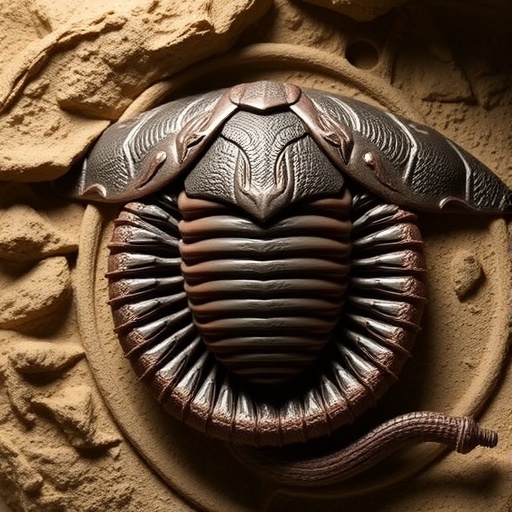
For over 270 million years, trilobites reigned as one of the most prolific and diverse groups of organisms in Earth’s oceans, boasting more than 22,000 cataloged species that roamed every continent during the Paleozoic Era. Despite their omnipresence in the fossil record and seemingly unmatched evolutionary success, a crucial and enduring mystery has persisted: how did these ancient marine arthropods breathe? This fundamental question about their respiratory biology has eluded definitive answers—until now.
A groundbreaking study led by Dr. Sarah R. Losso, a postdoctoral researcher in the Department of Organismic and Evolutionary Biology at Harvard University, offers compelling evidence that conclusively identifies the feather-like exopodite structures on trilobite limbs as highly efficient gills. Employing state-of-the-art 3D modeling technology, the research conducted detailed morphometric analyses combining fossil specimens with comparisons to extant marine arthropods. The findings, recently published in Biology Letters, decisively resolve a scientific debate that has long divided paleobiologists regarding the respiratory capabilities of trilobites.
Respiration, a biological imperative for energy production in all animals, hinges on the presence of organs capable of sufficient gas exchange. Trilobites possessed biramous limbs—appendages composed of two branches. The inner branch, or endopodite, functioned primarily in locomotion and managing food intake, while the outer branch, known as the exopodite, bore an array of thin, lamellar filaments. These lamellae were hypothesized to serve various roles, including swimming aid, ventilatory mechanism, or respiratory surface organ. The crux of the debate centered on whether these lamellae presented a substantial enough surface area to support effective oxygen diffusion required for sustaining the metabolic demands of trilobites.
Earlier paleontological investigations yielded conflicting results. For instance, mid-Cambrian Olenoides serratus specimens exhibited exopodites with relatively modest surface areas, seemingly insufficient for respiratory function by modern physiological standards. Contrariwise, Late Ordovician Triarthrus eatoni displayed lamellar exopodites with surface areas comparable to those of modern aquatic arthropod gills, re-opening the question of trilobite respiration. These contradictory data underscored the necessity for precise, quantitative analysis to elucidate the true function of these enigmatic structures.
To address this, Losso and colleagues employed modern anatomical reconstruction software, including Shapr3D for modeling and Ansys for computational surface area calculations, to create highly detailed three-dimensional representations of exopodites from exceptionally preserved fossil specimens of Olenoides serratus and Triarthrus eatoni. The team computed the lamellar surface areas with unprecedented accuracy, subsequently examining how these measurements scaled with overall body size and biomass. For example, the 67.8 mm-long Olenoides serratus exhibited a total lamellar surface area of 16,589 mm², while the smaller Triarthrus eatoni, measuring 36.3 mm, possessed 2,159 mm². These quantifications provided critical insights into the physiological capacities of trilobites by enabling direct comparison with extant marine arthropods.
Expanding their study, the team analyzed nine additional trilobite species spanning a temporal range from the Cambrian to the Silurian Periods. This broader dataset unveiled a consistent pattern: trilobite lamellar surface area displayed exponential growth relative to body length, mirroring ontogenetic growth dynamics seen in living aquatic arthropods. Notably, the enhanced respiratory capacity in larger trilobites was not achieved through increasing the number of lamellae or limbs. Instead, these ancient creatures extended the length of existing filaments significantly to augment oxygen uptake efficiency.
This distinct biological strategy is exemplified by the giant Redlichia rex, a species with lamellae reaching lengths of up to 11.02 mm—substantially longer than those found in smaller trilobite relatives. This adaptation underscores the evolutionary ingenuity of trilobites in meeting rising metabolic demands imposed by increasing body size. It highlights a sophisticated trade-off in respiratory morphology optimized for maximizing oxygen exchange without the metabolic cost of developing additional limbs or lamellae.
A pivotal aspect of the study involved benchmarking trilobite respiratory surfaces against those of contemporary aquatic euarthropods, including the Atlantic horseshoe crab (Limulus polyphemus). The surface area-to-biomass ratios calculated for trilobite species ranged from approximately 174.62 to 759.48 mm² per gram, overlapping significantly with values observed in modern thalassinid shrimp, whose ratios span from 256 to 1,043 mm²/g. This remarkable correspondence strongly supports the hypothesis that trilobites possessed respiratory structures functionally analogous to those of extant crustaceans, capable of extracting dissolved oxygen effectively from ancient seawater.
These findings not only illuminate trilobite physiology but also offer insights into their ecological diversity and evolutionary adaptability. For instance, Triarthrus eatoni inhabited low-oxygen environments, yet its extensive lamellar surface area indicates physiological optimization for survival under hypoxic conditions. Conversely, the comparatively reduced surface area-to-body size ratio observed in Redlichia rex suggests alternative or supplementary respiratory strategies, possibly involving oxygen uptake through the ventral body surface or specialized exoskeletal modifications.
Dr. Losso emphasizes that the comprehensive analysis of gill morphology and functional metrics offers a window into the dynamic respiratory evolution of arthropods over an astounding half-billion-year timeframe. This integrative approach deciphers the fundamental biological constraints and innovations shaping extinct marine giants, deepening our understanding of Paleozoic marine ecosystems and their evolutionary underpinnings.
Moreover, the study’s synergy of fossil evidence with cutting-edge computational modeling exemplifies how modern technology can unravel longstanding scientific enigmas. It exemplifies the principle that vestiges of ancient life still inform the principles governing modern biological form and function. Professor Javier Ortega-Hernández, co-author of the study, succinctly summarized this perspective, noting that despite superficial anatomical differences, extinct and extant arthropod gills adhere to predictable patterns instrumental in evolutionary biology.
In conclusion, confirming the respiratory function of trilobite exopodites fundamentally reframes our interpretation of these iconic Paleozoic arthropods. It allows paleobiologists to better infer their energy metabolism, behavior, and ecological roles, thereby enriching our comprehension of how these ancient organisms dominated marine environments for hundreds of millions of years. This research rejuvenates a pivotal chapter in evolutionary history and paves the way for future inquiries into the physiology of other extinct taxa.
News Publication Date: April 21, 2026.
Web References:
DOI:10.1098/rsbl.2026.0071
Cite Scienmag News
Gavin Prescott. (April 22, 2026). Unveiling the Respiratory Secrets of Trilobites: How Scientists Brought an Ancient Mystery Back to Life. Scienmag. https://scienmag.com/unveiling-the-respiratory-secrets-of-trilobites-how-scientists-brought-an-ancient-mystery-back-to-life/
Gavin Prescott. "Unveiling the Respiratory Secrets of Trilobites: How Scientists Brought an Ancient Mystery Back to Life." Scienmag, 22 April 2026, https://scienmag.com/unveiling-the-respiratory-secrets-of-trilobites-how-scientists-brought-an-ancient-mystery-back-to-life/. Accessed 5 September 2026.
Gavin Prescott. "Unveiling the Respiratory Secrets of Trilobites: How Scientists Brought an Ancient Mystery Back to Life." Scienmag. April 22, 2026. https://scienmag.com/unveiling-the-respiratory-secrets-of-trilobites-how-scientists-brought-an-ancient-mystery-back-to-life/


