


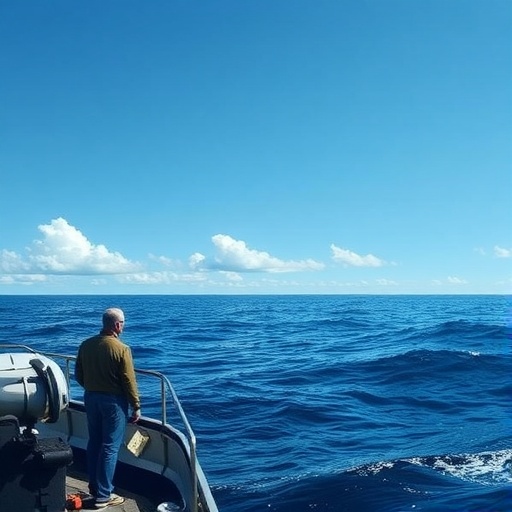
In a significant interdisciplinary advance, researchers at the University of Michigan have successfully integrated a U.S. Navy ocean forecasting model to predict the occurrence of internal tides within the ocean. This breakthrough allows for the refinement of satellite imagery critical for weather prediction and maritime navigation. The findings offer a transformative lens through which oceanic patterns, previously masked by complex energetic motions beneath the water’s surface, can now be observed with unprecedented clarity.
The ocean is a dynamic environment rife with intricate flows, among which small-scale oceanic eddies play a pivotal role. These swirling masses of water, shedding off from larger current systems such as the Gulf Stream, are central to the ocean’s ability to transport heat and carbon—elements critical to global climate regulation. Tracking these eddies with precision has long posed a scientific challenge due to the superimposition of internal tides, which introduce noise into surface-level observations. Understanding these eddies at fine spatial resolutions is essential not only for advancing oceanographic science but also for enhancing operational forecasting needed by the U.S. Navy and other maritime stakeholders.
In 2022, the Surface Water and Ocean Topography (SWOT) satellite was launched through a collaboration between NASA and the French space agency CNES with the principal aim of resolving ocean surface features at granular scales ranging from 5 to 10 kilometers. This marked a considerable improvement over previous satellites, which could only discern features at scales of approximately 100 kilometers. SWOT’s ability to detect such minute details enables monitoring of small-scale eddies, but its high sensitivity also captures vertical displacements in the ocean—internal tides—that obscure these valuable signals.
Internal tides are generated when the gravitational forces of the moon and sun cause large-scale tidal flows to interact with underwater topographical features such as mountains and ridges on the seafloor. These features cause stratified water layers—differentiated by variations in temperature and salinity—to oscillate vertically, creating complex wave motions within the ocean column. Despite originating deep underwater, these internal tides leave discernible imprints on the ocean surface, interfering with satellite measurements designed to identify surface water movements associated with eddies.
The research team formulated an innovative approach by adapting the Navy’s Hybrid Coordinate Ocean Model (HYCOM), a sophisticated ocean forecasting tool, to predict the sea surface height signatures resulting from internal tides. By doing so, they were able to generate a comprehensive global estimate of internal tide activity and discern their temporal evolution. These model predictions were then rigorously compared against sea surface height data collected by the SWOT satellite, enabling the scientists to quantify precisely how much of the satellite’s signal could be attributed to internal tides.
The major breakthrough lies in the model’s ability to accurately account for approximately 60% more of the internal tide signal identified from satellite observations compared to existing modeling approaches. This substantial improvement translates into a much cleaner dataset from SWOT, wherein the veil of internal tide-induced noise is minimized, allowing the underlying smaller-scale eddy features to emerge more clearly. This enhanced signal clarity is pivotal for both scientific research and operational applications.
Lead author Yadidya Badarvada, formerly a University of Michigan postdoctoral fellow and now an oceanographer at Florida State University, emphasizes that the refined modeling not only improves current satellite observations but also creates a positive feedback loop between agencies. The Navy’s forecast model enhances NASA’s satellite data, which in turn improves future Navy oceanographic predictions, fostering a synergistic relationship that bolsters the capabilities of both organizations.
Brian Arbic, a U-M oceanographer and co-author, highlights the broader significance of these results beyond immediate observational improvements. Ocean surface dynamics directly influence atmospheric conditions and thus weather patterns, but the significance extends beneath the surface as well. Internal waves eventually dissipate and break at depth, inducing turbulent mixing processes that redistribute heat and nutrients and influence biological productivity and ocean circulation on a global scale. Improved understanding of these processes is therefore crucial for climate modeling and predicting ecological changes in marine environments.
The study embodies years of cumulative scientific effort from both the Naval Research Laboratory and NASA, reflecting decades-long investments in understanding ocean physics and refining predictive models. The iterative enhancements cultivated by these institutions laid the groundwork for the integration of HYCOM with SWOT data and demonstrate the vital importance of sustained funding and collaboration in advancing oceanographic science.
Internal tides have historically been a confounding factor in interpreting satellite data due to their complex generation mechanisms and elusive signatures. The seawater stratification driven by temperature and salinity gradients dictates the energy transmission and vertical motion of internal tides, rendering them subtle yet pervasive agents in the ocean’s dynamic environment. The ability to accurately simulate and subtract their contribution from observed sea surface height data is a milestone achievement.
The researchers’ strategy relied on HYCOM’s advanced computational framework, which employs hybrid vertical coordinates blending fixed depth levels and terrain-following layers to accurately resolve oceanic phenomena across multiple scales and depths. This approach allows for detailed prediction of how internal tides propagate and modulate sea surface height globally. By integrating these simulations with SWOT measurements, the team exposed a clearer, more detailed picture of the ocean’s small-scale circulations in near-real time.
Importantly, this methodological innovation not only mitigates a longstanding observational challenge but also has tangible implications for operational activities that depend on precise ocean state information. Navigation, naval fleet operations, and climate monitoring all stand to benefit from improved characterizations of the ocean surface and subsurface dynamics. As internal tides have significant interactions with ocean mixing, which impacts heat and carbon cycling, this advancement facilitates more accurate climate models and environmental assessments.
The collaborative cycle initiated by coupling HYCOM forecasts with SWOT satellite data underscores a paradigm shift toward integrated ocean observation and modeling systems. This synergistic feedback loop promises continuous refinement of both observational datasets and predictive models. The joint utilization of Navy models for improving spaceborne observations exemplifies a holistic approach to Earth system science that pools expertise and resources across agencies.
In sum, the University of Michigan-led research advances a novel methodological framework that leverages the predictive power of Navy ocean models to decode and remove the confounding influence of internal tides from satellite data. This breakthrough enables more accurate visualization of small ocean eddies critical to climatic and ecological processes, marking a major step forward in our capacity to monitor, understand, and predict complex oceanic phenomena at fine spatial scales.
News Publication Date: Not explicitly stated; implicit to 2023 based on context.
Web References:
- Brian Arbic, University of Michigan: https://lsa.umich.edu/earth/people/faculty/arbic.html
- Yadidya Badarvada personal webpage: https://yadidya-b.github.io
References: Published study in Science Advances (specific citation details not provided).
Cite Scienmag News
Violet Maxwell. (June 3, 2026). U-M Researchers Sharpen Focus on Ocean Observations. Scienmag. https://scienmag.com/u-m-researchers-sharpen-focus-on-ocean-observations/
Violet Maxwell. "U-M Researchers Sharpen Focus on Ocean Observations." Scienmag, 3 June 2026, https://scienmag.com/u-m-researchers-sharpen-focus-on-ocean-observations/. Accessed 4 September 2026.
Violet Maxwell. "U-M Researchers Sharpen Focus on Ocean Observations." Scienmag. June 3, 2026. https://scienmag.com/u-m-researchers-sharpen-focus-on-ocean-observations/


