


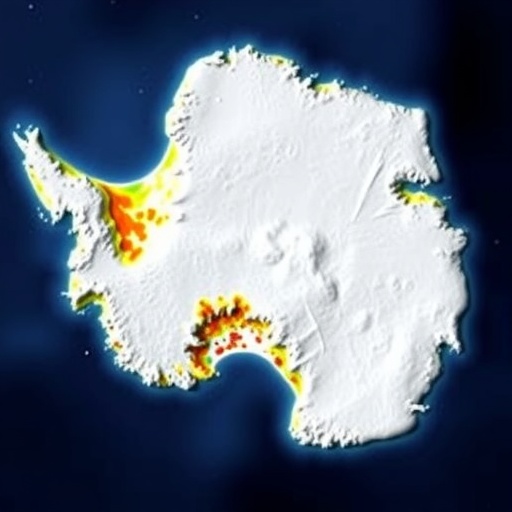
A groundbreaking tectonic model has emerged from the depths of East Antarctica’s frozen landscape, revealing a colossal rotational extension process that shaped a striking handheld-fan-shaped structural feature beneath the ice. This vast subglacial basin province, meticulously reconstructed by geoscientists, offers compelling evidence of continental-scale deformation that redefined East Antarctica’s crustal architecture. The implications of this discovery reverberate beyond geological curiosity, stirring fresh insights into the ancient tectonic forces that sculpted one of the planet’s most enigmatic continents and linking these subterranean transformations to the dynamics of Gondwana’s fragmentation.
At the heart of this tectonic revelation lies a single, continent-wide mechanism dominated by rotational extension—an earth-shaping process that not only dramatically reworked pre-existing structures but also set in motion subsequent geological phenomena of monumental scale. This model suggests that the rotational extension instigated a complex reconfiguration of East Antarctic lithosphere, fundamentally influencing the geological evolution of critical mountain ranges, including the Gamburtsev and Transantarctic Mountains. The resulting deformation and segmentation within these ranges underpin the formation of conjugate continental margins, which form a semi-circular pattern between Antarctica and Australia, illuminating previously obscure steps in the precursory tectonic stages leading up to the ultimate breakup of Gondwana.
One of the most intriguing aspects of this tectonic scenario concerns the spatial coincidence between the fan-shaped province’s pivot point and the Euler poles inferred for the extension between East and West Antarctica after approximately 34 million years ago. Although there remains uncertainty surrounding the precise location of these rotational poles, the close alignment raises provocative questions about the stability of deformation centers over geological time scales. This alignment further suggests a potential causal link bridging intraplate deformation mechanisms with the broader plate tectonic motions that characterized the region during late Cenozoic rifting and continental evolution.
Remarkably, this fan-like rotational deformation appears confined exclusively to the Antarctic lithosphere. Detailed analyses fail to identify any continuation of these features into the adjacent Australian continent, signaling a previously unrecognized intraplate deformation zone within East Antarctica. This discovery holds profound implications for reconciling longstanding inconsistencies in tectonic reconstructions, particularly in refining the fit between the Australian and Antarctic continental margins. Identifying this localized deformation zone may illuminate why some plate reconstructions have documented unusually broad crustal overlaps and difficult-to-explain mismatches across conjugate basement terranes and major fault systems.
Beyond its tectonic significance, this rotational extension model profoundly informs our understanding of the East Antarctic Ice Sheet’s origins and dynamic behaviour. Initiated approximately 34 million years ago, the ice sheet’s evolution intersects the geological fabric sculpted by the extensional forces operating beneath it. The subglacial basins forming the handheld-fan-like structure influence not only the basal topography but also the dynamic feedback mechanisms governing ice sheet retreat and advance. Due to ongoing subsidence and cooling of the crust following extension, many of these basin floors lie near or below modern mean sea level, engendering conditions that likely amplify the ice sheet’s sensitivity and vulnerability to climatic perturbations.
Topographically, the segmentation of major mountain ranges in East Antarctica via a network of east-west oriented circular shear belts has played a pivotal role in directing glacial pathways. Shear zones along these belts create structural weaknesses exploited by massive outlet glaciers such as Byrd, Beardmore, Nimrod, David, Priestley, and Tucker. These glaciers have incised profound troughs into the mountains, driving further isostatic uplift of the peaks and perpetuating a cycle of tectonic and glacial interaction. This dynamic interplay exemplifies how ancient tectonic architecture continues to govern present-day cryospheric and geomorphological processes in Antarctica’s interior.
Similarly, the prominent fan-shaped boundary system oriented roughly north-south within the East Antarctic subglacial basin province appears intimately linked to the positions of some of the continent’s most significant outlet glaciers on its coastal margins. Totten, Vanderford, Denman, Frost, and Amery glaciers align closely with major basin boundaries, suggesting that structural geology fundamentally controls glacial drainage patterns. This tectonic-ice sheet interface underscores the critical role geological processes dating back more than 150 million years play in determining the contemporary ice sheet’s behaviour and its response to environmental change.
From a broader geodynamic perspective, the existence of this rotational extension province challenges conventional interpretations of East Antarctica’s lithospheric rigidity. Instead of behaving as a monolithic block, the continent’s eastern sector underwent profound internal distortion and segmentation, contesting previous models that invoked more homogeneous deformation. This nuanced understanding demands re-evaluation of geodynamic models that couple onshore structural features with offshore fracture zone studies, highlighting the complementary roles of both deep and shallow earth processes in continent-scale reorganization.
Moreover, the timeframe of deformation pinned to the EAFBP coincides intriguingly with marked geological shifts at the Paleogene-Neogene boundary. This temporal intersection accentuates the role of tectonics in modulating the environmental context for large-scale ice sheet nucleation and persistence. The established relationship provides a unique opportunity to integrate tectonic forcing into climate and cryosphere models, potentially refining predictions of ice sheet behaviour within a warming world.
Delineating the rotational extension process also sheds light on the segmentation observed within the Transantarctic Mountains and the West Antarctic Rift System. These structural discontinuities reveal how the continent’s lithosphere accommodated strain over millions of years, via curved shear belts and fault zones demarcating discrete tectonic blocks. Such segmentation arguably fostered localized uplift and subsidence patterns, influencing sediment deposition regimes and geomorphological evolution throughout the continent’s interior.
Perhaps most strikingly, this in-depth investigation emphasizes the enduring influence of early Mesozoic tectonics on shaping Antarctica’s geological framework, long after the initial stages of Gondwana’s breakup. By identifying a singular large-scale rotational extension event as a formative agent, this model unites seemingly disparate observations—from subglacial basin geometry to mountain range uplift—into a cohesive tectonic narrative. This unified perspective provides a valuable blueprint for reinterpreting the continent’s evolutionary trajectory and contextualizing its role within global plate tectonics.
The pioneering interdisciplinary approach harnessed to unravel this subglacial province integrates geophysical imaging, structural geology, and tectonic reconstruction techniques. Detailed gravity anomaly mapping and seismic reflection profiles provide unprecedented subsurface illumination, enabling researchers to differentiate subtle deformation patterns beneath kilometers of ice. The resulting dataset affords unparalleled clarity into the three-dimensional architecture of East Antarctica’s crust, setting a benchmark for future Antarctic geoscience research.
In conclusion, this discovery of a fan-shaped rotational extension province unveils an overlooked GPS of tectonic activity underpinning the East Antarctic lithosphere. It highlights the dynamic and evolving nature of continental interiors, traditionally considered tectonically inert. As our understanding deepens, so too does the appreciation for how ancient geological forces continue to wield influence over ice dynamics, mountain formation, and continental fragmentation—processes that shape Earth both past and present.
The identification of this rotational extension province opens new avenues for refining plate reconstructions involving Antarctica and Australia. It simultaneously challenges simplifications inherent in previous models, advocating for nuanced treatments of intraplate deformation zones. This progression promises enhanced geological models capable of incorporating the intricate interplay of forces molding Earth’s least accessible continental frontier.
Ultimately, these insights carry profound ramifications for predicting Antarctica’s future amid climate change. Given the pivotal role tectonic features play in modulating ice sheet sensitivity and stability, understanding their genesis and evolution becomes crucial for anticipating responses to accelerating global warming. This research thus exemplifies the vital synergy between geological sciences and cryospheric studies essential for informed stewardship of polar environments.
Cite Scienmag News
Violet Maxwell. (June 3, 2026). Fan-Shaped East Antarctic Basin Formed by Rotation. Scienmag. https://scienmag.com/fan-shaped-east-antarctic-basin-formed-by-rotation/
Violet Maxwell. "Fan-Shaped East Antarctic Basin Formed by Rotation." Scienmag, 3 June 2026, https://scienmag.com/fan-shaped-east-antarctic-basin-formed-by-rotation/. Accessed 4 September 2026.
Violet Maxwell. "Fan-Shaped East Antarctic Basin Formed by Rotation." Scienmag. June 3, 2026. https://scienmag.com/fan-shaped-east-antarctic-basin-formed-by-rotation/


