


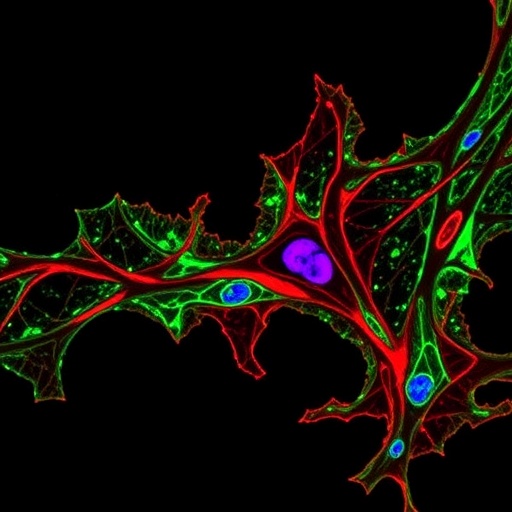
In an era where metastatic cancer remains one of the deadliest challenges in medicine, a revolutionary study has emerged, providing groundbreaking insights into the molecular choreography that facilitates cancer spread to distant organs. A team of researchers led by Huang, Z., Yan, Y., and Wang, X. has uncovered a critical mechanism by which bladder cancer cells manipulate the lung microenvironment to foster metastasis. Their findings, published recently in Experimental & Molecular Medicine, elucidate how tumor-derived WNT7A signaling reprograms pulmonary fibroblasts, remodeling the metastatic niche and promoting bladder cancer lung colonization.
The complexity of cancer metastasis involves a dynamic interplay between disseminated tumor cells and the host organ microenvironment. This study sheds light on the pivotal role of WNT7A, a secreted glycoprotein involved in developmental signaling pathways, acting as a key modulator in cross-talk between metastatic bladder cancer cells and lung fibroblasts. Prior research had suggested roles for WNT family proteins in tumor progression, but this is the first comprehensive delineation of WNT7A’s functional impact on lung stromal cells during metastatic niche formation.
At the heart of this investigation is the concept of the pre-metastatic niche, a specialized microenvironment that is conditioned by the primary tumor to enable successful colonization of secondary organs. The researchers demonstrate that bladder cancer cells secrete elevated levels of WNT7A, which then act on resident pulmonary fibroblasts. These fibroblasts undergo phenotypic and functional reprogramming, acquiring an activated state characterized by enhanced extracellular matrix remodeling and secretion of pro-tumorigenic factors. This reprogramming effectively transforms the lung interstitium into a fertile soil for metastatic seeding.
The team employed a multifaceted experimental strategy combining in vivo murine models of bladder cancer metastasis, ex vivo lung tissue cultures, and cutting-edge single-cell transcriptomics. Using lineage tracing and gene expression profiling, they revealed that WNT7A stimulation triggers a cascade of intracellular events in fibroblasts, including activation of the canonical Wnt/β-catenin pathway. This activation enhances fibroblast proliferation and secretion of matrix metalloproteinases, enzymes crucial for extracellular matrix degradation and remodeling, thereby facilitating tumor cell invasion.
Remarkably, the study elucidates the positive feedback loop wherein reprogrammed fibroblasts upregulate chemoattractants that further recruit circulating bladder cancer cells, amplifying metastatic colonization. This intricate interaction exemplifies how tumor-induced stromal alterations can govern metastatic efficiency. Inhibition of WNT7A signaling in preclinical models markedly impaired pulmonary fibroblast activation, stunted niche formation, and significantly curtailed lung metastasis burden, underscoring the therapeutic potential of targeting this axis.
The implications of these findings extend beyond bladder cancer, as WNT signaling pathways are highly conserved and implicated in diverse malignancies. By characterizing the molecular underpinnings of stromal reprogramming via tumor-secreted WNT7A, this study pioneers a paradigm shift in understanding organ-specific metastasis. It opens new avenues for developing metastasis-preventive therapies aimed at disrupting tumor-stroma communication, which is a critical but often overlooked dimension of cancer progression.
Furthermore, the study’s emphasis on pulmonary fibroblasts addresses a long-standing gap in metastatic biology. Fibroblasts are increasingly recognized as key architects of the tumor microenvironment, yet their role in metastatic niches has been underexplored, particularly in lung metastasis. This research illuminates their plasticity and responsiveness to extrinsic tumor signals, advancing the field’s appreciation of stromal heterogeneity and functional specialization within metastatic organs.
Technically, the use of advanced mouse models simulating spontaneous bladder cancer dissemination adds robustness and physiological relevance to the conclusions drawn. Coupled with high-resolution imaging and proteomic analyses, the research meticulously maps the spatial and temporal dynamics of fibroblast activation in the metastatic lung. Single-cell RNA sequencing further dissects fibroblast subpopulations, unmasking distinct gene signatures associated with pro-metastatic phenotypes induced by WNT7A.
The clinical translation potential is profound. WNT7A or its downstream effectors could serve as biomarkers predicting metastatic risk in bladder cancer patients, enabling stratified patient management. Moreover, therapeutic agents designed to inhibit WNT7A signaling might synergize with existing treatments, enhancing efficacy and reducing metastatic relapse, which remains a major cause of mortality. This study thus lays the groundwork for novel intervention strategies targeting the tumor microenvironment to thwart metastasis.
Beyond its direct scientific contributions, this work exemplifies the power of integrative cancer research that bridges molecular biology, immunology, and bioinformatics. It highlights the necessity of deciphering tumor-host interactions at a granular level to unlock innovative therapies. As metastasis accounts for the majority of cancer deaths, dissecting such complex mechanisms offers hope for more effective eventual cures.
In closing, the discovery that tumor-sourced WNT7A reprograms lung fibroblasts to sculpt a pro-metastatic niche marks a major advance in cancer biology. It not only unravels a key molecular axis driving bladder cancer lung metastasis but also establishes a new framework for understanding and interfering with metastatic niche formation. Moving forward, translating these insights into the clinic holds significant promise for improving patient outcomes and mitigating the scourge of metastatic cancer.
This study is a testament to the evolving landscape of metastasis research, where the microenvironment is now acknowledged as a sculptor of tumor fate rather than a passive bystander. Future investigations inspired by these findings will likely explore additional stromal components and signaling pathways, propelling the field toward comprehensive metastasis interception and personalized cancer therapy.
Cite Scienmag News
Nathaniel Bowman. (June 3, 2026). Tumor WNT7A Drives Lung Fibroblast Changes, Boosts Metastasis. Scienmag. https://scienmag.com/tumor-wnt7a-drives-lung-fibroblast-changes-boosts-metastasis/
Nathaniel Bowman. "Tumor WNT7A Drives Lung Fibroblast Changes, Boosts Metastasis." Scienmag, 3 June 2026, https://scienmag.com/tumor-wnt7a-drives-lung-fibroblast-changes-boosts-metastasis/. Accessed 5 September 2026.
Nathaniel Bowman. "Tumor WNT7A Drives Lung Fibroblast Changes, Boosts Metastasis." Scienmag. June 3, 2026. https://scienmag.com/tumor-wnt7a-drives-lung-fibroblast-changes-boosts-metastasis/


